 +
+
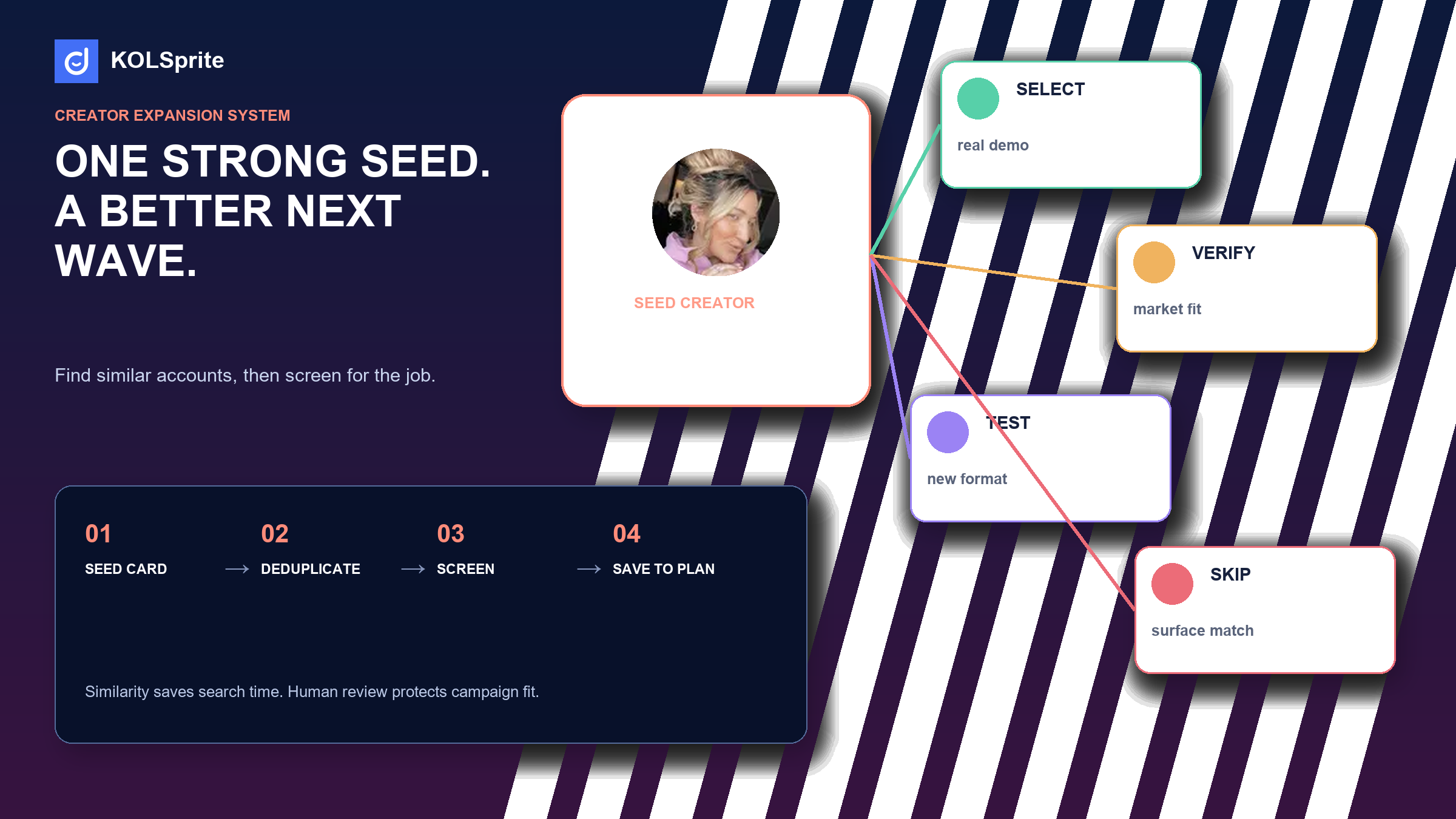
If you already have one useful creator, the fastest answer to how to find similar TikTok accounts is to use that profile as a seed, generate a candidate pool, and screen each result against the campaign job. KOLSprite adds a Similar Creators action on TikTok profile pages and can save selected results into a promotion plan. This guide gives you the seed criteria, the review sequence, and a four-state shortlist: select, verify, skip, or test.
Ten-second answer: write down why the seed creator is useful before launching a similar-account search. If you cannot name the buyer job, content format, and proof that worked, the tool will only help you scale a vague preference. Similarity saves search time; evidence earns a place on the shortlist.
Two creators can look alike and still perform different jobs. They may use the same visual style but speak to different buyers. They may cover the same category but demonstrate products with different depth. They may have similar follower counts while one has current activity and the other has stopped posting.
The right seed is not simply your largest creator. It is an account that shows a pattern you want to reproduce: a credible room or routine, a clear product demonstration, useful audience questions, reliable posting, or a format that fits the offer.
Do not use ROI as the only seed note. A past result may depend on price, timing, commission, product availability, or paid support. Record the visible reason the creator fits before asking for lookalikes.
| Seed field | What to record | Why it matters |
|---|---|---|
| Buyer job | The problem the audience is trying to solve | Prevents category-only matching |
| Content format | Review, tutorial, comparison, routine, live demo, or UGC | Protects the proof style |
| Visible proof | The action or result shown on screen | Separates demonstration from enthusiasm |
| Product fit | Price, category, setting, and claim boundary | Keeps the next creator tied to the offer |
| Audience evidence | Relevant questions, objections, or repeated use cases | Adds context beyond follower count |
| Recency | Recent posting and category activity | Avoids inactive lookalikes |
For a drawer organizer, a useful seed might be a home creator who shows a real drawer, measures the space, installs the product, and answers fit questions. "Home creator with 80,000 followers" is too weak.
TikTok's official TikTok One creator-search guide recommends reviewing region, audience, recent content, performance, and similar creators. Those are useful screening dimensions, but they still need to be tied to the specific proof task in your campaign.
The current KOLSprite Extension User Guide describes the profile-page workflow:
The guide states that free users can view 10 results per search and premium members can view 30. Treat that as a current product detail, not a permanent guarantee; membership limits can change.
KOLSprite adds Similar Creators on TikTok profile pages, groups results in a promotion plan, removes duplicates, and lets you move candidates from Pending Screening to Selected.
Register and claim a three-day trial
Check market, language, current activity, category, and basic audience size. This pass should be fast. Do not spend time scoring a creator who cannot serve the campaign.
Open recent relevant videos. Can the creator show the product in a believable setting? Do they explain a problem, demonstrate an action, or simply hold the item? Look for proof that matches the seed card.
Every candidate should leave review with one state and one reason. A long list with no next action is not a shortlist.
Campaign fit is clear enough for outreach. Record the product, angle, offer, and next contact date.
One important fact is missing, such as market, recent category activity, contact, or product fit.
The creator resembles the seed superficially but does not match the buyer job or proof task.
The creator has an interesting adjacent format. Use a small seed test instead of treating the match as proven.
Add one sentence of evidence to every state. "Select: recent small-kitchen demonstrations answer fit questions in comments" is useful. "Good creator" is not.
Suppose the seed creator made a strong drawer-organizer video. The visible proof was a before-and-after view inside a small apartment kitchen. The useful audience response centered on drawer size, utensil fit, and installation.
A suggested creator who posts polished home tours but rarely demonstrates products may look similar. The correct state is skip or test, not select. Another creator with fewer followers may repeatedly measure spaces, install organizers, and answer fit questions. That creator better preserves the job.
Decision rule: preserve the reason the seed worked, not the surface style that made the profiles look alike.
A team often chooses the creator everyone likes. That can be fine for brand taste, but it is not enough for expansion. Use a seed that has a clear link between content, audience response, and campaign job.
Look at three recent relevant videos. If the useful behavior appears once, it may be an accident. If the creator repeats the format and the audience asks related questions, the pattern is stronger.
You can also use more than one seed for separate jobs. One creator may be strong at tutorials. Another may be strong at live objection handling. Do not mix the two into one search note. Build two small pools and compare them later.
These questions work across categories. They also make reviews more consistent when several people share the list.
Duplicate removal saves time, but keep the old decision reason. A creator skipped for the wrong market may become useful later. A creator skipped for unsafe claims may remain a poor fit.
Use short reason codes such as market, inactive, no proof, wrong buyer job, already contacted, or test later. The code helps the next search without turning the plan into a large report.
The number of suggested creators is not the number you need. Work backward from samples, outreach capacity, reply rates, and launch dates. A team that can manage ten real conversations should not select 100 names.
Keep a small reserve. If the plan needs eight creators, select the strongest group and keep a few verified alternatives. Do not lower the standard only to fill a target.
The reason for selection should appear in the first message. Mention the relevant format or product job, not a generic compliment. Then describe the offer and proof task in plain language.
"Your small-kitchen setup videos show how products fit real spaces. We are testing an adjustable drawer organizer and need one clear measure-install-result demo. Would you like to review the product and terms?"
This message shows why the creator is on the list. It also makes the work easier to judge. Avoid claiming that the creator is "similar" to someone else. That is internal research, not a useful pitch.
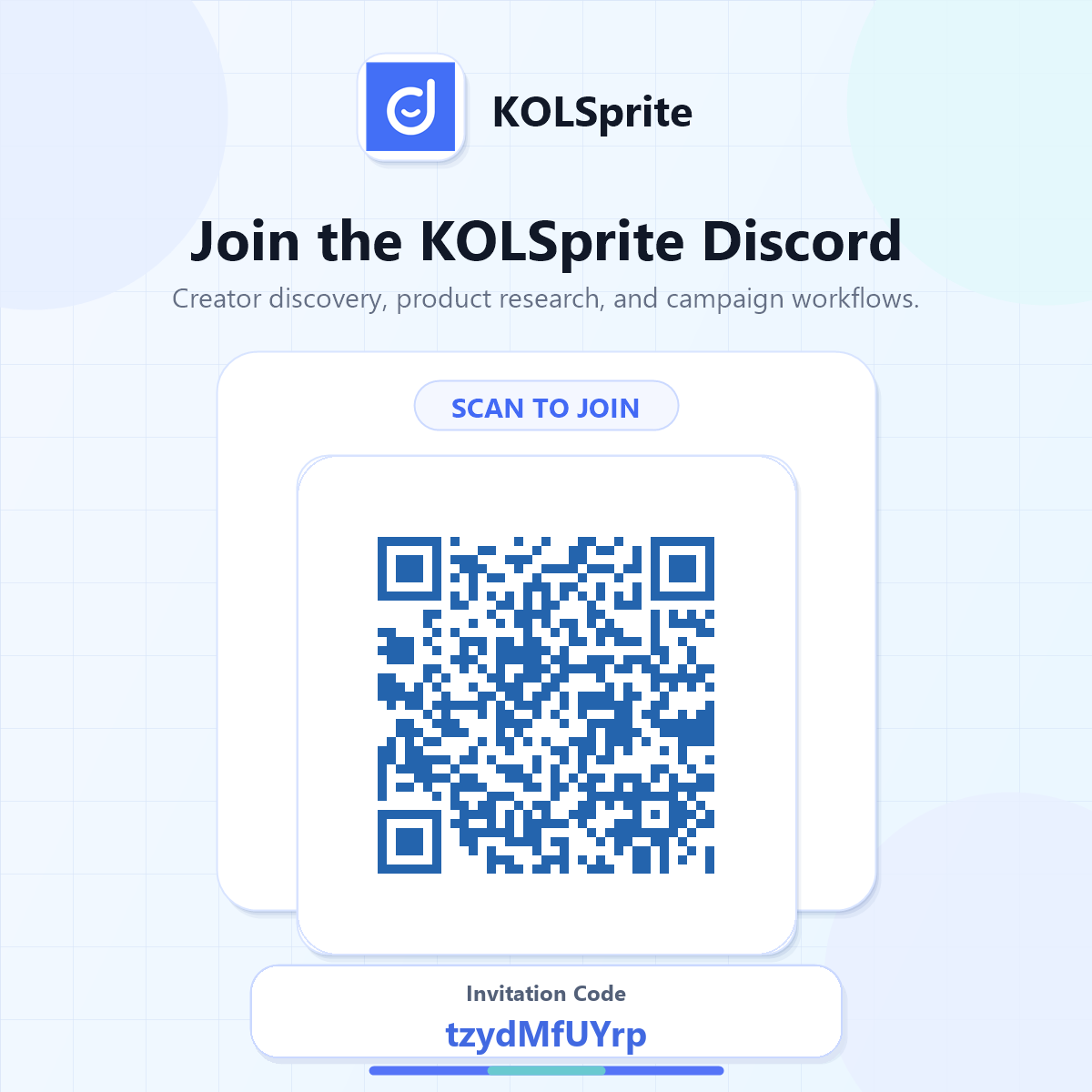
Bring the seed account, the product, and why the creator worked. Other partnership teams can help identify which similarities matter and which are cosmetic.
 +
+
Join the KOLSprite Discord community
After the campaign, update the seed card. Record which creators published, what proof they showed, which questions appeared, and what action followed. A creator who was only a visual match should not remain a strong seed.
The next similar-account search should start from the new evidence. This is how the system improves. It does not depend on the tool remembering every business reason for you.
A healthy pool has more than one creator style. It has enough market and language coverage for the campaign. It also has clear reasons for every selected account.
If every candidate looks the same, add a second seed with a different proof format. If the pool is large but few creators pass review, repair the seed card. If outreach replies are weak, check the offer and message before running more searches.
The tool should reduce repeated discovery work. It should not hide a weak product, brief, or offer behind a bigger list.
Read each selected row aloud. Say why the creator fits. Say what they would show. Say what still needs proof. If the sentence is vague, move the creator back to verify.
A useful sentence is short: "Select for a small-kitchen demo; recent videos show real installs and answer size questions." A weak sentence says, "Great fit and strong engagement." The first can guide outreach. The second cannot.
Ask one more question: would we select this person if the seed creator did not exist? If the answer is no, the match may be cosmetic. Check the buyer job again.
When the list is ready, stop searching. Send the outreach. Learn from the reply. A shortlist has value only when it moves into a real campaign step.
Keep the first wave small. Give the team time to reply well. Note who says yes. Note who asks for more detail. Note who does not fit after a call. These facts are easy to use. They can shape the next seed. They can also fix the offer. A slow, clear loop will teach you more than a fast list of names.
Selection is not the end. Record the creator URL, chosen product, proof task, outreach angle, offer, contact status, sample status, deadline, and next action inside the promotion plan. This prevents the same creator from being rediscovered and reviewed again next week.
KOLSprite's value is the connection between discovery and operation. Similar Creators expands the pool, duplicate removal reduces repeated work, and the promotion plan keeps the selected names attached to follow-up. Human review still decides whether the fit is strong enough.
A seed-based search is not always the right first step. If no creator has worked yet, start with the TikTok Shop creator discovery workflow. If the category is broad, use the Creator Marketplace research workflow to define the product and proof task first. If a successful creator exists but the content angle is unclear, inspect the product proof matrix before searching for lookalikes.
These routes form a loop. Broad search finds a seed. Campaign results reveal why it worked. Similar-account search expands the pattern. The next campaign feeds new evidence back into the seed card.
That is how to find similar TikTok accounts without repeating weak creator research. Let the tool expand the pool, but make the seed logic and final decision visible. The goal is not more names. It is a shorter path from one known fit to the next testable partnership.
Product source: KOLSprite Extension User Guide and current extension page, accessed August 10, 2026. Suggested similarity does not guarantee audience quality, creator availability, product fit, or campaign performance.
Latest Articles
As an essential, data-driven toolkit for TikTok influencers and marketers, KOLSprite provides powerful features for effortless creator discovery, trending content identification, and actionable real-time insights.
It empowers users to make smarter decisions and significantly boosts their TikTok business.
 Refer & Earn