 +
+
The weekly report says one post won. One person circles the view count. Another points to saves. Soon the room is debating what to repeat: the creator, opening line, product, edit, or posting time. The number is real. The conclusion often is not.
TikTok content analytics should help a team decide what to test next. It should not turn one strong result into a pile of borrowed explanations. A useful review pairs a team-owned metric with a visible comparison between the winning post and a reasonable counterexample. Then it records one creative choice that can be tested without pretending the data proved cause.
Analytics talks get vague when the team has not named the next decision. “What worked?” invites every theory in the room. Ask instead, “What one thing will we keep or change in next week’s test?” Then name the asset, creator brief, or production slot that this review will affect.
Choose a winner and a comparison post that are close enough to teach something. They may share a product, campaign objective, audience, or format. A viral post from a different category is usually a weak control. It may be useful inspiration, but it cannot explain the difference between two posts your team needed to choose between.
Write down the metric observation exactly as the account reports it. Do not translate a view difference into “the hook worked” before you have looked at the videos. The metric narrows where to inspect. It does not see the opening frame, the spoken promise, or the moment a product proof arrives.
Watch both posts with a simple comparison prompt: what could a viewer see or hear that differs before the point at which the metric diverges? That question catches a surprising amount of loose thinking. Maybe the stronger post puts the product in hand in the first second. Maybe it states a use case that the other post leaves implicit. Maybe the same offer is present, but one caption makes it readable without sound.
Keep the observation literal. “The winning post opens with a close-up of the product being used; the comparison post opens with a title card” is evidence. “Close-ups are better” is a conclusion that needs a test. Literal notes are less exciting in the meeting. They are more useful when a brief is written on Friday.
Public examples can add context when the team wants to see whether a format is common in the category. They cannot fill in missing private performance data. Account analytics and public research do different jobs, and a clean review keeps them separate.
| Surface | Best question it can answer | Boundary |
|---|---|---|
| Business Suite and account reporting | How did a team-owned account or campaign perform in its available first-party views? | It does not explain which visible creative feature caused the result. |
| Creative Center public examples | What public creative patterns and examples can a team inspect? | It is not a substitute for a brand’s private account results or attribution. |
| KOLSprite public research | Which supported public videos, captions, comments, hooks, and creator context are worth comparing? | It does not access private account analytics, prove causality, or predict a winner. |
Source note, reviewed August 21, 2026: TikTok describes Business Center, its Web Business Suite, and Creative Center as distinct public surfaces. TikTok’s Top Ads overview adds context on public creative discovery. Scope: current public product descriptions. Limitations: permissions, interface labels, and available views can change; no surface in this table establishes creative causation.
A good hypothesis can be wrong. “A product-in-use opening will hold attention better than a title-card opening for this offer” is testable. “We should make more authentic content” is a mood. It offers no controlled choice for the next production cycle.
Keep one variable in focus. If a new test changes the creator, hook, length, caption treatment, and offer at once, the team will have another result but not much learning. That does not mean every post has to be laboratory-perfect. It means the review should be honest about what changed. A busy production calendar can still reserve one paired test where the question stays narrow.
Comments can be useful evidence of how a public audience interpreted a claim or use case. They are not a representative survey and do not prove buyer intent. Read them as language and friction signals. The approach in TikTok comment analysis for ecommerce can help a team turn recurring questions into a prompt for the next comparison.
KOLSprite helps you inspect supported public videos, captions, comments, and creator context while your own analytics remains the source for account performance.
Register and claim a three-day trial
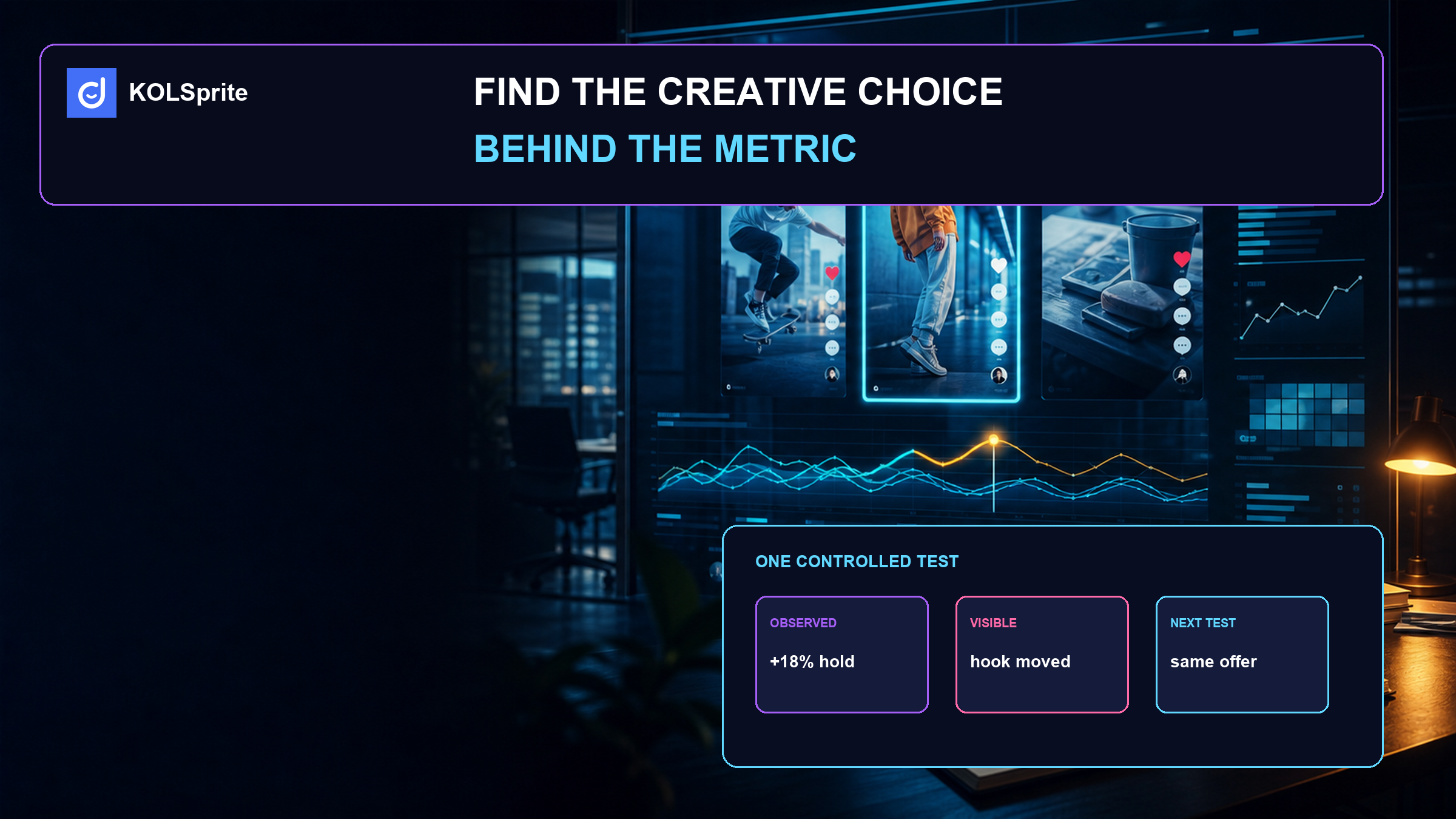
Use three columns. The first holds the observed metric change in the team’s own reporting. The second holds a visible creative difference, described without praise or theory. The third names the next controlled test. One record might read like this:
| Observed metric change | Visible creative difference | Next controlled test |
|---|---|---|
| Post A outperformed Post B on the team’s selected watch metric during the same review period. | Post A begins with the product being used. Post B begins with a static package shot before the use case appears. | Make two versions with the same creator, offer, and length. Change only the first two seconds from package shot to use demonstration. |
The record does not claim that the opening caused the result. It makes the assumption visible and assigns the next test. That is enough to move a creative meeting forward. It also creates a trail when the result later goes the other way.
KOLSprite can help a content team sort and inspect supported public videos, then compare visible hooks, formats, captions, comments, and creator context. Selected examples can sit beside the team’s first-party metric during a review. The value is in making the hypothesis more specific: what did viewers actually see, and which piece is practical to test?
That research does not provide private analytics, attribution, or a causal answer. It should not be presented as proof that a public pattern will work for a different brand. The team still owns the metric, the brief, and the decision. For a public-signal lens on who a creative may be speaking to, use TikTok audience insights workflow. For a broader public comparison before a seller brief, review TikTok Creative Center seller validation.
Join the KOLSprite Discord to discuss which visible difference deserves a controlled test and which conclusions the metric cannot support.
 +
+
Join the KOLSprite Discord community
A strong post can be a useful lead without becoming a template. Close the review once the team has a metric observation, a visible difference, and a next test owner. Record what remains unknown: audience mix, distribution effects, creator familiarity, offer fit, and the many details that did not stay constant. That list is not an excuse to do nothing. It is a guardrail against claiming certainty you do not have.
When the next test is ready, compare it against the recorded hypothesis instead of rewriting the story after the fact. TikTok content analytics becomes more useful when it leads to a choice the team can revisit, rather than a winner everyone remembers differently.
There is a practical difference between a review that has ten findings and one that has one next move. Ten findings usually leave the producer with a broad request to “use more of what worked.” One next move tells the producer which shot, line, sequence, or caption treatment deserves a controlled comparison. The narrower record may feel less complete, but it reduces the chance that five changes arrive in the next edit and make the result impossible to interpret.
Set the comparison window before anyone watches the clips. Decide which result period will be used, which posts count as the comparison set, and which metric is relevant to the team’s stated objective. That keeps a loud recent comment or a favorite creator from changing the standard halfway through. A weekly meeting does not need a research paper. It needs a stable enough frame that the team can notice when an explanation is being invented after the result.
Creative context also includes what the viewer sees around the main claim. Check whether the product, human face, price cue, caption, or proof arrives first. Check whether the weaker post has a different demand on attention, such as an opening title that asks the viewer to wait. These are useful observations because an editor can reproduce them deliberately. They remain observations until the next controlled post gives the team a chance to test them.
Keep a small archive of completed Creative Choice Records. After several cycles, the team can see which hypotheses were tested, which held up, and which only sounded convincing in the review. That history is more valuable than a list of winners because it records the decision rule, not just the outcome.
The best output from a weekly review is a sentence an editor and a creator can use. It should say what stays fixed, what changes, and what the team will inspect afterward. That sentence is more valuable than a crowded dashboard screenshot because it tells the next production what the previous one taught.
A short, defined research window can yield enough public examples for a focused comparison. Use them to inspect visible creative choices. Then place those examples beside the team’s own data, not in place of it.
Before the brief leaves the room, name the failure condition as well. For example, the team may agree that a product-in-use opening is worth another test only if the product still appears clearly and the offer remains unchanged. A condition like that protects the comparison from becoming a new concept halfway through production. It also gives the reviewer a fair way to close the loop when the result does not support the original hunch.
Latest Articles

As an essential, data-driven toolkit for TikTok influencers and marketers, KOLSprite provides powerful features for effortless creator discovery, trending content identification, and actionable real-time insights.
It empowers users to make smarter decisions and significantly boosts their TikTok business.

 Refer & Earn