 +
+
If you sell online, TikTok Creative Center trends can show what is gaining attention. They are not product forecasts. Use them to collect trend language, high-performing ad patterns, keywords, and creative ideas. Then move to product-level and creator-level evidence before you change inventory or spend. This guide gives you a source-selection map: which question Creative Center can answer, which question needs KOLSprite, and which question belongs in your store data. You will leave with a 30-minute validation route instead of a folder of inspiring screenshots.
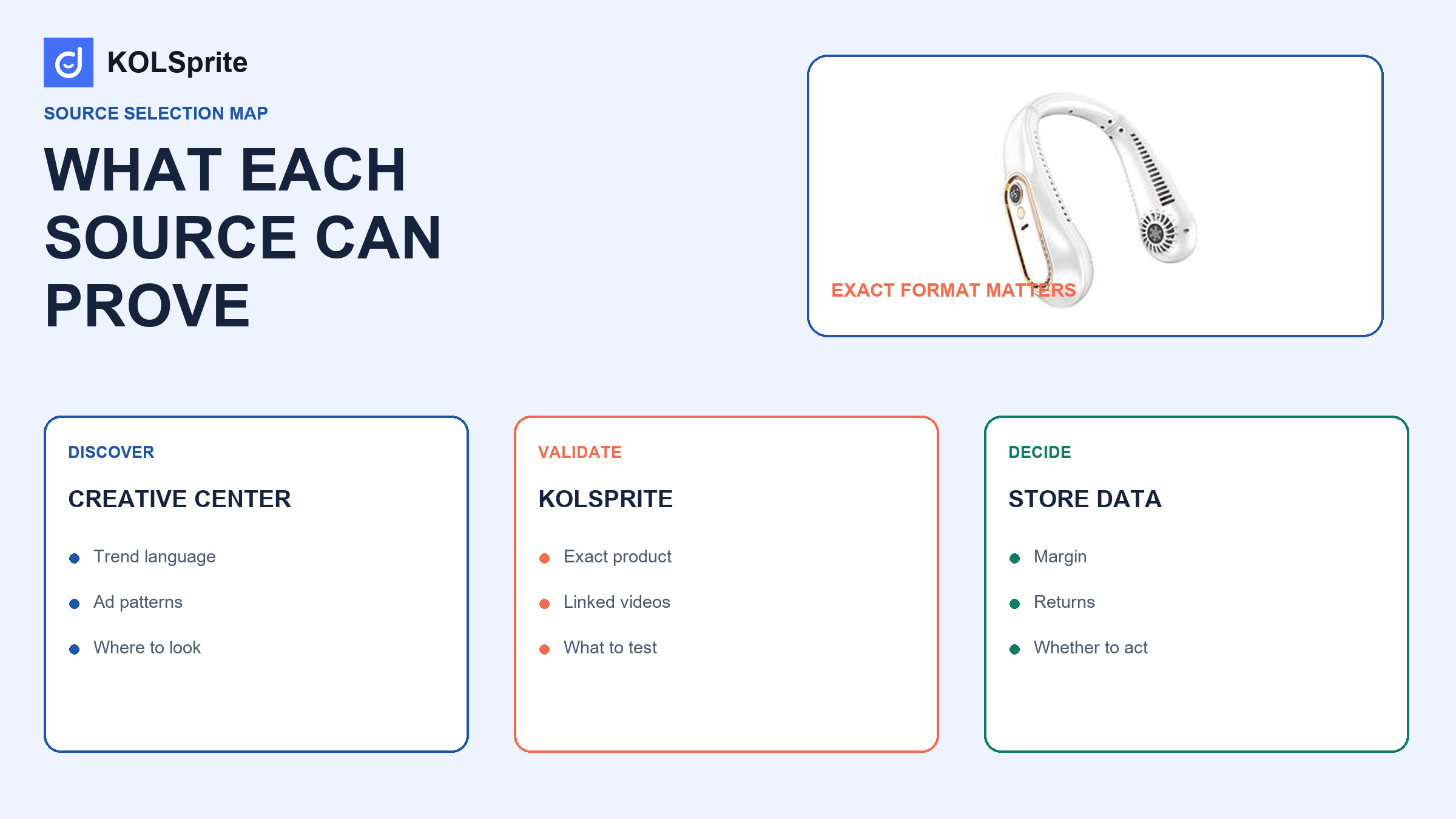
Creative Center is strongest at broad discovery. KOLSprite is useful when you need to follow an exact product, video, shop, or creator while browsing TikTok. Your store and channel systems decide whether the idea makes money.
Inspiration tells you where to look. Validation tells you whether to act.
TikTok's official help describes Creative Center as a place to explore high-performing ads, trends, hashtags, songs, creators, videos, products, keyword patterns, and creative tools. The exact modules and access can change by market. The service is valuable because it gives a broad view of what is visible across TikTok and its advertising ecosystem.
For a seller, that means it can answer questions such as: Which phrases are appearing around a category? Which ad formats are common? Which products or themes are getting attention? What kind of opening or edit deserves a closer look? These are discovery questions. They help the team write a research plan.
Review the current features in TikTok's official Creative Center guide. Treat the page as the source for what the tool offers, not as proof that a product will work for your store.
It does not know your landed cost, return rate, compliance risk, stock position, product quality, page conversion, or customer support burden. It also cannot prove that a broad trend applies to your exact product. A popular ad pattern can fail when the item, offer, and creator do not support the same promise.
The missing step is a connection between broad attention and an exact business object. That object may be a product ID, a shop, a creator, or a product-linked video. KOLSprite can help follow those objects. The seller then brings channel data to finish the decision.
| Question | Best first source | Why | Next check |
|---|---|---|---|
| What language or format is rising? | Creative Center | Broad trend and creative discovery | Find exact examples in your category |
| Which product and videos carry the idea? | KOLSprite | Connected product, video, shop, and creator research | Clean false matches and compare proof |
| Can our offer make money? | Store and finance data | Your cost, traffic, returns, and conversion | Set test limits and stop rules |
| Can the claim be used? | Legal, platform, and product evidence | Risk depends on the actual claim and market | Approve wording before the brief |
Suppose a seller notices a summer cooling theme and starts with the term “neck fan.” Broad discovery can reveal related language, ads, and seasonal energy. A KOLSprite product search then shows whether the exact category is active and whether the search term is clean.
In our July 28 review, the first five filtered results were not all neck fans. They included handheld fans, a true neck fan, and a waist-clip fan. That difference matters. The exact neck fan record showed a $7.07 price, 2,715 recorded 30-day units, a 4.3 rating, 496 reviews, and no linked creators or videos in that product record. A waist-clip fan showed 2,289 recorded 30-day units, 1,013 linked creators, and 2,600 linked videos. These are not interchangeable products or content systems.
Research note. KOLSprite product search for “neck fan”; US market; accessed July 28, 2026. Five results with minimum rating, review, and 30-day unit filters were reviewed. The set included handheld, neck, and waist-clip formats. Fields are directional platform snapshots and must not be read as a category forecast.
A neck fan sits on the body. Comfort, noise near the ear, hair safety, weight, battery, and social appearance may matter. A handheld fan adds a hand-use tradeoff but may suit makeup or travel. A waist-clip fan may fit outdoor work and needs airflow placement, clothing, and battery proof. One “summer fan” trend can hide three buyer problems.
This is where Creative Center inspiration should become a product brief. Write the exact format, target use, proof that must appear, and likely objection. Then use KOLSprite product search to clean the result set and video search to inspect how the exact format is shown. Do not borrow a strong waist-fan proof for a neck-fan listing.
Teams waste time when every source is expected to answer every question. Put the map in the research brief. The trend researcher owns discovery language. The product researcher owns exact-item matching and alternatives. The content lead owns proof and creative variation. Finance owns the test limit. Legal or compliance owns claims that create risk.
The map also stops meetings from turning into arguments about whose dashboard is correct. Two sources can both be correct while measuring different things. A popular keyword, a product sales field, and your store conversion rate are three different signals. Their value comes from the decision they support.
This route is short because it is a triage step. It should tell you whether deeper research is worth the time. It should not approve a large inventory order, a national campaign, or a regulated claim.
For each idea, list what the source does not show. Creative Center may not show whether your exact item can make the same proof. A product record may not show why people bought. A video may not show returns. Your store report may not explain why a creator's opening held attention. The misses column prevents one attractive number from becoming the whole story.
| Signal found | Useful meaning | What it misses | Required action |
|---|---|---|---|
| Rising summer-cooling theme | Seasonal language deserves review | Exact product and offer fit | Split neck, hand, and waist formats |
| Strong product record | Exact item has visible activity | Profit and future demand | Check economics and time window |
| Many linked videos | Creative supply may be broad | Rights, quality, and repeatability | Review proof across creators |
| High store conversion | Your offer worked for current traffic | Whether the trend caused it | Use a controlled campaign comparison |
Stop when the exact product cannot support the popular proof. Stop when the trend requires a claim your evidence cannot support. Stop when the offer only works at a price that breaks the margin. Stop when the trend has no clear relationship to the buyer your store serves.
Hold when the product and proof fit but seasonality, stock, or creator supply remains unclear. Test when the proof is repeatable, the risk is capped, and the team has named the metric that will change the decision. This language gives broad discovery a clean exit.
If the idea survives, use the TikTok video trends guide to decide which trend deserves a real content test. Then use the cross-channel product workflow when the same item must work on Amazon as well as TikTok. These links continue the decision; they are not generic product pages.
For a creator brief, carry over the exact buyer moment, proof shot, and misses. The creator should not receive a screenshot that says “make this trend.” They should receive a problem to solve and a boundary they can trust.
Keep the broad summer theme, but split the product formats before testing. Reject any plan that combines handheld, neck, and waist-clip fans under one proof. Hold the neck-fan idea until creator and video evidence is available for the exact product. Consider a controlled waist-clip test if the use case, claims, and economics fit. This is how TikTok Creative Center trends become useful: they start the question, while connected product and store evidence finish it.
Review broad trends once a week, not every hour. Save only the ideas that map to a real audience and product format. Give each saved idea an owner and a deadline for the next evidence check. Archive it when no one can name the decision it supports.
That habit keeps TikTok Creative Center trends in their strongest role. They remain a rich source of language and creative direction without becoming a machine for random product bets.
Create a KOLSprite account and claim a three-day trial membership. Use the trial to inspect TikTok content signals, save useful examples, and plan the next creative test.
Register for a three-day KOLSprite trial
Bring the trend, exact product format, and the question assigned to each source. Other operators can help find where inspiration has been mistaken for product proof.
 +
+
Review the source-selection map on Discord
Latest Articles
As an essential, data-driven toolkit for TikTok influencers and marketers, KOLSprite provides powerful features for effortless creator discovery, trending content identification, and actionable real-time insights.
It empowers users to make smarter decisions and significantly boosts their TikTok business.

 Refer & Earn