 +
+
TikTok Creative Center Top Products is a discovery surface for products that appear often or convert well in ads for a selected region and category. It is not a sourcing instruction. The practical workflow is to find a candidate in Creative Center, inspect its product, creator, and video evidence in KOLSprite, then add the business facts public data cannot show. This guide ends with a six-field card that produces one of three decisions: test, hold, or reject.
Ten-second answer: use Creative Center to find a candidate; use KOLSprite to inspect market and content evidence; use your own margin, return, stock, and compliance data to decide whether a small test is justified.
TikTok describes Creative Center as a public collection of trends, ad examples, best practices, and creative tools. Top Products lets marketers browse products commonly featured or converting in a selected region and category and review related ads.
That helps with discovery. It can show that advertisers are active, that a product category has creative examples, and that a specific item deserves inspection. It does not show your landed margin, likely refund cost, warehouse fit, intellectual-property risk, customer support load, or whether your team can make credible content.
Ranking is evidence of activity, not proof of your opportunity. The right question is not "Is this product hot?" It is "Which uncertainty should we pay to test next?"
In plain terms, the list is a lead, not a purchase order. A candidate earns a test only after content proof and business constraints point in the same direction.
Save the filters with the candidate. A product ranking without market and date context is easy to misuse in a later meeting.
| Field | Question | Evidence | Decision use |
|---|---|---|---|
| Demand signal | Is activity recent and broad enough to inspect? | Creative Center position plus dated product data | Open or close the research task |
| Creative supply | Are there several usable proof angles? | Related ads and public product videos | Define the first creative test |
| Creator supply | Can more than one creator type explain the product? | Creator count, content fit, and recent activity | Estimate outreach difficulty |
| Buyer proof | What can a viewer see in seconds? | Demonstration, comparison, setup, or result | Choose the core claim |
| Missing economics | What public data cannot answer? | Margin, returns, freight, stock, support, compliance | Set a stop rule |
| Next state | Test, hold, or reject? | All fields above | Assign owner, budget, and deadline |
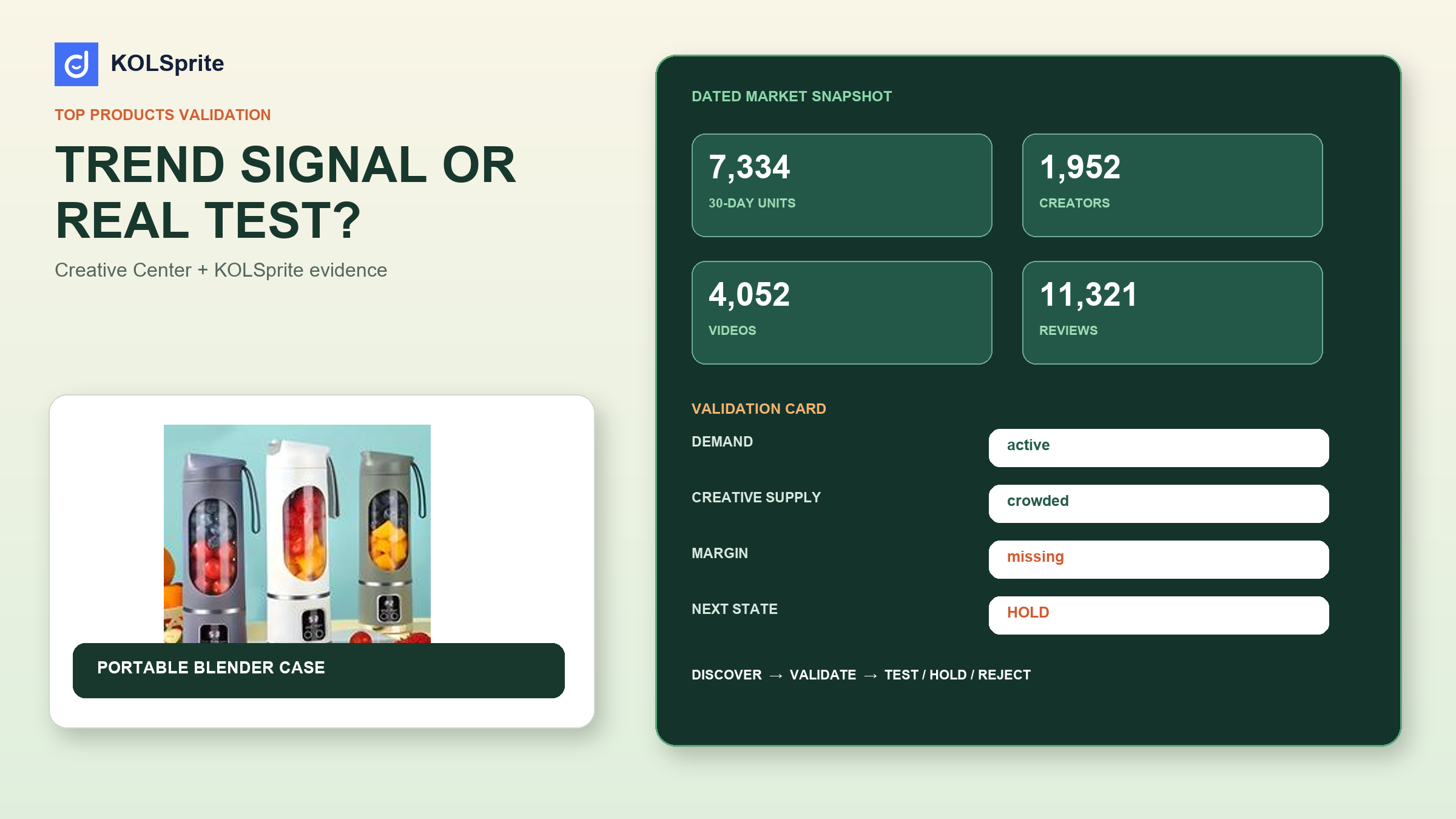
On August 10, 2026, a KOLSprite US product search for portable blenders returned a compact model with 7,334 units in the prior 30-day field, 98,897 total units, 11,321 reviews, 1,952 creators, and 4,052 videos. A related high-view video record showed 8.9 million plays, 186,700 likes, 2,180 comments, 22,400 shares, and 1,138 recent attributed units.
Those numbers show substantial activity and a large creative supply. They do not prove a new seller can enter profitably. In fact, the size of the creator and video pool may signal a crowded market. The data changes the next question from "Does anyone care?" to "Can our product, proof, and economics be meaningfully different?"
Case decision: hold for an economics and differentiation check. Do not reject the category, but do not buy inventory from the public signal alone. Price the delivered unit, inspect returns, choose one proof angle, and set a small test budget first.
KOLSprite product, creator, and video searches help you inspect the content supply behind a Creative Center candidate before the team commits inventory or creative budget.
Register and claim a three-day trial
Open a sample of videos with different view levels, not only the biggest one. Record the first-frame promise, visible action, proof moment, creator setting, comments, and product variation. Look for repeated proof, not repeated adjectives.
For a portable blender, possible proof angles include desk use, gym use, cleanup, one-serving capacity, noise, or ingredient limits. Each angle speaks to a different buyer job. A single "must have" montage cannot validate all of them.
KOLSprite is useful here because product search, linked videos, creator data, and sorting live in the same research system. The seller can move from the public category signal to specific examples without losing the product context.
A large recent sales field asks whether demand is still active. It does not answer why the item sold. A large creator count asks whether the category has enough content supply. It may also show that many sellers are competing for the same attention.
A high video count asks whether several proof styles exist. It can also mean the common hooks are tired. A strong review count asks what buyers experienced. It does not remove the need to read current negative reviews and support issues.
Turn each number into a question for the next evidence source:
This keeps the dashboard from deciding on its own.
Before you call the candidate a test, write the lowest margin that makes the test worth running. Start with the selling price. Subtract the unit cost, freight, duties, platform fees, creator commission, expected discount, fulfillment, ad cost, refund reserve, and support cost.
Use a range when a number is not final. A range is better than a blank. It shows which input can break the case.
| Cost line | Known? | Range or source | Stop rule |
|---|---|---|---|
| Landed unit | Pending quote | Low and high supplier case | Stop above the approved ceiling |
| Creator and sample | Estimated | Plan by creator tier | Cap the first wave |
| Returns | Unknown | Use category range until test data arrives | Hold if downside removes margin |
| Support and damage | Unknown | Ask operations | No test without an owner |
The table does not need to be perfect. It needs to reveal the number that matters most.
Choose three common videos from the category. Write the job each one proves. Then ask what your product can show more clearly, more honestly, or in a setting competitors ignore.
For a blender, that may be cleanup in a shared office sink. It may be a measured serving for a specific routine. It may be an honest limit that builds trust. "More viral" is not a creative advantage.
If the team cannot name a fresh proof angle, the correct state is hold. Buying the same product and copying the same hook adds risk without adding a reason to choose you.
Do not leave with "do more research." Name the missing fact, owner, source, and deadline. A hold decision should be active, not a parking lot.
A first test should answer one hard question. It may ask whether a buyer understands the use. It may ask whether a creator can show the proof. It may ask whether the price works after real costs.
Set a cap for units, samples, creator fees, and media. Set a date to stop. Write the result that would make you continue. Also write the result that would make you stop.
For the blender case, the first test could focus on desk use. Choose three creators who already show work routines. Give each the same basic proof task. Let them use their own voice. Review product questions, watch quality, and the cost of each useful response.
Do not add five buyer jobs to the first wave. You will learn less. A narrow test makes a weak result easier to read.
Bring the category, Creative Center signal, and the economics you still do not know. Other sellers can help decide whether the next step is a small test, a hold, or a reject.
 +
+
Join the KOLSprite Discord community
A strong result can support the next test. It cannot promise a full launch. A weak result can show that the proof, creator, price, or product is wrong. It may not tell you which one without a clean setup.
Record what happened in the same validation card. Add links to the videos, the offer, the costs, and the main questions. Choose a new state: expand, revise, pause, or reject.
This closes the loop. The public ranking led to a small decision. The small decision created first-party evidence. The next step now depends less on a trend page.
A no answer does not always mean reject. It tells you where the risk sits. Place that risk on the card and price the next step around it.
Now make the choice in one line. Test means the team knows the question, cap, owner, and stop date. Hold means one named fact is missing and someone owns the check. Reject means the product fails a required rule. Avoid soft words. A clear state saves time.
Share the card with product, content, and operations. Ask each team to correct only the facts it owns. Then lock the first test. This keeps the meeting short. It also prevents a trend signal from becoming a large plan before the basic facts are ready.
Landed cost, expected discount, creator commission, ad spend, refund reserve, and support cost.
Stock lead time, battery or liquid restrictions, packaging, damaged-item risk, and delivery promise.
Tested ingredients, capacity, charging, cleaning, noise, warranty, and prohibited claims.
A setting, buyer job, or demonstration your product can own without copying a crowded claim.
If one of these areas is blank, the decision is hold. Public momentum cannot fill an internal data gap.
A good test has one product version, one buyer job, one proof task, a capped sample or media budget, and a stop date. Define the result before contacting creators. For example: "Test whether office workers understand the one-serving desk use after one full demonstration. Stop if qualified product questions do not appear across three distinct creators."
The result may still be no. That is useful. The purpose of validation is to spend a small amount to remove a large uncertainty.
Use the TikTok viral-products validation checklist when the team needs a fuller inventory memo. Use the Amazon-to-TikTok product research workflow when marketplace demand and store economics must be checked beside TikTok content fit. If the next uncertainty is creator fit, move into the creator discovery workflow with one tested proof task.
This creates a closed loop: Creative Center finds a candidate, KOLSprite reveals the product and content system around it, internal data sets the business boundary, and a small test returns new evidence.
TikTok Creative Center Top Products can shorten discovery. KOLSprite can shorten the next evidence pass. Neither should make the inventory decision for you. The strongest operator keeps the ranking, the dated case, the missing facts, and the next test on one card.
Sources: TikTok for Business Creative Center documentation and KOLSprite MCP public US product/video search accessed August 10, 2026. Figures are a dated snapshot and may change; they are not a forecast or a promise of performance.
Latest Articles
As an essential, data-driven toolkit for TikTok influencers and marketers, KOLSprite provides powerful features for effortless creator discovery, trending content identification, and actionable real-time insights.
It empowers users to make smarter decisions and significantly boosts their TikTok business.

 Refer & Earn