 +
+
A folder with 200 competitor clips feels like research until someone asks a plain question: what are these brands actually promising customers? The answer is often buried in screenshots, loose links, and a few memorable hooks. A team has gathered attention, not made a decision.
A TikTok competitor analysis tool earns its place by turning public examples into a claim map. The map links each claim to proof on screen. It also records viewer questions and the gaps the brand must still check. A strategist can then write a sound brief without copying a competitor’s creative.
Start with the promise, not the clip. A competitor may be saying a product saves time, solves a visible problem, fits a particular routine, or offers a specific result. Write that claim in the words used or in a close plain-language summary. Do not improve it. The point is to capture what a viewer could reasonably take away from the public video.
One clip can carry several claims. Separate them. “This cleans in minutes” and “this works on a delicate surface” need different proof. A visible demo may support the first. The setting may only imply the second, or the product context may conflict with it. A crowded swipe file hides that gap. A case board puts it in view.
Give each claim an owner. Someone still needs to decide what happens next. The claim may become an angle to avoid, a customer research question, or an opening for a new brief. Without an owner, competitors become an endless feed of material that nobody is allowed to act on.
Public videos can show a before-and-after sequence, a demonstration, a creator’s routine, a text overlay, or a product feature. They can also show the absence of proof. A claim may repeat across several videos without a clear demo. That is a reason to ask what customers need to see before they believe it.
Keep the evidence label narrow. “Creator pours the product into a sink at 00:06” is observable. “The product works for every drain” is not established by that shot. Screenshots and saved clips can document the first statement. They do not establish product performance, legal substantiation, or the right to reuse the creative.
Comments can reveal confusion, repeat objections, or the words viewers use for a problem. They are a limited sample, not a market vote. A group of questions about fit may justify more research. It does not prove demand or tell a seller what to stock.
| Public surface | What it can reveal | What it cannot establish |
|---|---|---|
| Creative Center and Top Ads materials | Public creative examples and patterns available through TikTok’s creative surfaces. | Private competitor results, sales attribution, or why a specific post performed. |
| Competitor posts and captions | Visible hooks, stated claims, product framing, and caption wording. | Whether a claim is substantiated, approved, or responsible for sales. |
| Public comments | Questions and reactions within the visible sample. | Representative social listening, buyer intent, or a complete audience view. |
| Product and creator context | Visible use cases, presentation choices, and surrounding public context. | Rates, availability, rights, or permission to reuse a person’s content. |
Source note, reviewed August 21, 2026: TikTok’s Creative Center help page, Top Ads overview, and creative product page describe public creative-discovery surfaces. Scope: public materials and public posts. Limitations: availability and interfaces change, and these sources do not expose private competitor data or prove that a visible claim drove performance.
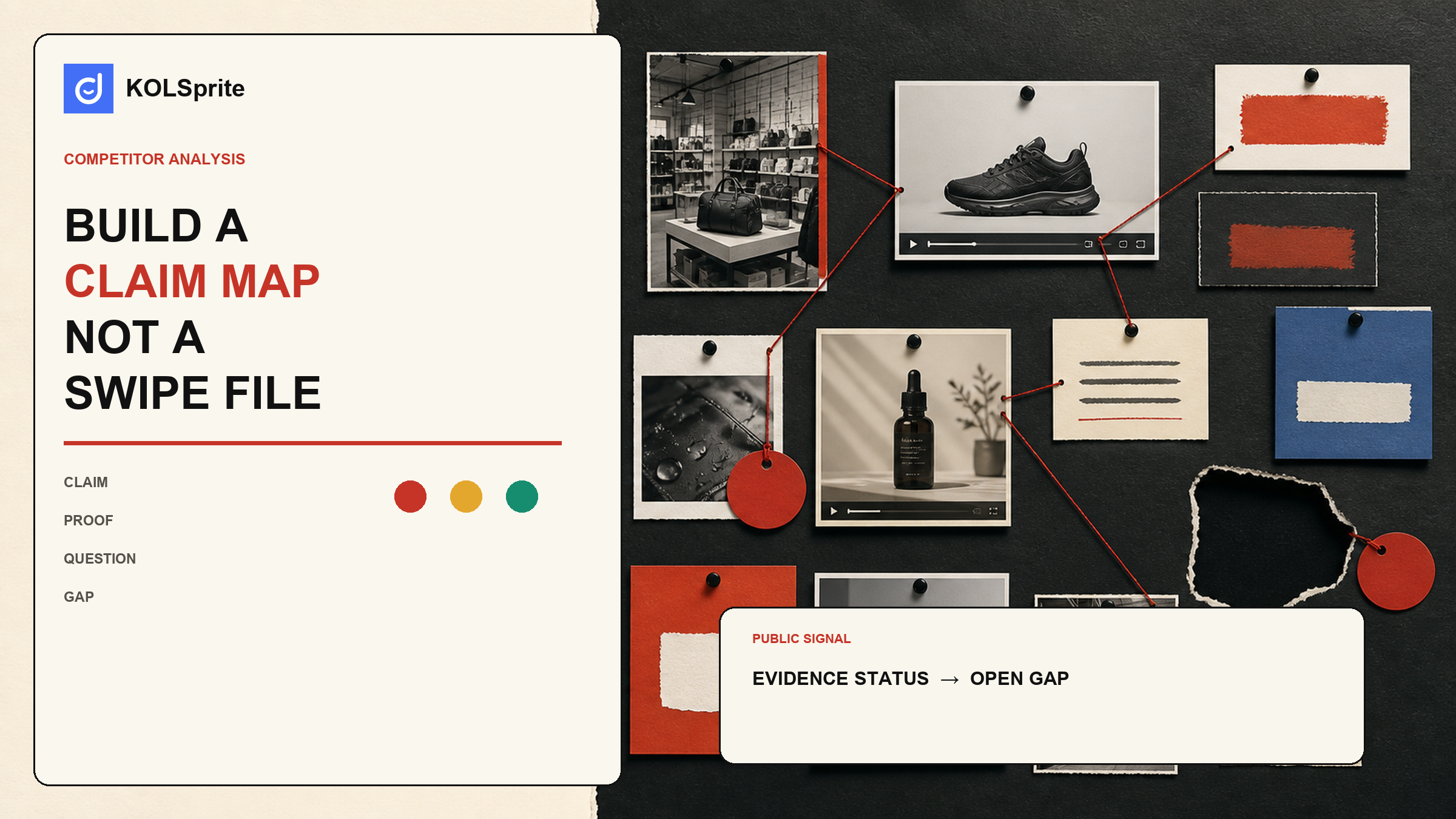
The colors rate the evidence, not the appeal of the claim. Green means the public material shows a clear claim, visible proof, and a useful context note. Yellow means the claim is present, but the proof is partial, indirect, or mixed. Red means the reviewed material does not support the claim or the claim is too broad.
This makes a useful distinction during a launch review. A competitor’s popular opening may be green as a documented messaging pattern while still being a poor fit for your category. A yellow claim may be the better research lead because it exposes a question no one is answering clearly. The color prevents a slide deck from turning every repeated phrase into a recommendation.
Use KOLSprite to inspect supported public posts, subtitles, comments, and creator context, then preserve the evidence behind each claim and open question.
Register and claim a three-day trial
| Claim | Visible proof | Audience question | Open gap | Status |
|---|---|---|---|---|
| “Makes weekday cleanup faster” | Creator shows a short cleaning sequence and the result on one surface. | Will it work on the surfaces customers ask about? | No visible comparison, compatibility detail, or claim boundary in the reviewed sample. | Yellow |
That one row is more useful than ten saved clips. It tells the creative team what is visible. It shows the product owner what is missing. It also shows legal or operations where a broad statement needs support. The final column also gives the strategist permission to say, “We have seen this claim. We have not established enough to repeat it.”
For public example discovery, TikTok Creative Center seller validation can help frame the material. For a closer look at audience questions in a limited public sample, use TikTok comment analysis for ecommerce.
A claim map should have a time boundary. Review a defined set of public posts around a launch, category, product form, or creative question. Save the date and the URLs or references needed for later verification. Do not promise complete market coverage. Public posts disappear, availability changes, and no browsing set is the whole category.
KOLSprite can help teams review supported public competitor posts in context. Where available, teams can sort and filter videos, inspect captions and comments, save examples, and compare creator or product context. This can speed up public research. Private competitor data, sales attribution, reuse rights, and proof of cause remain outside its scope.
Join the KOLSprite Discord to compare public evidence, repeated promises, buyer questions, and gaps without treating another brand's creative as a reusable brief.
 +
+
Join the KOLSprite Discord community
The strongest next move is not to make the competitor's video. Answer the question their public material leaves open. A competitor may promise speed without showing a difficult use case. Your brief can ask for that specific demo. If its captions make a broad claim without proof, use a narrower statement and a visible test.
That approach keeps the team in its own voice. It also makes the research more durable. A swipe file ages badly because it relies on what happened to be memorable. A map records why an example was collected and what the team did not learn from it. For audience framing beyond the clip itself, see TikTok audience insights public-signal workflow.
Stop collecting when each priority claim has a status, a source note, an open question, and an owner. More clips will always be available. The goal is a decision a strategist can defend. Which promise is overused? Which proof is thin? Where can an original idea be more specific?
Use public research to sharpen that board. Keep the evidence dated, keep the limits beside it, and keep the next brief tied to a gap rather than somebody else’s execution.
Before a launch review, scan the board for hidden repeats. Competitors often use different words for the same promise. “Fast routine,” “five-minute reset,” and “less time cleaning” may form one claim group. Note how each post supports its version. This stops the team from treating repeated wording as a wider set of benefits. Keep the original words in the evidence note for later checks.
Also separate a creator’s personal story from a product claim. A creator may say that a product changed their routine, while the brand caption makes a broader promise. Both are visible public material, but they carry different weight in a brief. The map should say who made the statement and what proof appeared in that specific post. A TikTok competitor analysis tool helps organize this material. It does not turn one creator’s experience into proof that a product will work for every buyer.
Write the gap as a question a customer would recognize. Ask whether the result can be shown on the surface people worry about. That is stronger than a vague request to increase proof. The question can lead to a demo request, a product test, or a reason to avoid the claim.
The finished board should be readable by someone who did not collect the clips. They should be able to trace any green, yellow, or red status back to a dated public example and see the stated limitation. That traceability is what turns collection into competitive intelligence instead of a visual archive.
One final check protects the team from accidental imitation. Remove any instruction that describes a competitor’s execution more closely than the customer problem it addresses. The next brief should ask for your own product proof, your own language, and a clear reason for the viewer to care. A competitor example may remain in the research note as context. It should not become a shot-by-shot assignment.
That discipline is especially helpful when several brands converge on the same visual convention. Repetition can signal a recognizable category pattern, or it can signal that every team is watching the same public clips. The claim map keeps the question open long enough to decide which is true for the evidence in hand.
Latest Articles
As an essential, data-driven toolkit for TikTok influencers and marketers, KOLSprite provides powerful features for effortless creator discovery, trending content identification, and actionable real-time insights.
It empowers users to make smarter decisions and significantly boosts their TikTok business.
 Refer & Earn