 +
+
If you buy inventory for Amazon, Shopify, or TikTok Shop, seeing the same product all week can feel like proof that you need to move fast. It is not. TikTok Shop trends tell you what deserves a closer look, not what deserves a purchase order. This guide gives you a five-signal decision card and a 48-hour review you can use to make one clear call: run a small test, wait for a missing fact, or reject the idea before it consumes stock and attention.
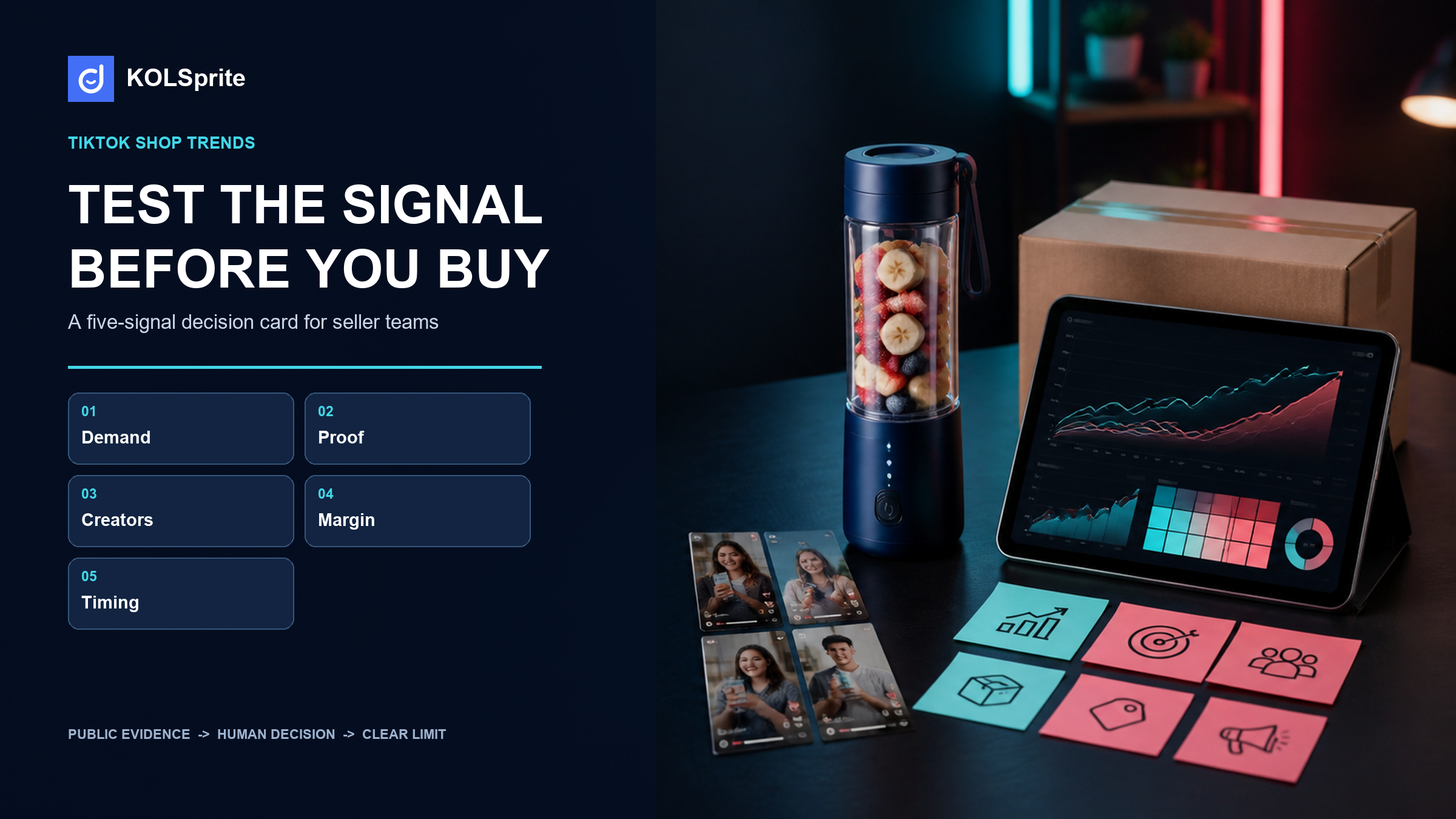
Ten-second answer: views earn a product a place in the research queue. A test requires a clear buyer job, a repeatable video demonstration, creators who can deliver it, workable economics, and a reason to act now. If one of those is missing, wait or walk away.
It is easy to confuse repetition with demand. You see the same gadget in several videos, a creator says it sold out, and a few comments ask where to buy it. Those are reasons to investigate. They are not proof that the item fits your margin, supply chain, claims, or audience. TikTok Shop Product Opportunities and Creative Center can help surface topics and content patterns. Shop and search analytics can add another platform signal. None of those tools can tell you whether your version of the product can arrive on time, survive returns, or make the promise the video makes.
That distinction matters most for teams that already sell elsewhere. An Amazon seller may see a category with healthy search demand but no short-form hook. A Shopify brand may see a beautiful video pattern but no reliable creator pool. A TikTok Shop seller may see both and still lack a workable sample budget. The useful question is not, "Is this hot?" It is, "What is the smallest decision we can make with the evidence in front of us?"
Start by naming the decision. A category lead might need approval for ten sample units. A buyer might need permission to request a supplier quote. A content lead might only need a creator test. These are different commitments. When a trend card states the commitment first, it prevents a research note from turning into an accidental inventory order.
Use one short card for one category, product shape, or use case. Do not combine a whole category with three unrelated products. A card should be dated because trend evidence changes fast. It should also include the missing evidence, not just the encouraging evidence.
| Signal | Question to answer | Useful proof | What it cannot prove |
|---|---|---|---|
| Product | What job does the item perform? | A clear use case, price band, and product variation | Supplier quality or margin |
| Video | What does the clip make visible? | A repeatable hook, demonstration, and objection response | That the hook will work for your brand |
| Creator | Who can explain the job credibly? | Relevant audience context and similar content | Availability, fee, or private audience data |
| Commercial | What could break the test? | Price, shipping, claims, sample cost, return risk | A complete financial forecast |
| Timing | Why act this week instead of later? | Current activity, season, inventory window, or platform event | Long-term category demand |
A good card is allowed to say "unknown." In fact, it should. If the product lane is strong but the commercial lane is blank, the decision is not "buy." It is "price the test." If creator evidence is thin, the decision may be "collect five more relevant examples." This keeps the team from filling every blank with optimism.
A public portable-blender check shows why a single number is weak evidence. Four videos in the same broad product area had about 26,600 to 73,700 views. Their reported video-linked sales ranged from 2 to 221. The videos did not all have the same price, creator, offer, timing, or buyer setting. That means the figures are not a market census and they do not prove that one edit caused the sales. They do show a useful operational point: high reach and transaction evidence can move in different directions.
Source note: These are public TikTok-market snapshots collected for a bounded product-research check. They are useful for comparing questions, not for estimating category revenue or claiming causality. Verify current price, stock, policy, and seller-side data before acting.
When you inspect examples in KOLSprite, keep the question beside the evidence. A product and video search can show the visible demonstration, comments, creator context, and repeated patterns without forcing you to bounce between tabs. Save the examples that answer a defined question. Do not save every clip with a high view count. The next person should be able to see why an example was kept.
Start a three-day KOLSprite trial and use the product, video, creator, script, and comment views to collect only the public evidence your card still lacks. Bring margin, stock, compliance, and fulfillment facts from your own systems before you approve a test.
Register and claim a three-day trial
The sprint is not a launch plan. It is a way to close the largest evidence gaps before you spend more. Give one owner a simple output: a trend card with a test, wait, or reject recommendation. Keep the time box short enough that people stop browsing and start deciding.
Use a stop rule. For example, stop a test if the product requires a claim you cannot support, if the creator examples depend on a price you cannot sustain, or if the visible hook only works for a competitor's feature. A stop rule is not failure. It is a controlled way to protect time and stock.
Choose a limited test when the buyer job is clear, the video proof is repeatable, at least a small creator pool exists, and the major commercial risk has an owner. State the unit count, the proof task, and the review date.
Wait when the pattern looks real but a decision-critical fact is missing. Examples include unclear product safety, unstable supplier pricing, a seasonal question, or no creator who can credibly demonstrate the use case.
Reject when the pattern needs a misleading claim, cannot support acceptable economics, has no workable delivery path, or attracts a buyer group you cannot serve. Record the reason so the team does not reopen the same weak idea next month.
The wording matters. "We do not have enough proof to order" is better than "The trend is bad." A trend can be valid for another seller and still fail your test. This keeps category reviews practical and reduces the habit of chasing whatever is newest.
KOLSprite is useful at the evidence stage. It helps a team search public product, video, and creator context while it is looking at TikTok, then keep a short record of the examples that support or weaken the card. It can also help review a video's script and comments when those elements matter to the buyer job. That is different from claiming it can validate a product by itself.
It cannot confirm landed margin, private seller performance, supplier reliability, legal claim approval, or a creator's willingness to work with you. Those remain business checks. The value of a browser-native research workflow is that it makes the handoff cleaner: the product manager sees the evidence, the creator lead sees the format, and the buyer sees what still needs to be priced.
Share the dated trend card, the decision you favor, and the fact that could still change your mind. Other sellers in the KOLSprite community can challenge the weak lane without turning the discussion into another round of trend guessing.
 +
+
Join the KOLSprite Discord community
The most useful cards often contain a disagreement. A product may have a clear video pattern but weak creator supply. It may have active creator content but a price point that leaves no room for a sample test. It may have rising platform attention while the core use case is already late for your season. Do not smooth out that disagreement in the summary. Put it in the recommendation.
For example, a portable blender can look strong in a desk-based video because the demonstration is easy to understand: add ingredients, blend, drink. Yet the buyer may immediately ask about battery life, cleaning, leakage, noise, or ice. If the public examples do not address those questions, the content signal is incomplete. The next task is not to order more units. It is to find out whether the product can answer the questions without stretching the claim.
Keep a "what would change our mind" line on every card. A wait decision might become a test if three relevant creators show the same buyer setting with a credible demonstration. A test might become a reject if the landed-cost check removes the price room. This line makes the card useful after the meeting. It tells the team what evidence is worth collecting and what evidence would only add noise.
Research stalls when a single person is asked to solve every part of the question. Give the category or content lead responsibility for the public evidence card. Give the buyer or operations owner responsibility for cost, supply, and policy checks. Give the creator lead responsibility for the shortlist and the proof task. They can work in parallel, but the final decision should show who answered each lane.
This also prevents a familiar handoff problem. A content researcher may find a useful trend and assume it is ready for a creator campaign. The creator lead may find good people and assume stock is available. The card is the place where those assumptions meet. If an owner has not answered a critical question, the card should say so plainly instead of using a green label.
Finish with four sentences: the candidate, the evidence that supports a limited action, the business condition that still controls the action, and the next review date. A clear memo might say: "Test one portable-blender angle for desk smoothies. Public videos show a repeatable setup and buyer questions about cleanup. Do not expand until cost, battery claims, and fulfillment checks are approved. Review the first creator cohort in two weeks." That is enough to begin work without pretending the market is solved.
After the decision, keep one compact record with the date, the five signals, the choice, the owner, and the next review point. Add the examples that changed the decision, not a long gallery of clips. This gives a new teammate enough context to understand why the team tested a trend or passed on it.
For a product you test, compare the original card with what happens next. Did creators use the same hook? Did comments reveal a different buyer problem? Did shipping or price make the original promise weaker? That comparison turns a trend card into a learning loop. It also makes the next category review faster because the team has evidence about its own constraints, not only market noise.
For a related workflow, connect the initial card to your inventory validation process, then use a Creative Center review to compare current creative patterns. If the signal survives both checks, use the TikTok Shop product rejection test before a purchase order. When the card earns a live product check, move to KOLSprite product research or video research with a specific question in hand.
TikTok Shop trends become useful when they change a small, defensible decision. Treat the feed as a place to find candidates. Treat the card as the place where you decide what deserves money, attention, or a firm no.
Latest Articles

As an essential, data-driven toolkit for TikTok influencers and marketers, KOLSprite provides powerful features for effortless creator discovery, trending content identification, and actionable real-time insights.
It empowers users to make smarter decisions and significantly boosts their TikTok business.

 Refer & Earn