 +
+
If you source products for an ecommerce store, finding a hot item is not the hard part. The hard part is deciding what deserves cash, storage, and time. This guide turns TikTok Shop product research into a rejection test. You will leave with a one-page card for demand, creator proof, price risk, and operating risk. Reject an item when its sales story rests on one discount, one creator, or a claim your team cannot repeat. Hold it when the content works but the math is still unknown. Test it only when several creators can show a clear use case and your store can keep the same promise.
A rising sales count feels like permission to buy. It is not. A good product researcher writes the rejection rule before opening a dashboard. That rule keeps an exciting chart from changing the standard halfway through the review.
Popularity can put a product on the review list. Only a repeatable buyer outcome can keep it there.
Put four rows on the decision card: product match, proof, offer, and operating fit. Give each row a clear fail rule. The product row fails when the result is not the item you meant to study. Proof fails when a video states a benefit but does not show it. The offer fails when your store cannot match the price. Operating fit fails when shipping, safety, returns, or support can erase the margin.
This is stricter than a trend score on purpose. A score can help you sort a list. It cannot tell you if a glass jar will survive delivery. It cannot check battery papers or explain whether a low price drove the result. Those facts must be on the same card before anyone approves an order.
| Gate | Pass | Hold | Reject |
|---|---|---|---|
| Exact product | Search result matches the intended item and use | Close substitute needs a separate review | Result belongs to another category |
| On-camera proof | Several videos show the result clearly | Benefit is visible but conditions are unclear | Claim cannot be shown or checked |
| Offer | Price and bundle can work at your costs | Discount source is unclear | Only an extreme price makes it attractive |
| Operations | Shipping, returns, and support are manageable | One cost or rule still needs an owner | Risk can wipe out the expected margin |
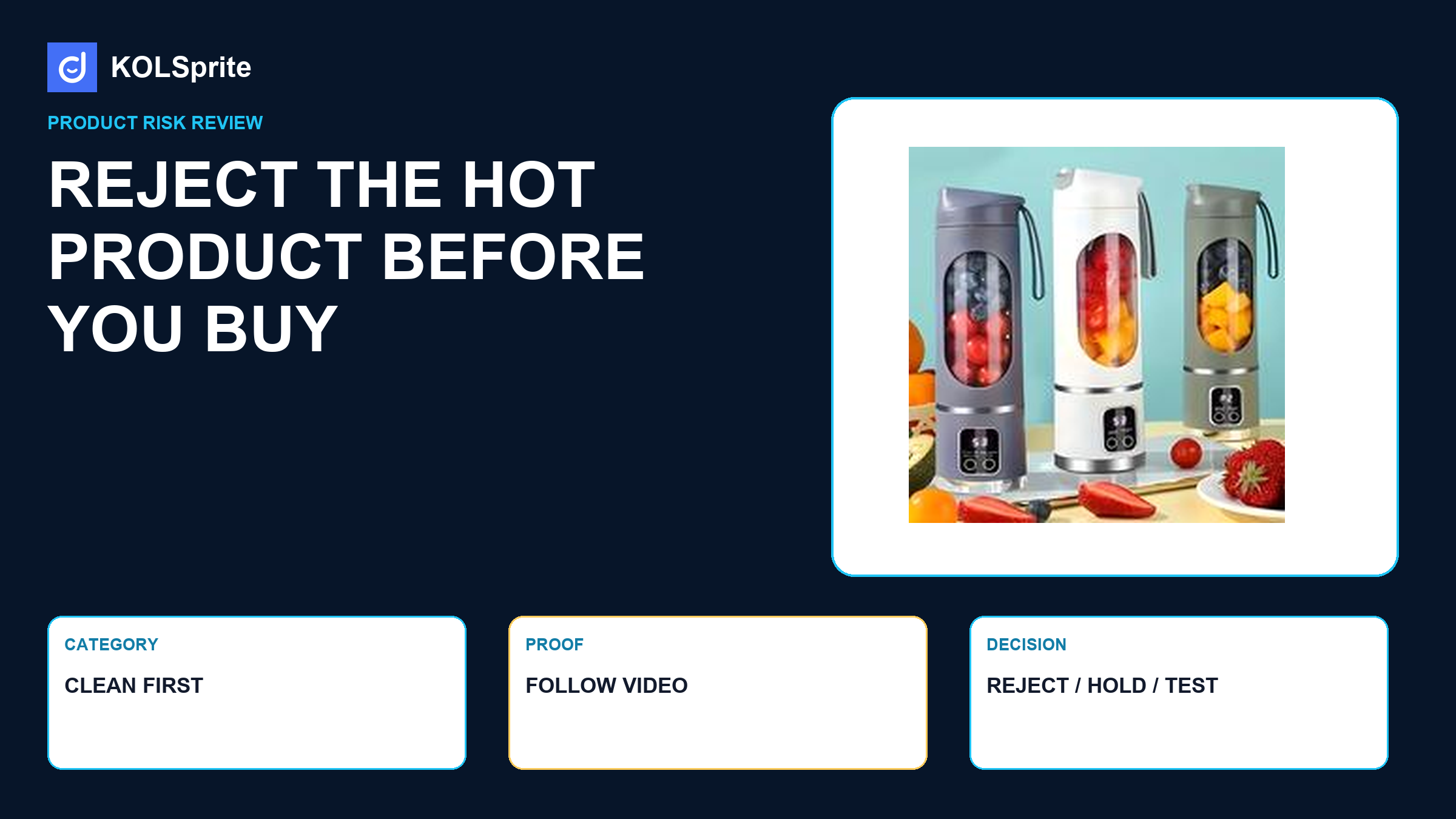
We searched KOLSprite for “portable blender” in the United States and checked the first 20 results. The list had real blenders. It also had a milk frother, garlic choppers, a shaker bottle, and a beauty sponge. A raw total would have made the market look larger than the useful result set. So the first step was not ranking products. It was removing items that did not answer the sourcing question.
One relevant blender from HomeGadget Depot provided a connected case. At the time of review, its KOLSprite record showed a $15.86 price, 10,929 recorded units over 30 days, 96,543 lifetime units, a 4.3 rating, 11,040 reviews, 1,923 linked creators, and 3,950 linked videos. These fields show enough activity for deeper work. They do not prove profit, future sales, or demand on Amazon or Shopify.
Research note. KOLSprite product and product-linked video records; US market; accessed July 28, 2026. The broad result set was cleaned for category relevance. The case below follows one exact product ID. Values are directional platform snapshots, not audited revenue or a forecast.
The next step was to open videos linked to that exact product. The sample included a 37-second video with about 6.8 million plays and 1,482 recorded 30-day units, a 58-second Spanish video with about 7.1 million plays and 1,404 units, and a 23-second video with about 9.1 million plays and 927 units. Another smaller creator account had a video with roughly 2.4 million plays and 806 units.
The signal is not that every large video sold well. The useful point is that different creators can show the item in short and long clips, in more than one language, and to audiences of different sizes. That lowers the risk of relying on one creator. It also raises better questions. Did the clip show power, cleanup, travel, or a recipe? Did comments ask about charging, leaks, ice, or size? A buyer does not buy “millions of views.” A buyer buys a result under real conditions.
KOLSprite keeps that trail in one place. A researcher can move from product search to videos tied to the exact item. The team can then save clips that show different types of proof. Rebuilding the trail by hand makes it easy to mix up products, shops, and creators.
A mood board saves clips. A rejection card forces a choice. For this blender, the product match passes after cleanup. Creative proof passes for a small test because several videos show the item. The offer stays on hold because the TikTok price may not fit your landed cost or store price. Operations also stay on hold until the team checks leaks, battery papers, food-contact claims, spare parts, and return reasons.
| Question | Observed evidence | Decision | Owner |
|---|---|---|---|
| Can several creators show a useful result? | Yes; multiple high-reach videos and creator sizes | Pass for creative testing | Content lead |
| Does one discount explain the demand? | Unknown from the content sample | Hold | Merchandising |
| Can our product support the same demo? | Needs ice, leak, charge, and capacity tests | Hold | Product QA |
| Are channel costs acceptable? | Not answered by TikTok records | Hold | Finance |
| Should we place a large order? | No complete operating case yet | Reject for now | Category owner |
This outcome is not a failure. “Reject for now” protects the budget while naming the missing proof. The item can move back to test status when the owner fills the two most important gaps. A review that ends with “interesting” is unfinished. A review that ends with a dated condition is useful.
If the unit economics survive the first check, run a test built around one unknown. Do not ask five creators to make the same generic smoothie clip. Give one creator the ice test, one the cleanup test, and one the commute or office use case. Keep the product, offer, and landing page stable enough to compare the result.
The test brief should say what the creator may claim, what the clip must show, and what it must not imply. It should also define the next move after a weak result. Stop if every sound demo needs an ingredient or condition your listing cannot support. Revise when buyers understand the use but keep asking one clear question. Expand only when a second creator can repeat the winning proof.
An Amazon seller still needs Amazon search, review, return, fee, and competition data. A Shopify store still needs traffic cost, conversion, support, and repeat-purchase logic. The Amazon-to-TikTok research workflow shows how to carry a product idea between those systems without treating them as the same market.
Amazon's Product Opportunity Explorer is one official source for Amazon search, purchase, review, and return signals. Use it beside the TikTok evidence when the item will be sold on Amazon. The two sources answer different parts of the stock decision.
TikTok answers one narrow but useful question: can people grasp and share the product story in a short video? A product with sound math can still fail when its value is hard to show. The reverse is also true. A product can look great on camera and still lose money after fees, returns, and support.
Use the same card in future TikTok Shop product research. The proof will change by category. A beauty device needs claim and skin-safety checks. A home organizer needs size and before-and-after proof. A wearable fan needs battery, comfort, noise, and runtime checks. The four gates remain useful because they force the content signal to meet the business.
Do not place a larger order based on the current record. The portable blender has earned a controlled creative test, not an inventory bet. Confirm costs and product safety, then run three proof-led creator briefs. If the same useful outcome appears across creators and the economics hold, reopen the order decision. That is the practical role of TikTok Shop product research: not to make you chase more products, but to help you reject weak bets earlier.
Once an item passes the rejection card, the next task is not broad creator search. It is finding a creator who can show the chosen proof. Use the creator outreach SOP to turn that evidence into a clear contact message. After the first clips arrive, the TikTok UGC strategy guide helps organize the next round around the buyer question that proved useful.
Create a KOLSprite account and claim a three-day trial membership. Use the trial to research products, inspect linked videos, and check the evidence before you act.
Register for a three-day KOLSprite trial
Share the rejection card, the missing cost facts, and the three proposed proof tests. Another seller may spot a return, claim, or margin risk before it reaches the purchase order.
 +
+
Discuss the inventory decision on Discord
Latest Articles

As an essential, data-driven toolkit for TikTok influencers and marketers, KOLSprite provides powerful features for effortless creator discovery, trending content identification, and actionable real-time insights.
It empowers users to make smarter decisions and significantly boosts their TikTok business.

 Refer & Earn