 +
+
Product discovery tools are good at creating interest. A clip gets attention. A product appears across several creators. A ranking page makes the item look current. Then the seller orders samples and asks the late questions. The team learns that a public signal was never a reason to buy stock.
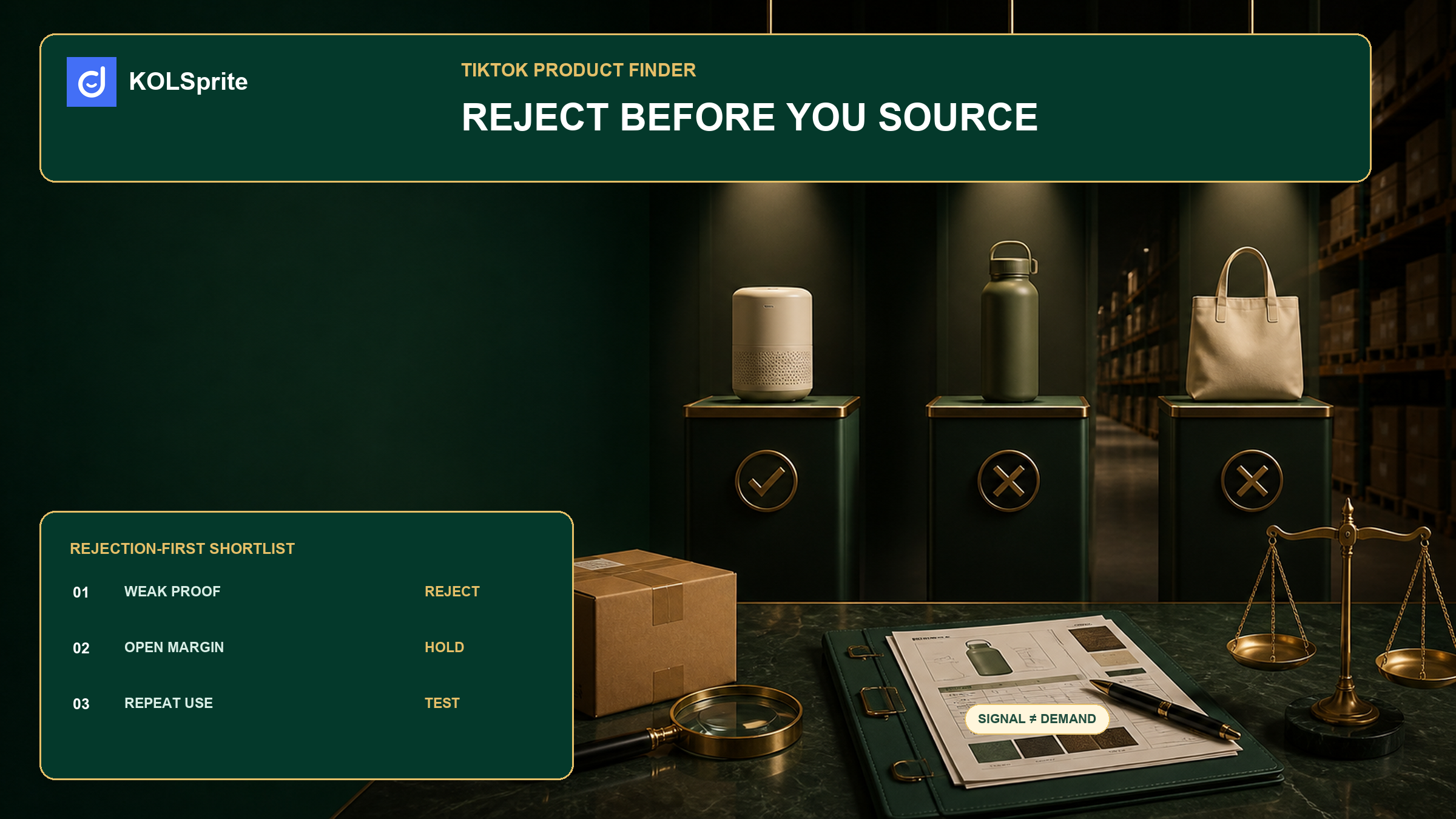
A TikTok product finder should help a team reject weak ideas before it spends time or buys stock. The output should be a short record. It shows the public evidence, why the item may fail, what still needs a business check, and who owns the next question. Popularity can enter the file. It cannot close the case.
Each candidate starts with a narrow use case. A portable light for small desk videos is a useful example. A viral lighting product is not. The narrow version tells the reviewer what evidence to seek and which buyer question may matter. Broad category labels invite broad assumptions.
Ask for a reason to reject before a reason to buy. Does the use case rely on a brief novelty? Is the product hard to grasp without a long explanation? Does the video hide fit, setup, or care needs? Does the claim do more work than the demo? A seller does not need proof that the item is bad. The team needs enough doubt to pause before a purchase order.
This order changes the meeting. The team stops defending a favorite and starts recording uncertainty. Some candidates survive. The survivors are clearer because they have already met the questions that eliminate weaker ideas.
A product may appear often in public videos for many reasons. Creators may have received samples. A sound or format may make the item easy to show. A seasonal event may bring the use case into view. None of this reveals landed cost, return risk, supplier quality, rules, margin, or future sales.
That is why the sourcing work must remain outside a public-content review. The commercial team still needs to examine suppliers, specifications, packaging, and category rules. It must also review costs, customer service, and its own sales context. A research file should make those handoffs easier. It should not create the false sense that they are already complete.
| Surface | Useful public signal | Outside its scope |
|---|---|---|
| TikTok Shop Product Opportunities material | Official education about a TikTok Shop opportunity surface and its public workflow. | Supplier diligence, profit, returns, compliance, or an inventory recommendation. |
| TikTok Shop ranking or trend surface | Current public ranking context that may help a team notice products or categories. | Confirmation that the pattern will continue or fit another seller. |
| KOLSprite public product-video research | Supported public products, linked videos, recurring use cases, and creator evidence worth preserving. | Demand measurement, supplier quality, landed cost, margin, or future sales. |
Source note, reviewed August 21, 2026: TikTok Shop’s Product Opportunities education, the public ranking list, and TikTok’s Creative Center help page describe public discovery surfaces. Scope: public signals and official product descriptions. Limitations: availability, ranking, and interfaces can change; internal commercial checks remain outside all three.
“Too risky” does not help the next owner. A better note says, “Public videos show the result but not the setup time or required conditions.” That tells sourcing what to test. It also tells the content team why a simple demo may mislead. Other reasons should name the mismatch. It may be a narrow setting, a feature that needs a banned claim, or creator context the seller cannot copy.
Do not turn missing evidence into a negative fact. A lack of public proof may be a reason to pause, not proof that the product fails. Write “unknown” when it is unknown. That is the discipline a buying workflow needs.
Use KOLSprite to inspect supported public product, video, and creator evidence before your team applies supplier, margin, compliance, return, and inventory checks elsewhere.
Register and claim a three-day trial
| Candidate | Public signal | Reason to reject | Open question | Next owner |
|---|---|---|---|---|
| Candidate A | Repeated public demonstrations of one clear use case. | Videos do not show whether the use case holds outside a controlled surface. | What specifications, tests, and claim support would be needed? | Product or sourcing review |
| Candidate B | Current ranking visibility and creator mentions. | The product benefit is unclear without a long spoken explanation. | Can a truthful first-frame demonstration make the use case clear? | Creative and product review |
| Candidate C | Several creators show similar product context. | No public evidence of the operating constraints a buyer would face. | What are the supplier, cost, packaging, and compliance requirements? | Sourcing review |
The record gives a category manager a way to say no before a sample order becomes momentum. It also makes a surviving candidate easier to hand off. Everyone can see what public research supplied and what another function still needs to validate.
Public videos can show how a product is framed. They can also reveal repeated use cases and common viewer questions. They cannot answer whether the business should buy inventory. Treat these as adjacent reviews with different owners. A content lead may use the public evidence to write a test brief. A sourcing lead may reject the same candidate because the operational questions are unresolved. Both decisions can be right.
KOLSprite can help a team find supported public products and inspect linked videos or creator evidence. Teams can compare dates and repeated use cases. They can then save or export the evidence for a separate sourcing review. This public research can narrow the list. It cannot confirm demand, supplier quality, landed cost, margin, returns, compliance, or future sales.
For a tighter screen on public product material, see TikTok Shop product research rejection test. To avoid treating a short-lived trend as a buying instruction, compare it with TikTok trend analysis test-watch-exit.
Join the KOLSprite Discord to discuss public product signals, open sourcing questions, and the evidence that should stop a sample order.
 +
+
Join the KOLSprite Discord community
A shortlist should be short because each survivor requires work. Give a candidate a next owner only when its public signal is clear. That signal should justify one external validation task. Everything else can stay rejected or parked. The discipline is not pessimism. It is a way to preserve budget for products that survive closer scrutiny.
When a team needs public creative context around a survivor, TikTok Creative Center seller validation can support that review. The final purchase decision still belongs to the people who can inspect the commercial facts.
Date the public evidence, record the rejection reason in plain language, and state the unanswered question. That file remains useful when a category reappears months later. It tells the next reviewer why the team paused. They do not have to rediscover the same uncertainty from a collection of clips.
Public discovery is valuable when it reduces the list. End the shortlist with candidates that have earned a real sourcing question. Keep the rest out of the warehouse conversation.
Use one time frame for the review. A product seen in public videos six months ago may still be worth a look. Do not place it beside a current example without a date. A recent post does not prove demand. It only prompts the next reviewer to ask if the use case is current, seasonal, or fading. The shortlist should keep old and new evidence apart.
Ask if the public demo still makes sense on a real product page. A creator can show an item in a polished setting from a careful angle. The seller must still state what the buyer gets and how the item works. The listing must also make its contents and promises clear. A strong first frame may earn a creative test. It does not prove the item can support a clear and honest retail offer.
There is value in recording why an item was rejected even when the answer later changes. A supplier may solve the original packaging question. A product team may find a compliant way to describe a benefit. The old record tells them where the concern began and which facts need to be revisited. It does not bind the team to an old decision. It prevents a previous unknown from becoming a confirmed positive without new proof.
That is the standard a TikTok product finder should support. Show the public evidence and the reason to pause. Then hand the open commercial question to the right person. The record becomes useful precisely because it refuses to make that external decision on public video signals alone.
At the next sourcing meeting, review one candidate at a time. Is the public signal still visible? Has the team answered the rejection reason? Has the named owner made a decision? If any field is blank, the candidate is not ready. A short delay costs less than finding the gap after samples, content work, or stock plans have begun.
The record also makes disagreement easier to manage. A creative lead may see enough public evidence for a test. A sourcing lead may still reject the candidate because its specifications are incomplete. Put both views in the same file, with their owners and dates. Do not ask one function to settle the other team's question. The next meeting can then focus on the exact missing fact.
That is how a rejection-first list stays practical. It does not reward the most exciting clip or the loudest meeting argument. It rewards candidates that survive clear questions. It also makes each unknown visible before money and time collect around the product.
Assign a review date for any parked candidate. When that date arrives, either refresh the public evidence and reopen the questions, or close the item. An unreviewed parked list creates another risk. Old signals can quietly return to a buying discussion as though they were current. A clear expiry keeps the shortlist honest.
Latest Articles

As an essential, data-driven toolkit for TikTok influencers and marketers, KOLSprite provides powerful features for effortless creator discovery, trending content identification, and actionable real-time insights.
It empowers users to make smarter decisions and significantly boosts their TikTok business.

 Refer & Earn