 +
+
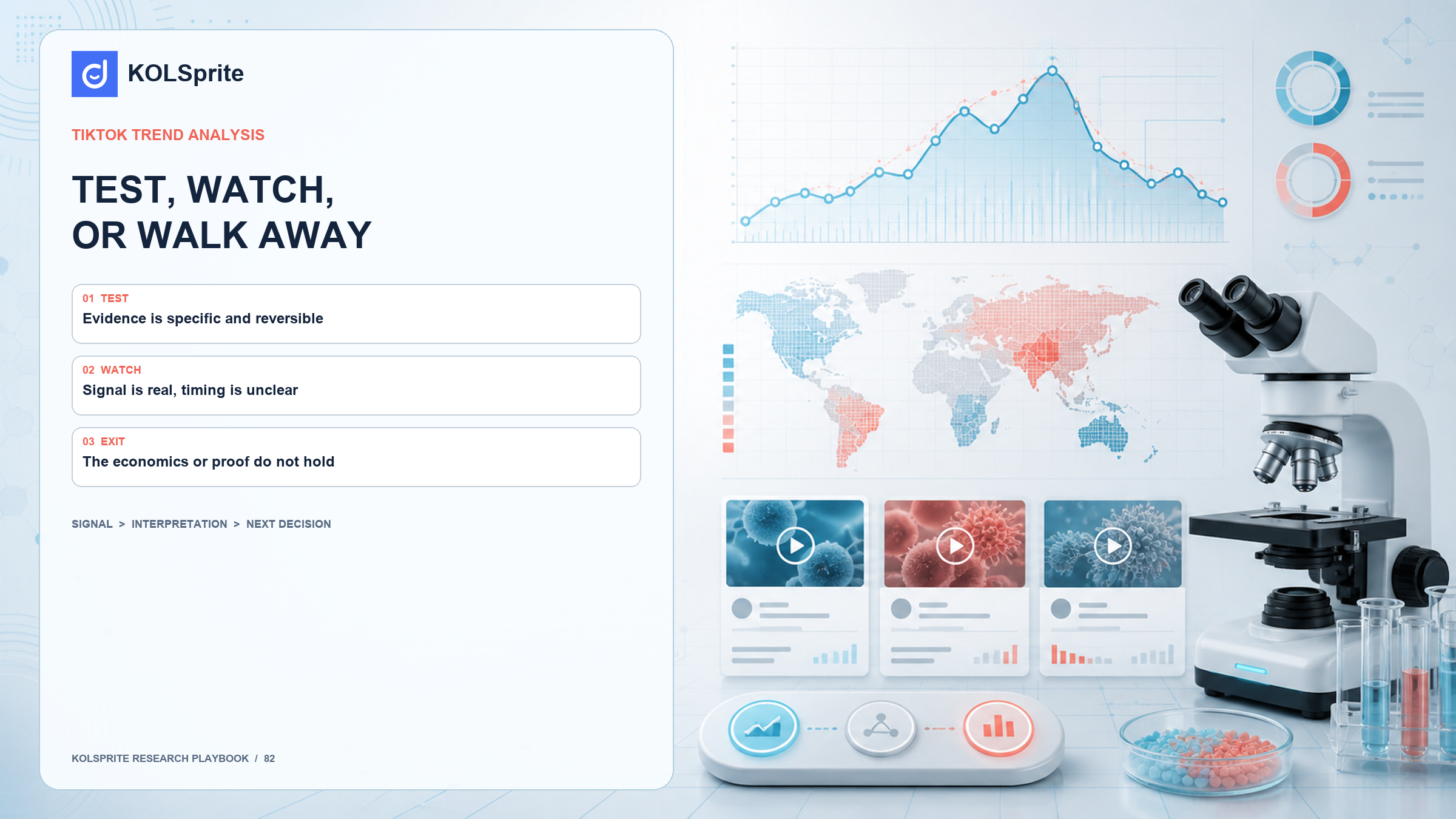
Amazon and Shopify teams often see a topic rise in videos, search, or competitor feeds. Then comes the pressure to act before the window closes. Yet repeated attention does not tell you whether to buy stock, make content, or wait. The signal should become a dated choice: test now, watch until a set review date, or walk away. This article gives you a Trend Stage Map and a short memo. Both separate visible activity from business proof. You will leave with a move you can reverse, not a story about a trend.
TikTok trend analysis is useful when it leads to a choice with an end date. The review starts with three questions. What stage is the signal in? What facts support that view? What would make us change our mind? If the team cannot answer, it is watching, not analyzing.
TikTok’s Creator Search Insights helps creators explore search topics and content gaps. It offers signals, not a demand forecast. TikTok’s Creator Search Insights documentation explains the tool and how it should be used.
A four-stage map keeps the goal on a decision rather than a dramatic label.
| Stage | What you can observe | Practical move |
|---|---|---|
| Emerging | A problem or format appears in a few recent, distinct posts; the explanation is still forming. | Watch closely or run a tiny content probe. |
| Forming | Several creators explain a similar buyer problem, but the use cases vary. | Test one product angle with a defined limit. |
| Crowded | Formats and claims repeat; attention may be real, but differentiation is harder. | Test only if your proof is meaningfully different. |
| Cooling | Recent examples become less frequent, less specific, or mainly repeat old language. | Exit unless another channel supports the case. |
The labels are not forecasts. They make the team state what it saw and what it will do next. A signal may move back or split into smaller uses. It may also look crowded because your sample is narrow. Write the evidence beside the stage so someone can test the choice later.
Every note needs a date, plus the problem shown, the format, and why it matters. A feed full of screenshots with no dates gives the team a mood, not a trail of proof.
A useful review compares recent content with older content. The key is a change in the story, not just a large number. Are more creators joining in? Are viewers asking useful questions? Are people showing the same use, or taking the idea into new settings? A pattern across dates and formats tells you more than one strong post.
For seller choices, platform guides can help you tell discovery from action. TikTok Shop materials describe product and content workflows for sellers. Check the current setup rules before you turn a trend signal into a Shop action. TikTok Shop Seller University is the main source for that platform context.
KOLSprite helps you compare public videos, creator patterns, and content angles in the TikTok browsing flow before you write the test memo.
Register and claim a three-day trial
A product trend does not always create a good creator opening. Ask if enough creators can make the proof clear. The question is not “Are there creators?” There almost always are. Ask instead: “Can a creator show this product solving a real viewer problem in a format their audience knows?”
This is where KOLSprite helps. The work starts with the topic and product question, followed by dated public content and the creators taking part. The saved evidence stays tied to product research, with a clear reason for each possible creator lane. The result is a short research set the team can explain. It can support a test brief or a choice to wait.
When the review date arrives, KOLSprite can reopen that saved public evidence set so the team compares the same question across time. The output is not a forecast. It is a cleaner record of what changed, what held, and whether the next reversible step still makes sense.
Do not turn public activity into a claim about total market demand. Public TikTok activity cannot prove margin, stock needs, future reach, cause, or sales. It can only help you ask a better next question.
A trend should get only the resources needed to learn the next key fact. Set the test limit before you act. It may cover one product version, a small creator set, one content window, or a simple landing-page angle. Do not let one good video set the budget.
Write the boundary in ordinary language. “We can test this with existing inventory and one proof angle, but we will not add a new SKU.” “We will make two creator briefs, then review whether the product can be explained without a discount.” “We will watch for ten days and require three distinct use cases before we make content.”
Teams often confuse a test with a commitment. A small test has a clear stop rule. A commitment changes stock, staffing, or goals before proof exists. Make that difference clear in the memo for the person who approves the work.
Copy this structure into your normal planning document. Keep it to one page.
When you need to connect market proof to creator proof, compare the channel choice first. This look at TikTok Shop versus Amazon can keep the choice from turning into a vague “go viral” request. If the item began as an Amazon bestseller, this guide on moving an Amazon bestseller to a TikTok product story gives you a product-focused view.
Join the KOLSprite Discord to compare test, watch, and exit calls with operators who also need to separate a real opportunity from a noisy spike.
 +
+
Join the KOLSprite Discord community
Use a compact memo after the map. The format is intentionally strict:
Decision: Test now, watch until [date], or exit.
Why: Two dated observations and one unresolved risk.
Smallest useful action: The reversible test or watch task.
Change condition: What evidence would reverse the decision.
Owner: The person who brings the next evidence back.
A watch choice needs a firm date. Watching with no date is a way to avoid a choice. For an exit, state why the signal did not clear the proof or cost limit. That note stops the team from reopening the same idea next month with no new evidence.
TikTok trend analysis fails when it treats attention as a sales forecast. A video can spread because of editing, novelty, a creator bond, debate, or an unrelated news event. The creator and topic may still matter. The evidence still has limits.
Use the method to decide what to test, not to certify an outcome. For query-level validation, pair the map with a disciplined search review such as this guide to TikTok search trends and query validation. Then return to the decision date with new evidence, not a larger pile of links.
The strongest conclusion is often modest: “There is enough recent, repeated proof to test one angle.” That is a good decision because it tells the team what to do, how much to risk, and when to stop.
When a signal comes up in a meeting or shared channel, use the same short path. In the first minute, name the product problem and the signal you saw. In the second, compare a few dated examples and find the clearest proof format. In the third, write the business limit and choose test, watch, or exit. This quick path does not replace deeper research. It keeps a loose talk from becoming an unplanned commitment.
A useful test has a learning goal that people can recognize afterward. “Find out whether a creator can explain the setup in a routine video” is a learning goal. “See if it goes viral” is not. The first can lead to a clean review; the second encourages the team to reinterpret any result as success or failure after the fact.
Make the review date close enough to preserve the original context. A topic can change quickly, and a long delay can leave the team comparing different moments as if they were one trend. At the review, bring back the same evidence fields: date, format, buyer problem, creator supply, and business boundary. Add only the evidence that could change the original decision.
An exit does not mean the topic will never matter. It means the current evidence does not support this team’s next business move. That can save stock, content time, and focus for a clearer opening. State the exit reason in plain terms: weak proof, no sound creator lane, a cost limit, or a signal that is too crowded for your product.
Later, new evidence may reopen the question. A new product variant, a different use case, or a sustained search pattern can justify a fresh map. Start a new map rather than quietly changing the old conclusion. This keeps the team honest about what changed and avoids the familiar cycle of chasing the same idea with a different label.
The method works because it makes uncertainty explicit. A careful watch decision can be stronger than a rushed test, and a clear exit can be stronger than a vague backlog item. The value is not predicting the internet. The value is choosing the next reversible move while the evidence is still useful.
Latest Articles
As an essential, data-driven toolkit for TikTok influencers and marketers, KOLSprite provides powerful features for effortless creator discovery, trending content identification, and actionable real-time insights.
It empowers users to make smarter decisions and significantly boosts their TikTok business.

 Refer & Earn