 +
+
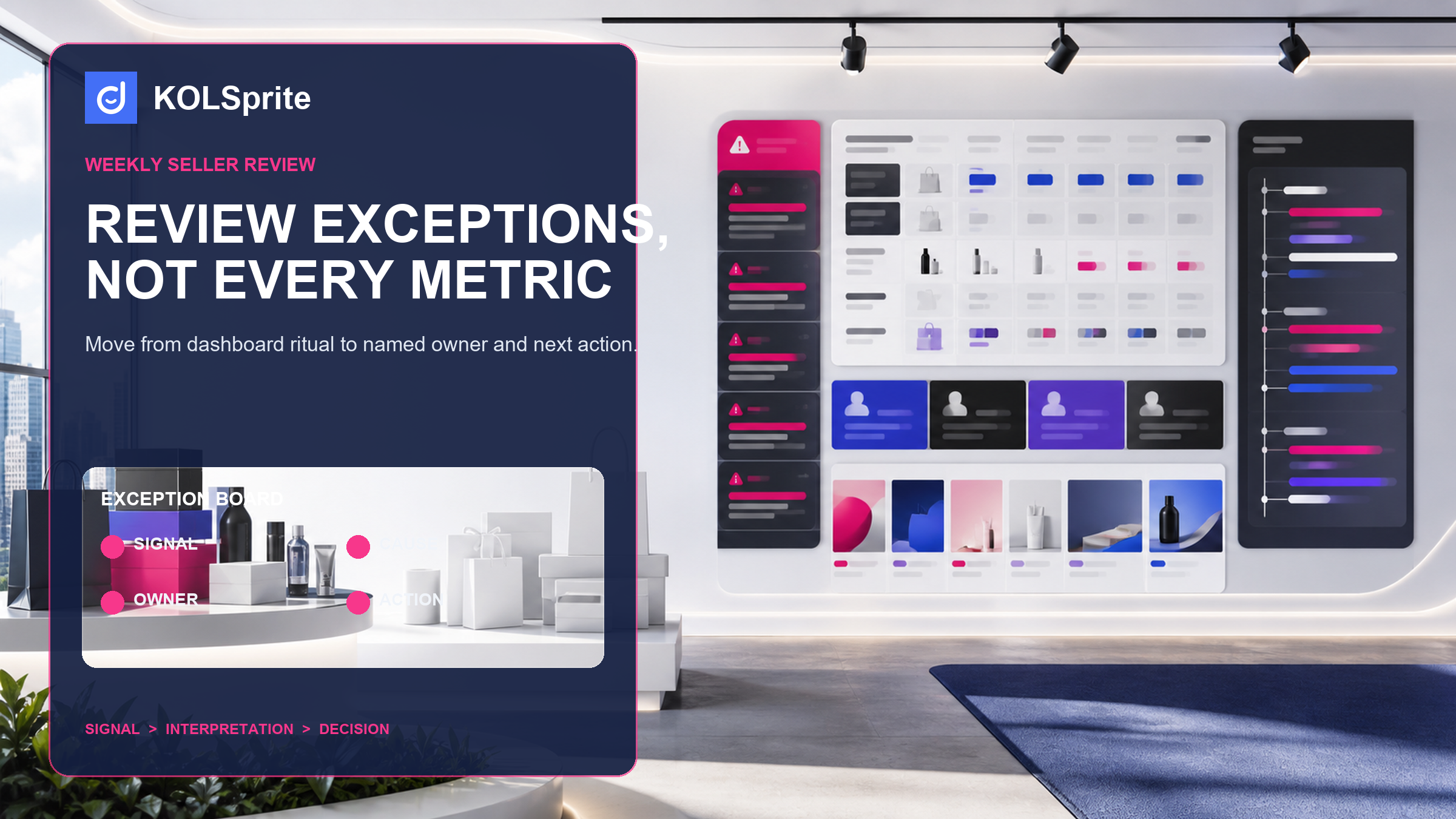
TikTok Shop operators and cross-platform ecommerce leads do not need another dashboard ritual. They need a short weekly list that says which change breaks a baseline, what proof is missing, and who owns the next choice. That is the practical use of TikTok Shop analytics. The direct answer is to review flags, not every metric: check, hold, test, restock with care, or assign an owner. This working brief gives you a Weekly TikTok Shop Flag Brief, a proof check for apparent momentum, and a meeting structure that turns signals into choices without pretending research data replaces Seller Center, finance, stock, or attribution records.
Review only the changes that violate a planned range. Pair each observed flag with corroborating proof, a named owner, a next choice, and a review date. A dashboard without that chain is reporting, not working.
Most analytics meetings start with a wide screen and end with a long list of things someone might look into. The problem is not that the team lacks metrics. It is that the review does not distinguish a number that merely changed from a change that requires a choice. A useful flag is a measurable departure from a baseline the team can state in advance.
For example, a product can show strong 30-day sales and still carry a sharply down 30-day growth field. That does not prove a demand collapse. It does mean the team should not read volume as a complete answer. The next question might be whether a shorter window, product context, partner activity, supply information, or working records point in the same direction. The owner is then assigned a specific check, rather than the whole room speculating about a chart.
Stock and partner choices have deadlines. Reviewing every metric often delays action. A short flag brief highlights uncertain, choice-useful changes while routine monitoring stays where it belongs.
TikTok offers seller-facing business resources, including a TikTok Shop holiday checklist and its Business Help Center. Use useful platform and working sources to confirm actual account, stock, and finance conditions. Research signals should shape questions, not replace them.
Register for KOLSprite and claim a three-day trial to organize supported product, creator, video, and comment context around a seller question.
Register and claim a three-day trial
A flag begins with a planned range or state. “Sales are down” is too loose. “The product's current 30-day signal is high, but its current growth field is sharply down; confirm whether the movement persists before buying stock” is a flag. It states the finding, identifies the conflict, and points to the choice at stake.
Use four kinds of flags in the weekly pass. A momentum flag appears when volume and change move in other directions. A proof flag appears when a promising result lacks enough context to support a choice. An ownership flag appears when an issue has no person assigned to resolve it. A timing flag appears when the next review date would arrive after a purchasing, content, or partner choice is due.
These labels keep the discussion focused. They also make it acceptable to hold a choice. Holding is not inaction when the note says what proof is missing, who will check it, and when the team will return to it.
| Planned range or state | Observed flag | Corroborating proof to seek | Owner | Choice and review date |
|---|---|---|---|---|
| Volume and change should tell a consistent story | High 30-day volume with a sharp recent decline | Current 7-day signal, record context, and working records | Named operator | Check, hold, test, or restock with care |
| Product signal should be useful to the current question | Record is high ranking but context is unclear | Product, linked partner, and linked video context | Research owner | Check or reject by the next review |
| Action should have a choice owner | Signal is discussed without a responsible person | Choice record and working deadline | Team lead | Assign owner and date |
Scope: weekly flag-review workflow for TikTok Shop research signals. Market: United States seller-operations review. Access date: 2026-08-31. Sample: five KOLSprite product-search records for home organization, sorted by 30-day sales descending. Cleaning: 7-day and 30-day sales, growth, rating, review, linked partner, and linked video fields retained when current. Limit: fields vary by record and refresh window; the sample is a flag-review example, not a category forecast or an working record.
The observed product sample exposed sales, growth, rating, review, linked partner, and linked video fields, though fields can vary by record. Its high-volume storage-bag result with sharply down 30-day growth is the exact kind of contradiction a weekly flag review should surface. It is a lead for check, not a forecast and not an automatic stock instruction.
Its proof column must be specific. Do not write “check more data.” Name the next source or comparison that could change the choice. For the high-volume, down-growth example, compare the current short-window signal, product record context, and linked partner or video context in the research surface. Before acting, reconcile the finding with Seller Center, finance, stock, and attribution records.
This sequence prevents two common mistakes. The first is treating a ranked result as a confirmed opportunity. Research rankings are leads, not business choices. The second is dismissing an uncomfortable change because a headline number remains large. Both errors come from allowing one field to close a question that needs corroboration.
Keep wording disciplined. “Observed in this record” is better than “the market is declining.” “Check before replenishment” is better than “do not buy.” The first pair reflects bounded signals and a choice process. The second pair pretends the current fields can make a complete stock call.
First minute: choose the planned state. It may be a range the team already watches, a relationship between current fields, or a deadline that cannot slip. Do not start by scanning every tile on a dashboard. Start with the baseline whose failure would change an action.
Second minute: record the observed flag and the corroboration needed. Search supported product, shop, video, and partner records as useful, compare current time-window and supply fields, and retain a scoped note. KOLSprite can help a configured AI client call supported MCP tools and organize research leads. It does not make the stock, spend, or partner choice for the business.
Third minute: name the owner, action, and review date. Check when the signal is meaningful but incomplete. Hold when the choice cannot wait for better proof. Test when a contained action can reduce uncertainty. Restock with care only after the useful working records support it. Assign an owner when the next check is clear but currently unowned.
A practical weekly meeting should end with a short list of these records. A long dashboard review creates the appearance of control. A finished flag brief creates a record of what will happen next.
Join the KOLSprite Discord to discuss seller signals, evidence limits, and the next test worth assigning.
 +
+
Join the KOLSprite Discord community
KOLSprite research signals can expose product, shop, video, and partner records and help form a bounded flag note. The fields vary by result, definition, market, and refresh window. Rankings are research leads. Those limits should stay with the note as it moves from analyst to operator, especially when a result will be used near an stock or budget discussion.
Do not replace Seller Center, finance, stock, attribution, or other working records with public or research-visible signals. A strong flag brief separates the research finding from confirmation needed for the choice. This is not needless administration. It keeps an outside signal from becoming the system of record.
For product context, separate momentum from demand. For a more focused buying discussion, ask five questions before buying stock. Both are most useful when the flag note already names what the research can and cannot support.
The existing article URL had 499 GSC impressions, zero clicks, and an average position near 28.95 in the dated 2026-08-24 compact snapshot. DataForSEO reports 260 US monthly searches for the exact term as of this brief. Those figures describe a refresh opportunity; they do not establish why the page underperformed or guarantee a new outcome. The better response is to give a searching operator a usable choice method rather than another list of platform features.
This is the memorable working rule: a flag is a question with an owner. It has an planned state, an observed departure, the next corroborating proof, and a date when the team must decide. Without the owner and date, even a sharp finding becomes another tab left open after the meeting.
Close the review by removing resolved items and carrying forward only flags whose missing proof is still choice-useful. That discipline keeps TikTok Shop analytics connected to action rather than turning into a growing archive of screenshots. A result that has been confirmed, rejected, or assigned should leave the front of the queue.
Connect the working brief to earlier and later choices. Add an analytics flag path when reviewing top-selling products, and connect trend durability to weekly flags when a trend signal appears to require more time. For an initial product gate, reject or test a product before stock. The weekly review earns its place when it turns uncertain movement into a named next action before the choice window closes.
Latest Articles
As an essential, data-driven toolkit for TikTok influencers and marketers, KOLSprite provides powerful features for effortless creator discovery, trending content identification, and actionable real-time insights.
It empowers users to make smarter decisions and significantly boosts their TikTok business.
 Refer & Earn