 +
+
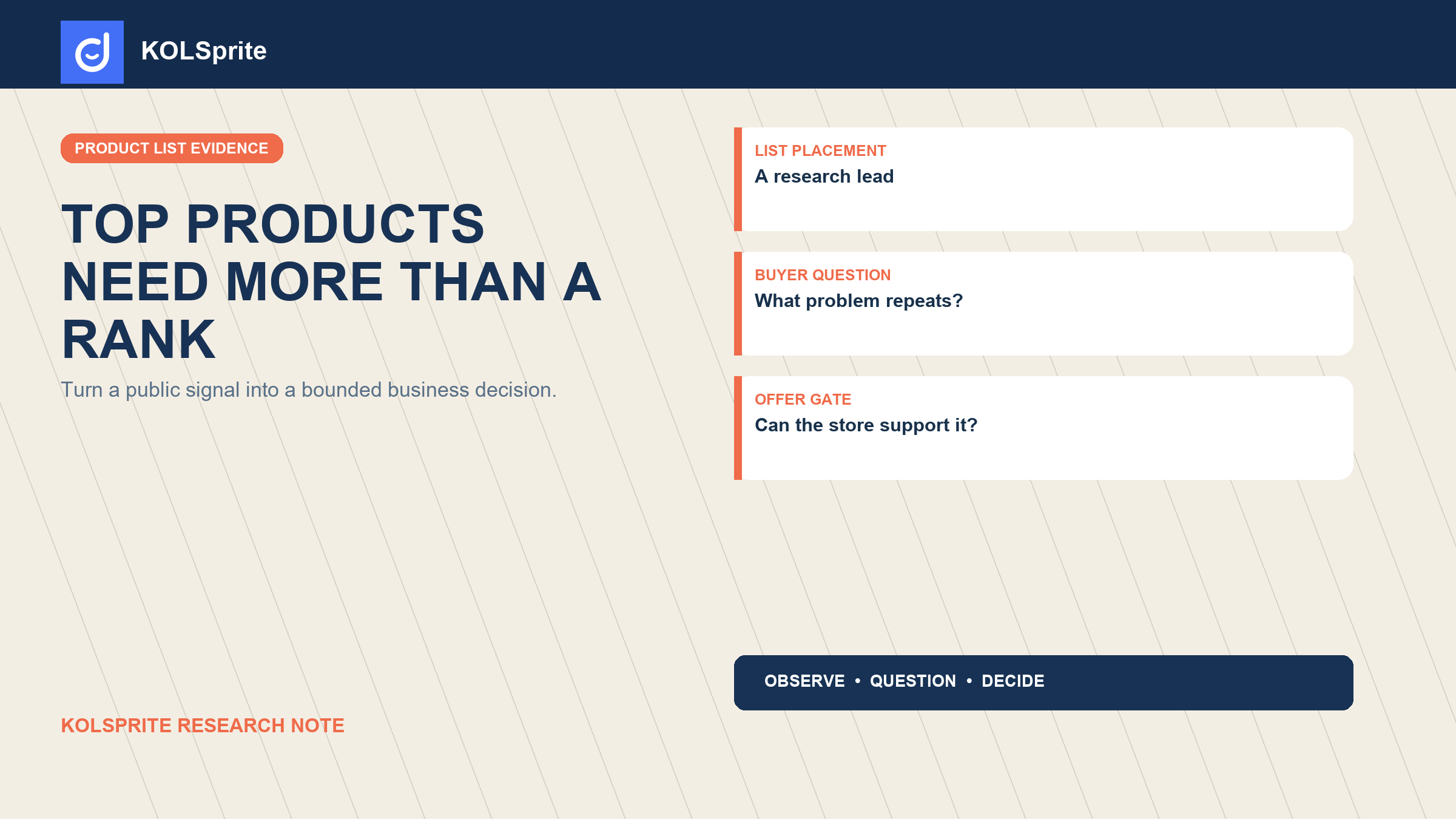
A list of top selling TikTok products is tempting because it appears to shorten product research to one scroll. For an Amazon or Shopify team, that is usually the wrong decision. A list can show that a product is visible. It cannot tell you why buyers cared, whether the offer works in your market, or whether the product can earn a useful place in your catalog. This article gives product teams a Product List Evidence Card: a small way to decide whether a list item deserves more work or should stay a lead.
Ten-second answer: Use a product list to find candidates, then test four separate facts: the buyer situation, the demonstration, the offer constraint, and the missing proof. Advance a product only when the four facts point to a real next question.
Most product lists collapse several signals into one rank. The rank may reflect views, sales claims, affiliate activity, or editorial selection. Those are not the same thing. A product manager needs to know what the list actually measures before treating it as a business signal.
The practical move is simple: copy only the product name and the page or post that surfaced it. Do not copy the conclusion. The moment a product enters a research sheet, the team should replace the list's broad claim with a question it can investigate.
A tumbler, a light, or a storage item can look popular while serving very different jobs. Ask what situation the video makes visible. Is the buyer trying to save space, avoid a mess, compare a replacement, or make a small routine easier? The situation gives research a direction that a category label cannot.
This is where a list item often becomes less exciting but more useful. If the public content cannot show a believable buyer moment, there may be no reason to spend another hour on it. A product does not need a dramatic story. It needs a clear problem it can credibly help solve.
Register for KOLSprite and claim a three-day trial to keep the public list, the buyer moment, and the offer checks in one reviewable note.
Register and claim a three-day trial
A good TikTok demonstration can show that a product is easy to understand in a few seconds. That is valuable. It can also hide a lot: setup time, product quality, repeat purchase, or whether the scene is unusual. Treat the demonstration as evidence about communication, not as proof that the product is commercially safe.
KOLSprite can help a team keep the public video, its captions, and the surrounding comment context close to the product note. That makes it easier to reopen the source when a teammate asks why the candidate was added. It does not turn public content into an inventory forecast.
Comments can be more useful than praise when they reveal friction. A question about size, compatibility, cleaning, shipping, or a missing feature may point to a better product angle. It may also show that the visible product is hard to support with a straightforward offer.
Do not count comments as a poll. Read a small set in context and write the question in plain words. The aim is not to find a perfect percentage. The aim is to identify what a product page, supplier call, or next content test would have to answer.
| What you can observe | What it may mean | What it cannot prove |
|---|---|---|
| A product appears on a list | It may deserve a closer look | Repeat demand or margin |
| Several videos show one use | The use is easy to demonstrate | The use is the buyer's main job |
| Comments repeat a question | The question is worth checking | A listing claim is true |
Source scope: public list, video, and comment context reviewed as research leads on the access date. For platform trend surfaces, compare the result with TikTok Creative Center. Public context does not prove stock, margin, safety, or future sales.
A strong video idea cannot repair a weak offer. Before a candidate advances, check the facts your own team controls: landed cost, shipping limits, variants, returns, availability, and the claim a listing can honestly make. This is often where a list product should pause.
The Product List Evidence Card keeps the public clue and the internal offer fact apart. That separation prevents a familiar error: a researcher sees a compelling use case and assumes the seller can reproduce the same buying conditions.
Join the KOLSprite Discord to compare product leads, disconfirming signals, and the questions that keep a list from becoming a rushed buy decision.
 +
+
Join the KOLSprite Discord community
The card should end with one decision. Research further when the buyer moment is clear and an offer question can be checked. Park the idea when the visible signal is interesting but the conditions are not ready. Reject it when the list is doing all the persuasive work.
KOLSprite fits at the research stage because it helps organize supported public product, video, and comment context. The final product, supplier, and financial decisions remain human work. That boundary makes the note more useful, not less.
Trend lists move quickly. A recorded evidence card gives the team something more durable: what it observed, what it inferred, what it still needed to know, and why it chose the next action. That is enough to make later research cumulative instead of starting from a new list every week.
Before you add the next product to a shortlist, ask one question: if the list disappeared tomorrow, would this candidate still have a reason to be here? If the answer is no, it is still a lead, not a product decision.
Give the card four boxes. In the first box, write where the item appeared and what the surface actually ranked. In the second, write the buyer moment shown in the clip. In the third, list the offer facts your team must check. In the last, write the next decision. This is enough. The card is not a forecast sheet. It is a way to keep a popular item from getting a stronger conclusion than the source can support.
A team can make the card in ten minutes. One person saves the list entry and two representative clips. Another person reads a small number of comments for questions, not votes. A store owner adds the facts about price, shipping, variants, and the product page. The goal is not to make all four people agree that the product will sell. The goal is to see whether they are talking about the same opportunity.
For top selling TikTok products, the strongest card often contains one uncomfortable detail. The product may look good on camera but require a fragile fulfillment promise. It may solve a clear problem but only at a price that changes the offer. It may have a great demonstration but no honest point of difference. That detail is not a flaw in the research. It is the reason to slow down before a buyer-facing claim or an inventory order is made.
Use a simple decision label at the bottom: investigate, wait, or reject. Investigate means the buyer moment is clear and there is one fact worth checking. Wait means the public signal is real but an internal condition is not ready. Reject means the rank or clip is doing all the work. The labels let a product team move quickly without turning an early lead into a commitment.
The next review should start with the card, not the original list. Ask what changed since the last check. Did the buyer situation show up in other settings? Did the offer fact become clearer? Did a product page test answer the question? When the answer is no, the right move may be to close the note. Good product research does not need every lead to survive.
There is also a team benefit. A visible card gives a buyer, a researcher, and an operator a common object to review. It lowers the chance that one person remembers a clip as proof while another remembers it as a loose idea. Use the card at the start of a short review meeting. Read the observed facts first. Read the missing facts next. Then choose one owner and one deadline, or close the lead. That routine is faster than reopening the same popular list whenever the team needs a new idea.
A card can also travel well between teams. The person who found the item does not need to write a long handoff. The person who checks supply does not need to replay every clip. Each can add the fact they own. When the note is complete, the team can decide with a small shared record instead of a chain of messages. That makes the next review calmer and the decision easier to explain later.
Continue the research: reject a hot product before inventory · Amazon product validation on TikTok · use comment analysis to challenge a product lead.
Latest Articles

As an essential, data-driven toolkit for TikTok influencers and marketers, KOLSprite provides powerful features for effortless creator discovery, trending content identification, and actionable real-time insights.
It empowers users to make smarter decisions and significantly boosts their TikTok business.

 Refer & Earn