 +
+
Amazon sellers often turn to TikTok after a spreadsheet narrows the field. They do this before placing a larger stock order. If that is your decision, this guide gives you a clear answer: use TikTok to test whether buyers and creators can explain the product story, not to predict Amazon sales. The walking-pad case ends with a go, hold, or reject memo for your stock meeting.
Your first move is to write the conditions for each decision before you search. Reject the idea if the product has no clear buyer problem or honest visual proof. Hold it when the story looks useful but margin, compliance, returns, or supply facts are missing. Run a small test when several creators can show the same useful moment without making claims the Amazon listing cannot support.
The walking-pad evidence supports a small creator test, not a larger purchase order. KOLSprite found one useful product, its shop, and 1,055 linked videos. Several creator examples focused on desk routines, storage, and daily movement. That is enough to show that the category can be explained in more than one way.
It is not enough to show that this Amazon seller can win. The TikTok Shop snapshot does not show Amazon return rates, landed cost, or listing sales. It also cannot show if the same offer works at the seller's price. The useful decision is therefore test: brief three creators around three different buyer situations, cap the spend, and expand inventory only if one story produces qualified traffic and survives the Amazon checks.
A TikTok story can earn a test. It cannot earn a purchase order.
Most Amazon product research begins with a spreadsheet of categories, price points, reviews, and competitors. That is necessary, but it does not explain what a person would say about the product on camera. TikTok research fills that gap when the seller defines a decision first: reject, hold, test one angle, or build a launch plan.
For a walking pad, the decision is not whether people know the category. The test should focus on one buyer problem: a desk-bound workday, limited apartment storage, a low-impact routine, or a daily step goal. A generic product page that lists motor power and dimensions will not answer that question by itself.
| Signal | What to inspect | Decision use |
|---|---|---|
| Buyer problem | Which daily friction is shown in the first seconds? | Choose one opening promise for the test. |
| Proof mechanism | Can the creator show size, noise, setup, storage, or routine? | Avoid claims that need unsupported proof. |
| Comment demand | Are people asking price, fit, durability, shipping, or alternatives? | Turn recurring questions into listing and brief copy. |
| Creator supply | Can several relevant creators show the item naturally? | Use a small creator group instead of relying on one breakout post. |
The first result in the US search for "walking pad" was a mouse pad. That wrong answer was more than a cleanup detail: it showed how quickly a broad trend search can create false confidence when relevance is assumed. We removed it, selected the Freepi walking and vibration pad, product ID 1730148164700967336, and followed that exact item into its shop and linked videos. The recommendation became narrower as the evidence became cleaner.
| Item checked | What we saw on July 22, 2026 | Why it helps |
|---|---|---|
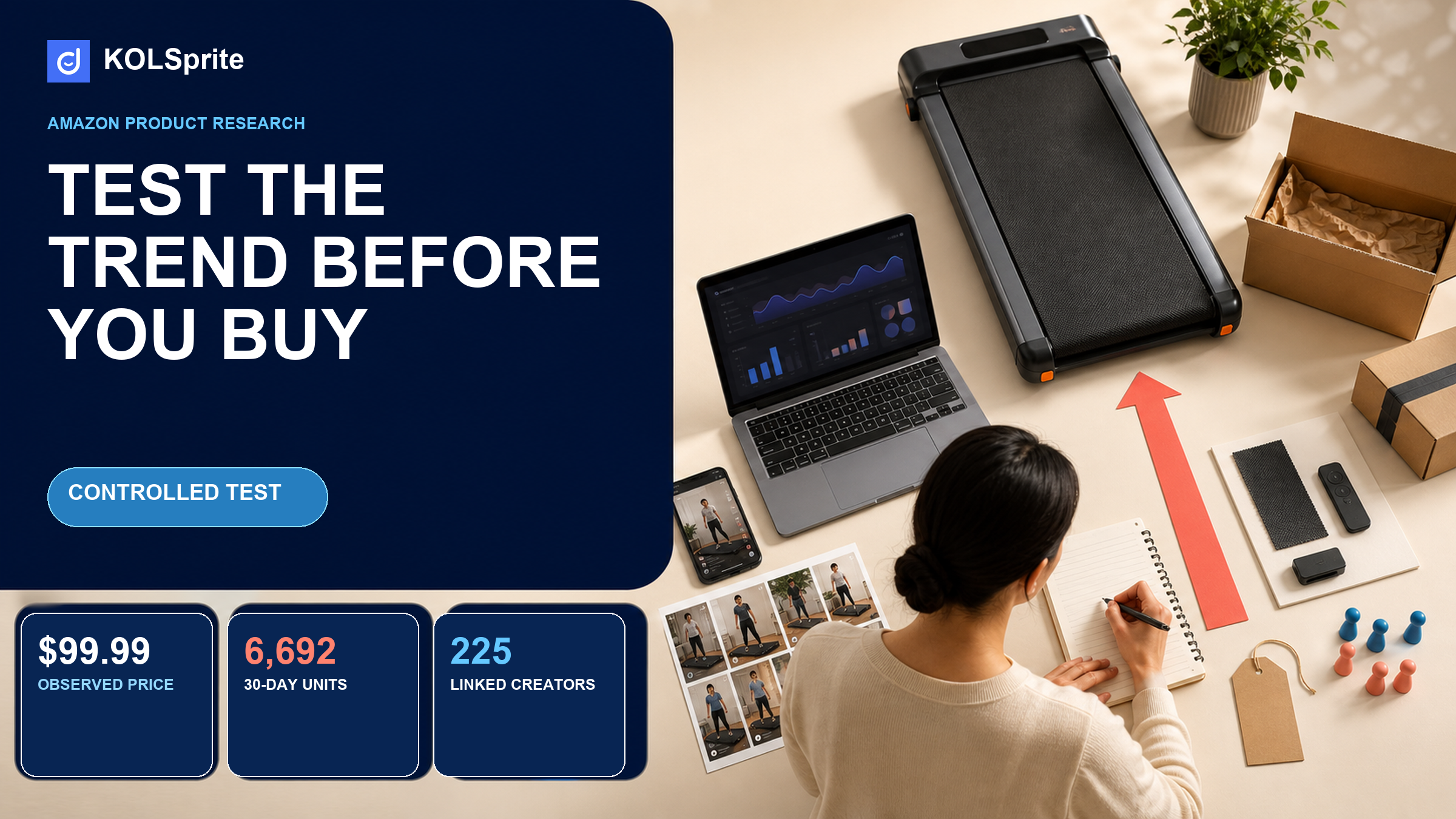
| Product | $99.99 price, 6,692 recorded 30-day units, 1,485 reviews, 225 creators, and 1,055 linked videos | Shows enough product and video activity for a closer look |
| Shop | Freepi, 25 products, a 4.5 rating, and 7,975 recorded 30-day units across the shop | Adds shop context without treating one item as the full business |
| Five linked videos | 2.0 million to 8.9 million plays, 7 to 54 seconds, and creators with about 4,100 to 11,900 followers | Shows video ideas based on storage, routine, step goals, and moving the pad |
The linked videos show several ways to explain the same item. Some focus on a daily routine. Others show storage or moving the pad. This gives a seller several ideas to test. It does not prove that the item will sell on Amazon or that a creator is ready to work with the brand.
Product, shop, and video numbers should stay separate because they may cover different time periods and may not mean the same thing. Their purpose is to sharpen the next questions. Can more than one creator show the benefit? Does the shop depend on this one item? Is the product easy to explain?
Amazon must supply the facts TikTok cannot. Its Product Opportunity Explorer includes search, purchase, review, and return signals that belong in the stock decision.
Research snapshot. KOLSprite product, shop, and product-linked video searches; US market; accessed July 22, 2026. One relevant product, its shop, and five linked videos were reviewed after removing a false-positive mouse-pad result. Recorded fields are directional snapshots, not audited revenue, Amazon demand, or future performance.
The evidence trail begins in KOLSprite product search, where unrelated items are removed before any numbers are compared. A useful result leads to its shop and then to TikTok video search for videos linked to that exact item. This keeps the product, shop, creator, and video story in one research path.
For each good example, write down four points: the buyer's situation, what the creator shows, the main buyer concern, and what the product page must explain. The Amazon-to-TikTok product workflow gives you a simple way to organize those notes. The team still needs to check claims, creator fit, safety, costs, and stock risk before moving forward.
A video you reject can teach you as much as a video you keep. It may have many views because of a special home, a very low price, a risky claim, or a creator style your brand cannot copy. The review should record that problem beside the good hook.
Use a research table for every video you keep. Add the buyer moment, the demo, the common question, the business idea, and the reason the idea may fail. Add a related Amazon review theme when one is available. This helps the team compare an attractive TikTok story with real product problems such as returns and support needs.
A review date belongs on the calendar before the next stock order. At that point, the team compares the first idea with the test result, notes which demo was clear, which buyer question kept appearing, and which page answer was missing, then decides whether to stop, revise, or run one more test.
Stop when the best video idea needs a claim you cannot prove. Stop when creators need unusual conditions to show the benefit. Stop when the real costs leave too little profit. Rejecting a weak idea early saves money for a better product.
The research becomes useful when it fits into a one-page note before the team meets. The note begins with the product idea and buyer problem, followed by the strongest video pattern, one warning example, the cost of a small test, and a clear reason to stop. A board full of attractive videos cannot make that choice for the team.
The same note should list what TikTok cannot answer. This includes shipping damage, long-term quality, Amazon rules, supplier risk, and profit at the real selling price. Placing those checks beside the TikTok findings shows what the team knows, what remains unknown, and what must be checked next.
Different teams need different parts of the same research. The product researcher needs the buyer problem and category context. The sourcing team needs packaging, safety, cost, and shipping checks. The creator lead needs a simple demo that several creators can repeat without making a false promise. One shared brief keeps those needs together instead of sending a folder of links.
Write the recommendation as a clear if/then rule. For example: test the desk-routine idea only if the listing shows storage size, the creator can film in a real home, and the margin can support the offer. This rule shows exactly what must be true before the team spends more money.
Many videos do not always mean there is a strong product opportunity. They may only show that the category is easy to copy. The stronger opportunity is a story your product can prove more clearly, a buyer question others do not answer, or an offer that works at your costs.
| Decision factor | Current evidence | Decision |
|---|---|---|
| Can the product be demonstrated? | Yes. Selected videos show setup, storage, moving the pad, and desk use. | Pass for a creative test. |
| Is there more than one usable angle? | Yes. Routine, small-space storage, and step-goal stories all appeared. | Test three angles instead of copying one hit. |
| Is creator supply obviously limited? | No. The product had hundreds of linked creators, including smaller accounts with high-play examples. | Shortlist creators by demo fit, not follower count. |
| Does TikTok prove Amazon demand? | No. Channel economics, reviews, returns, and listing conversion remain unknown. | Do not expand inventory yet. |
| What would change the decision? | A repeatable creative angle plus acceptable Amazon unit economics and return risk. | Review after the first controlled test. |
This table is the meeting document. Sourcing can challenge the product risk, content can challenge the proof, and finance can challenge the size of the test. The decision is not whether the clips look exciting. It is whether the next unknown is cheap enough to answer before the next stock order.
Bring the landed cost, expected Amazon fees, return risk, sample and creator cost, and the largest loss the team will accept. The TikTok evidence can justify a small story test. It cannot fill those five cells. This is where Amazon product research on TikTok earns its place: it narrows the creative unknown without pretending to finish the financial case. If one cell is still blank, keep the inventory decision on hold and assign an owner before the meeting ends.
Create a KOLSprite account and claim a three-day trial membership. Use the trial to research products, inspect linked videos, and check the evidence before you act.
Register for a three-day KOLSprite trial
Bring the product, the three proposed video angles, and the Amazon constraints to the KOLSprite Discord community. A second seller may spot a cost, claim, or creator-fit problem before it reaches the purchase order.
 +
+
Discuss the walking-pad test plan on Discord
The same decision memo works for products beyond walking pads when the cost of a bad inventory call is meaningful. For a beauty device, replace storage and noise with setup, skin-contact rules, and claim safety. For a kitchen gadget, inspect cleanup, counter space, and whether the result is visible on camera. For bulky home goods, keep delivery, returns, assembly, and room fit near the top of the memo.
The decision logic stays the same. Name one buyer problem and find several honest examples. Keep rejected clips, and separate the TikTok story from the Amazon math. The type of proof will change. A visual organizer may need a simple before-and-after. A product with safety risks may need formal proof that no creator video can replace.
The first pass can fit into 30 minutes: ten minutes to narrow the exact product and shop, ten minutes to review a small set of linked videos, and ten minutes to write the memo. That time box is for deciding whether deeper research is worth doing, not for approving inventory on its own.
Run a small three-angle creator test and keep the next inventory order unchanged. That is the role of Amazon product research on TikTok. The walking pad has earned a test. It has not earned more cash for stock. Move from test to expansion only when one angle produces useful traffic, the listing answers the same buyer problem, and the real Amazon margin can absorb returns, creator cost, and shipping.
Latest Articles
As an essential, data-driven toolkit for TikTok influencers and marketers, KOLSprite provides powerful features for effortless creator discovery, trending content identification, and actionable real-time insights.
It empowers users to make smarter decisions and significantly boosts their TikTok business.
 Refer & Earn