 +
+
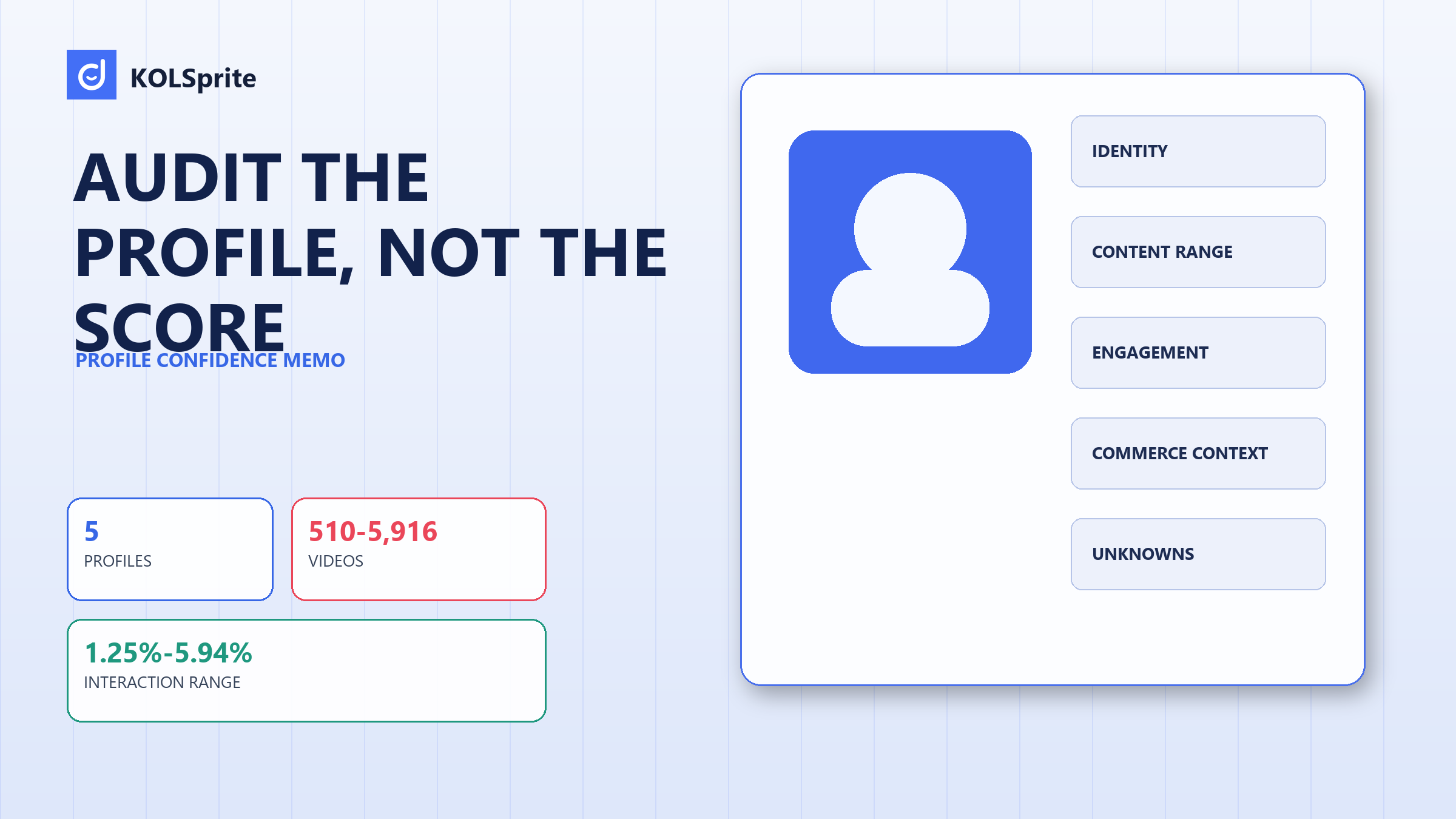
Before a creator partnerships lead moves a promising-looking account into review, one choice comes first: should this profile move into a content-fit review, or should it leave the first list? A TikTok profile analyzer is useful when it narrows that next review set. It is not useful when it turns a follower count or a single score into a verdict. The usable result is a one-page Profile Confidence Memo: account match, scale, posting pattern, commerce context, what is still unknown, and the person who owns the next check.
Ten-second answer: keep the account only when the public profile gives a coherent reason to inspect its content. Mark every missing field. A clean question is more valuable than a confident score built from partial public fields.
Teams often inherit a spreadsheet of handles, a screenshot, and a rush to send outreach. That is enough to make a profile look real, not enough to decide that it fits a campaign. The danger is subtle. A large audience can hide an old posting pattern. A strong response number can sit beside content that has little link to the buyer problem. Product-related activity can appear without showing whether the creator is currently available or interested.
That is why the first pass should be narrow. Do not ask, “Is this a good creator?” Ask, “Does the public record support another review slot?” TikTok describes creator marketing as a way for brands to work with creators. Still, a working relationship needs a fit review beyond the public profile. TikTok's creator-marketing guidance sets a useful limit. Discovery starts the review. It does not finish it.
A TikTok profile analyzer should therefore create useful friction. It should make the team write down what is observed, what is inferred, and what remains unknown before a profile becomes an outreach account.
A score compresses several other questions into one tidy number. Account match asks whether the account is the account you think it is. Scale asks how much public reach is visible. Match asks whether there is a current body of relevant work. Commerce context asks whether product-related work appears in the returned context. None of those fields proves the others.
Compression also hides the action. A team cannot tell whether a low result means “remove this account,” “watch three recent posts,” or “confirm the brand-safety requirement with the campaign lead.” When the output is a score, the team tends to discuss the score. When the output is a memo, the team can assign a check and move on.
Use public metrics as context, not as proof of future results. The account may have private audience details, availability constraints, paid support, or content changes that a returned profile cannot show. Those gaps are not defects in the memo. They are the reason to have one.
| Observed field | Range across five returned creator rows | Decision use |
|---|---|---|
| Search context | “tech” | Start a review set, not a category verdict |
| Returned rows | 5 | Keep the review bounded |
| Market | US | Keep the interpretation in the sampled market |
| Profile context | Observed returned creator context | Compare identity, visible scale, consistency, and commerce signals |
| Unknowns | Availability, private audience data, fit, and outcome | Assign manual checks rather than fill gaps with a score |
Scope: returned creator context from a bounded creator search. Market: US. Access date: 2026-09-01. Sample: 5 US creator-search rows for the tech query on page 1. Cleaning: scoped sample retained as returned; no ranking or endorsement. Limit: public profile fields are incomplete and time-sensitive and do not show private data, fit, availability, or campaign outcome.
The table is deliberately small. Its value is not a market estimate. It shows why the team needs five separate rows in the memo. A profile can clear the account match check while still needing a recency check. Another can show useful work while leaving response context unclear. The next move changes with the missing field.
Register for KOLSprite and claim a three-day trial to search creators, compare returned profile, content, engagement, and commerce context, then open a manual content-fit review.
Register and claim a three-day trial
Account match is the anchor. Record the handle and the account match proof shown in the returned context. If brand, niche, or account match is unclear, do not repair it with assumptions. Flag a manual profile check.
Content volume and age question is not a posting score. Write the practical question that the team needs to answer: is there a recent enough body of work to assess content fit? This preserves the difference between a public account and an active campaign account.
Response context keeps public interaction from becoming a promise. Note the context that is returned, then ask whether the useful content appears to earn attention in a way worth inspecting. Do not project that finding onto a future sponsored post.
Product work context shows whether the returned context gives a reason to review commerce or product-related content. It does not prove product results, audience response, or a creator's willingness to work with a brand.
Proof still missing and next owner turn doubt into work. One missing field should have one named owner: deal lead for fit, brand lead for claim boundaries, or a team for recent-content fit. A memo with no owner is only a better screenshot.
Imagine that a lead is choosing between two accounts from the first review list. The first has a clear account match and visible product-related context, but the returned record leaves recency unclear. The second has visible scale, but no clear niche link. The first account earns a content review because the missing item is specific and cheap to check. The second may leave the set until a useful reason appears.
Neither choice says that the first account will perform or that the second account is weak. It allocates limited team time. That distinction matters when an outreach list has to be defensible to the campaign lead later.
A useful Profile Confidence Memo might read: “Account match appears consistent with the account under review. Shown scale and response context warrant a content-fit check. Product work is present in returned context. Missing: recent useful posts and campaign availability. Next owner: deal lead.” It remains short because it is designed to cause one next action.
Once the memo tells you what must be checked, use KOLSprite to search and compare returned creator context, then manually inspect content fit before outreach. That workflow supports a documented review shortlist; it does not issue a risk score or a performance score. Start with the job-based framing in this TikTok influencer marketing strategy guide, then keep response in context with the engagement interpretation card.
The workflow should preserve the review trail: why the account entered the set, which fields were observed, which field is missing, and who checks it. That record prevents a later team from mistaking a search result for a final decision.
Public profile fields are partial and time-sensitive. They do not provide private data. They do not guarantee content fit, creator availability, or a campaign result. A manual review may also need to assess audience alignment, brand requirements, claims, paid usage, and outreach status. Keep those checks outside the profile signal rather than implying they are already resolved.
KOLSprite is useful at this earlier stage because its returned context starts a review record; the human team still owns private checks and outreach.
The limit is practical, not rhetorical. When a team treats a profile output as proof, it can skip the very review that protects the shortlist. When it treats the output as a bounded input, it can use the same proof without pretending to know more than it does.
Join the KOLSprite Discord to compare the evidence limits and the next test with other ecommerce operators.
 +
+
Join the KOLSprite Discord community
After the memo, the next choice is simple: deepen the review, park the account, or remove it from this campaign's first list. A profile with a clear account match and a specific missing check may deserve a deeper look. A profile whose fit is still a guess should not consume an outreach slot because its score is attractive. For campaign learning, carry the documented shortlist into a creator campaign learning system. The aim is not to turn doubt into false trust. It is to make each next check explicit, proportionate, and owned before a message goes out.
That last choice is where the memo earns its space. “Deepen” means the account has a concrete review question with a proportionate next check, such as inspecting recent useful content. “Park” means there is not enough reason to spend time now, but the proof does not support a permanent exclusion. “Remove” means the returned context does not support this campaign's initial fit question. These are staffing decisions, not quality labels attached to a person. Keep the memo beside the outreach record rather than replacing it with a final status. A later campaign may have another buyer problem, product niche, or claim limit. The same account can receive another review choice under another brief without making the earlier memo wrong. What must remain stable is the distinction between observed public context and the private or campaign-specific facts that were never available in the first place.
That discipline also helps when a stakeholder asks why a recognizable account is not on the list. The answer should be evidence-based and modest: the first pass did not establish the niche fit or current-content question needed for this campaign. It should never imply that the creator lacks value, has no audience, or cannot perform. A shortlist is a working hypothesis about where review time belongs. When the team later compares outcomes, keep the original memo, choice date, and owner. The campaign lead can then see whether the initial doubt was resolved. They can also see whether a manual content review changed the choice or revealed another unknown for future first-pass reviews. A past outcome still does not prove that public profile fields predicted it.
Use the memo as a guardrail against a familiar failure: a fast list grows until no one can explain why any account is on it. The better list may be shorter, but each row has a reason to exist and a question that can be answered. That is enough to decide where the next human review belongs. In this role, a TikTok profile analyzer supports a choice record, not a verdict. The memo should also make handoffs easier. A deal lead can tell a content team exactly why the account is under review. A content team can return a focused finding instead of an unstructured opinion. A campaign lead can decide whether that finding changes the shortlist. The same short record travels through those steps without pretending that it contains a final decision.
There is a cost to this restraint: some attractive accounts will remain uncontacted until a useful question is answered. That cost is usually smaller than broadening a list with accounts the team cannot defend or brief. The memo gives speed a defined limit. It allows the team to move quickly on clear proof while keeping the unknowns visible when they still control the choice.
Latest Articles
As an essential, data-driven toolkit for TikTok influencers and marketers, KOLSprite provides powerful features for effortless creator discovery, trending content identification, and actionable real-time insights.
It empowers users to make smarter decisions and significantly boosts their TikTok business.

 Refer & Earn