 +
+
When an Amazon seller sees returns on a product that needs a demo, the useful choice is the buyer question the listing and creator demo should answer first. TikTok videos cannot explain an Amazon return rate. But public demos can reveal promises, framing, and proof gaps worth testing against the seller's actual return reports. The result is a Demo Gap Map. It links one logged return reason to one buyer question, one demo proof job, one listing proof job, and one owner.
Ten-second answer: keep Amazon return proof and TikTok demo proof separate. Use the return reason to choose the question. Use the video to see whether the question is clearly shown, then test the change against the actual Amazon reports.
When returns rise, the pressure is to blame the item, the listing, or the creator who showed it. That shortcut skips the proof that matters most: the account-level reason logged for the return. Amazon's customer-facing return guidance describes the return process and its conditions. It does not turn a public video into a cause of a returned order. Amazon's return guidance is a useful reminder that policy and actual return reports belong in the seller's own review.
The content question comes after that record. If buyers expect easy storage, did the listing and demo show what that looks like? If they expect a particular feature, did the proof show how it works? The right answer may be a listing change, a demo change, a quality check, or no content change at all.
The first stream is the seller's Amazon data: return reasons, costs, quality notes, and policy checks. The second is public TikTok signals: titles, length, plays, and repeat themes. The first tells you which buyer question needs attention. The second can show what a demo makes easy to imagine and what it fails to show.
Do not merge them into an implied causal line. A high-play demo does not prove a return driver. A product with a return issue does not prove that creators created the question. A Seller Central forum talk can be useful context from sellers, but it is not a replacement for a seller's account data. This Seller Central discussion belongs in that narrower context.
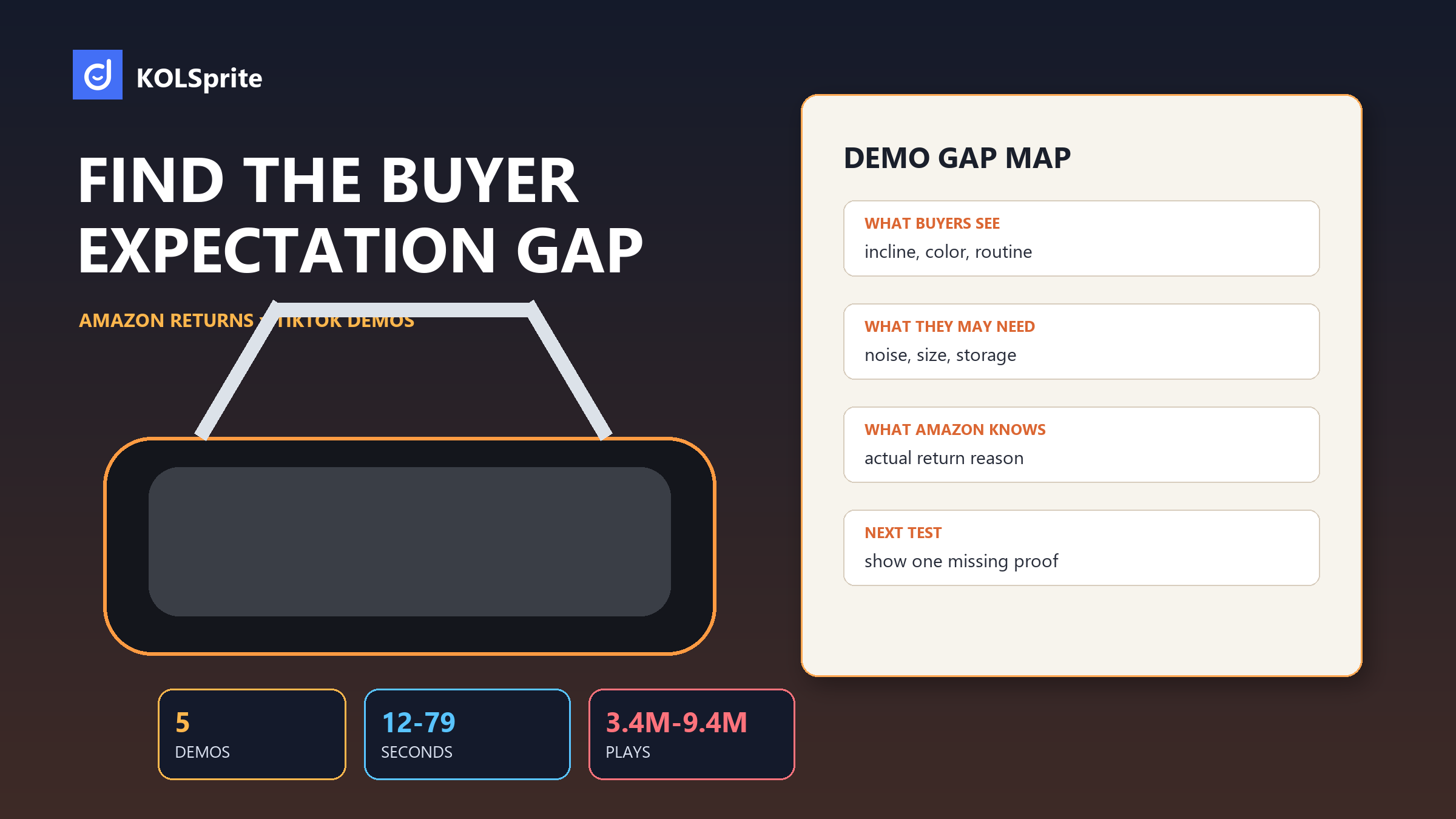
| Observed demo pattern | Scoped video signal | Proof not visible in titles | Use in a gap map |
|---|---|---|---|
| Incline framing | Five commerce videos for “walking treadmill” | Whether setup, limits, and use conditions are shown | Ask what the buyer expects the feature to do |
| Fitness framing | 12-79 seconds; 3.4M-9.4M plays | Whether the routine matches normal use | Ask which outcome needs a clearer boundary |
| Storage framing | Recurring across the sample | Whether moving, storage, and space are shown | Ask what physical proof the listing lacks |
Scope: public TikTok Shop videos for a walking-pad demo audit. Market: US. Access date: 2026-09-01. Sample: 5 walking-treadmill commerce videos, 12-79 seconds and 3.4M-9.4M plays. Cleaning: retained repeat themes around incline, fitness, and storage; titles were not treated as proof of what viewers saw. Limit: titles and metrics cannot explain Amazon returns, product quality, conversion, or buyer outcomes.
This is a pattern board, not a ranking. The numbers locate the sample; they do not select a creator or prove the strength of the claims. The useful column is the one that remains blank in the title. A title can mention storage while leaving the reviewer unable to see whether the hard part was shown.
Register for KOLSprite and claim a three-day trial to search relevant product demos, compare repeated proof jobs, and build a review set beside Amazon return reasons.
Register and claim a three-day trial
Take an actual Amazon return reason from the seller's records and describe the buyer question in plain language. Then ask what proof would help a buyer assess it before purchase. For a storage concern, the demo proof might show the relevant movement or storage setup. The listing proof might be a precise visual or spec that answers the same question. Neither is a promise that returns will fall.
That makes a compact Demo Gap Map:
| Return reason | Buyer need | Demo proof | Listing proof | Test owner | Stop rule |
|---|---|---|---|---|---|
| Use the seller's logged reason | State the question without blame | Show the detail a buyer must judge | Make the same detail clear on-page | Assign content or listing owner | Stop if review shows a strength, policy, or unit costs issue outside content |
The map is intentionally strict about ownership. A creator can demonstrate the relevant detail. A listing owner can clarify the spec. A quality team can investigate the item. An Amazon operator owns the decision based on return reports. Without that separation, a content test becomes a vague attempt to solve a problem it cannot measure.
Suppose a walking-pad return review points to a buyer question that can be checked before purchase. The team does not need five broad feature videos. It needs one testable proof question: what would a buyer need to see to understand the relevant detail? The demo can make that detail visible. The listing can make the same detail explicit. The seller can compare the change with the next account-level return proof, while holding strength and policy questions separate.
That choice remains useful even if the content test is rejected. The map may show that no honest demo can answer the buyer's concern, or that the concern belongs with product strength or shipping. Stopping at that point is a valid result.
KOLSprite can help find relevant demos, compare repeat proof, and build a review set. It has no access to Amazon return reports. Start with the validation frame in Amazon product research on TikTok, then use a technical-demo review to distinguish shown proof from a broad product claim in this creator demo research guide.
Use the output as a bounded review set: which demos repeat a buyer question, which proof is shown, and which proof is absent from the returned context. Bring that set back to the seller's return reason. The tool does not bridge the proof streams for you, and it should not be described as doing so.
The KOLSprite review set belongs beside the seller's return report, not in place of it. That keeps the demo review useful without turning it into a cause claim.
Keep the review set focused on the choice under review. A walking-pad search may return many demos, but the seller does not need a broad catalog of videos. The useful comparison is whether a repeat theme helps the team specify a buyer question and a proof job. Record the observation in plain language, attach the uncertainty, and leave the Amazon return proof in the seller's system of record.
Join the KOLSprite Discord to compare the evidence limits and the next test with other ecommerce operators.
 +
+
Join the KOLSprite Discord community
Do not make TikTok videos to fix an Amazon return rate. Instead, test whether a clearer, honest demo and listing can address a known buyer question. Continue only when the return record and proof job match. Pause when Amazon reports, costs, quality checks, or policy point elsewhere. Once the gap is clear enough for a creator brief, make it a limited original test with creator-ready test scripts. The tradeoff is intentional. A smaller proof test may feel less dramatic than general feature content. But it gives the seller a result to compare with the proof that matters.
The seller should record the starting detail before the test begins. That record may include the return reason under review, the relevant period in the seller's own report, the listing state, the demo state, and the owner of the quality or policy check. Those inputs do not need to become public claims. They make the review honest because the team can see what changed and what did not. One map can also show that the content team has no job. Suppose the logged reason points to a product defect, a shipping issue, a missing part, or a unit-economics problem. No creator demo can resolve that proof. In those cases, the correct output is an escalation to the responsible owner and a stop rule for the content test. A clear “not a demo issue” finding is better than a polished video that distracts from the real work.
When the concern is truly a mismatch, keep the proof narrow. A demo should show the detail a buyer needs to judge without adding outcomes it cannot support. The listing should use the same plain description so the buyer is not asked to reconcile two versions of the product. Review the test only against the account-level proof available to the seller, while acknowledging that many factors may change at the same time. Do not use the public sample to decide which creator will lower returns. The five observed walking-treadmill videos only show repeat framing around incline, fitness, and storage, along with the fact that titles leave important proof unseen. Creator choice still requires an appropriate content and brand review. The sample also does not reveal what a buyer saw before purchase or why an single order was returned.
The durable outcome is a better review conversation. Instead of asking whether a video is “good,” the team asks whether it makes the relevant detail visible, whether the listing answers the same question, and whether the actual return proof warrants another test. That is a narrower standard, but it keeps public content research in a role it can support. Keep the choice record even when the test makes no immediate listing change. It can show that the team reviewed a mismatch, identified a proof job, and found that the current proof did not warrant a content intervention. That finding prevents the same broad feature request from resurfacing as though nobody had investigated it. The Amazon return rate remains a seller metric, not a public-video metric.
That limit keeps the next choice tied to proof the seller can actually inspect.
Latest Articles

As an essential, data-driven toolkit for TikTok influencers and marketers, KOLSprite provides powerful features for effortless creator discovery, trending content identification, and actionable real-time insights.
It empowers users to make smarter decisions and significantly boosts their TikTok business.

 Refer & Earn