 +
+
If a product appears often on TikTok, an Amazon niche lead still has to decide whether to test the niche, hold it, or reject it before ordering stock. Amazon niche validation starts with TikTok Shop signals. It ends with Amazon unit costs and shipping inputs that TikTok Shop data cannot provide. The result is a Portable Blender Niche Memo. It records the observed price band, content crowding, difference to test, missing Amazon inputs, sample size, and a kill rule.
Ten-second answer: a niche is worth a controlled test only when price room, content supply, review strength, and recent trend still leave a clear gap to test. A high-selling row is not a buy signal on its own.
The retained portable-blender sample warrants a sales review, not a procurement choice. It is visibly active, it sits in a defined price band, and it has a large linked-video footprint. At the same time, the returned 30-day growth fields are negative and the content supply is already substantial. That combination does not say the niche is dead. It says a lead should not copy the most visible listing and call the work complete.
TikTok Shop's seller education explains its commerce environment. It does not prove Amazon search demand, margin, shipping, returns, sales, or future product sales. TikTok Shop seller guidance is a source for the platform boundary, not an Amazon forecast.
| Retained portable-blender comparison | Observed range | What it supports | What it does not support |
|---|---|---|---|
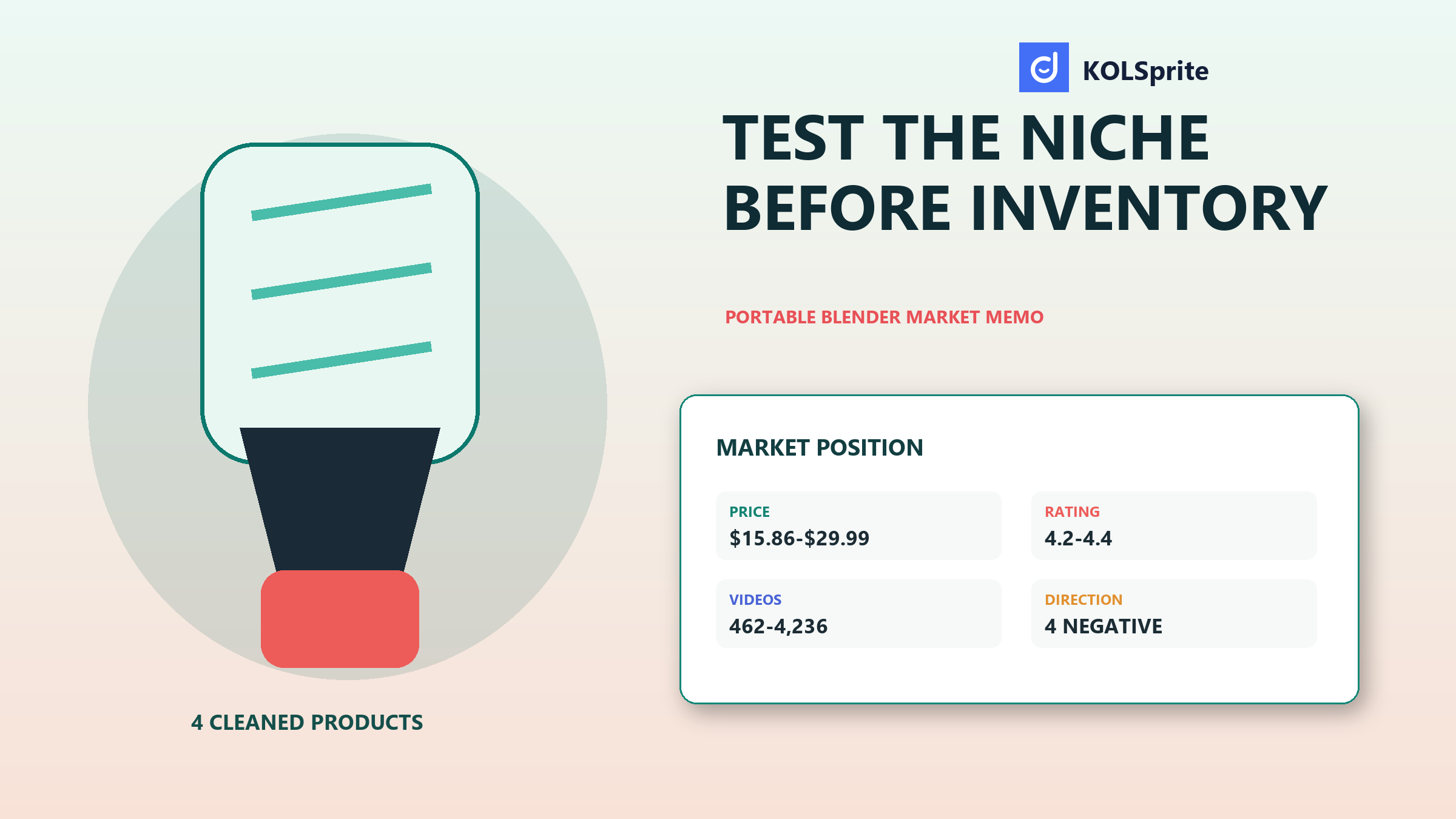
| Products retained | 4 | A scoped comparison | A full market census |
| Visible price | $15.86-$29.99 | A visible price band for investigation | Amazon price room or margin |
| Rating | 4.2-4.4 | A review-quality prompt | Amazon review quality or product reliability |
| Linked videos | 462-4,236 | Visible content saturation context | Future conversion or creator availability |
| 30-day growth fields | Negative across retained rows | A reason to investigate recent direction | A prediction of the niche's future |
Scope: retained portable-blender commerce product comparison. Market: US. Access date: 2026-09-01. Sample: 4 retained products priced $15.86-$29.99, rated 4.2-4.4, with 462-4,236 linked videos and negative returned 30-day growth fields. Cleaning: one garlic-chopper false positive removed. Limit: TikTok Shop fields do not prove Amazon search demand, margin, fulfillment, returns, conversion, or future sales.
The check makes the buying question sharper. There is no justification here for choosing the row with the largest linked-video count. That count may mean there is ample content supply. It may also mean the clear product story has already been heavily worked. The negative returned growth fields add a reason to test the trend, not a reason to invent a decline narrative.
A product can have an observed low price, a solid rating range, and hundreds or thousands of linked videos while still being a poor Amazon opportunity. The lead still needs landed cost, referral and shipping costs, expected return rate, listing sales, customer-service load, and a clear view of competitive offers. No TikTok Shop field substitutes for those inputs.
This is the practical care of Amazon niche validation. Treat each observed field as a question generator. The price band asks whether an Amazon offer can leave room after costs. The linked-video range asks whether there is an original proof angle left to produce. The ratings ask which review complaints or quality expectations should be investigated elsewhere. The recent trend field asks whether the first test should be smaller and time-boxed.
Register for KOLSprite and claim a three-day trial to search products, remove contamination, and compare price, reviews, sales windows, creators, and videos.
Register and claim a three-day trial
Test is sound when the lead can state a customer job, name an offer gap that is not a copied product claim, and show a plausible margin after Amazon inputs are gathered. The test should be limited in units and time, with a predefined kill rule.
Hold is sound when TikTok Shop sales are real but the missing Amazon inputs are material. A hold is not indecision. It is a record that the current proof cannot settle margin, returns, or shipping risk.
Reject is sound when the observed price band, crowding, or lack of a sound gap leaves no reason to continue. It is also correct when the search result is contaminated. The garlic-chopper false positive belongs in the record because it shows why a search result must be cleaned before it becomes a niche story.
The memo should fit on one page because its purpose is to expose the choice. Start with the customer job: what narrow job would a portable blender serve, in words that a buyer would recognize? Add the observed price band of $15.86-$29.99 and the content crowding range of 462-4,236 linked videos. Then state the gap to test. It might be a different proof question, a distinct use case, or a service and bundle idea. But it cannot be a borrowed claim with no proof.
Next list the Amazon margin and return unknowns plainly. Include the sample size of four retained products and state that a garlic-chopper false positive was removed. Finish with a kill rule. For example: stop the test when the proposed offer cannot maintain required margin after the relevant Amazon inputs, or when no sound gap remains after a content and review check. The rule should be measurable by the team that owns the unit-economics review.
A compact memo protects the meeting from a common mistake: treating a visible product as a winner before the operating constraints are known. It forces the niche lead to find the one thing that would make the niche worth testing and the one thing that would end the work.
KOLSprite supports the visible part of this review: search, clean contamination, compare returned fields, and build a review set. It does not produce a winning-product forecast. Use the no-go logic in this TikTok Shop product-research rejection test before treating the sample as a candidate set. For the broader field context, compare the memo with a TikTok Shop analytics seller workflow.
The workflow should preserve the rejected record and the check boundary. A clean four-product set is more useful than a larger list that silently includes adjacent products. Once the product scan is bounded, bring Amazon unit costs and shipping inputs into the same memo. That is the point where a review becomes a decision.
KOLSprite makes the visible product comparison easier to audit, while the Amazon cost and fulfillment checks remain with the operator who owns the inventory decision.
Use check fields to frame the next question, not to hide it. A lead who cannot explain why one returned product belongs in the retained set should not rely on its observed metrics. The memo is stronger when it preserves a small, intelligible sample and makes the missing sales inputs impossible to overlook.
Join the KOLSprite Discord to compare the evidence limits and the next test with other ecommerce operators.
 +
+
Join the KOLSprite Discord community
A niche lead does not need certainty to open a controlled test. The lead needs an explicit reason that the shown niche may have room, a set of missing inputs that matter, and a condition that closes the test. Here, the sound result is not “portable blenders will win.” It is “the public sample justifies a bounded Amazon review only if the proposed gap survives margin, shipping, return, and sales review.” Use this Amazon product research validation guide to take that proof into the next review. The tradeoff is speed for care. Ordering sooner may feel decisive. But a written hold or no-go can stop a TikTok signal from becoming stock without proper review.
The first sales question is not whether a portable blender has attention. The retained sample already shows visible commerce activity. The question is whether a particular Amazon offer can give a buyer a reason to choose it after the total cost of serving that buyer is known. A distinction can be useful only if it is clear, deliverable, and compatible with the price room the niche lead calculates. A vague idea about “better quality” is not a gap to test until the team defines what it means and can support it. Review strength deserves the same restraint. The observed 4.2-4.4 rating range is a prompt to check product feedback and trust through the appropriate Amazon proof. It does not prove that a new offer will earn the same rating or that a lower-rated item has a solvable problem. The niche lead should find which review or service issue would change the choice and who will check it. That turns a visible score into a useful research assignment.
Content crowding is also double-sided. The 462-4,236 linked-video range could mean that buyer education is easy to find. It could mean that the most clear demos are crowded and hard to differentiate. The lead should decide which reading matters by examining the proposed proof angle, not by turning the video count into a ranking. If no sound original proof angle survives that review, the correct choice can be reject even when the count is large.
A controlled test needs a bounded commitment. Record the planned scope, the time allowed for the unit costs and shipping review, the owner responsible for each missing input, and the kill rule in language that can be applied without reinterpretation. The kill rule should not be “stop if it does badly.” It should point to a known condition, such as insufficient margin after the relevant costs are included, unacceptable return reach, or the failure to establish a sound gap. Holding the niche can still be productive when the lead knows what proof is missing. A hold preserves the portable-blender check as a reference while preventing a premature stock order. It also makes it possible to reopen the case when Amazon inputs change, without claiming that the earlier TikTok Shop sample predicted the change. The record stays useful because it describes its scope and its limits.
That is the core tradeoff in Amazon niche validation: less momentum in the first meeting, more control over what gets ordered. The public sample has done its job when it makes the test, hold, or reject choice easier to explain. It has gone too far when a lead uses it to avoid the Amazon proof that decides whether the offer can operate.
Latest Articles

As an essential, data-driven toolkit for TikTok influencers and marketers, KOLSprite provides powerful features for effortless creator discovery, trending content identification, and actionable real-time insights.
It empowers users to make smarter decisions and significantly boosts their TikTok business.

 Refer & Earn