 +
+
A TikTok Shop partner lead may see a product row with hundreds of linked influencers and assume outreach will be easy. The choice is more specific: are there enough relevant creators to open a small, role-based outreach test? TikTok creator supply is useful only after the returned set is checked for fit, creator mix, proof range, and campaign fit. The usable result is a Creator Supply Strength Map that turns one count into four review questions and a small outreach cohort.
Ten-second answer: do not sort by the largest creator count. Clean the result, follow a stable product ID into linked videos, inspect the proof roles, and open outreach only when a small cohort has a distinct reason to be there.
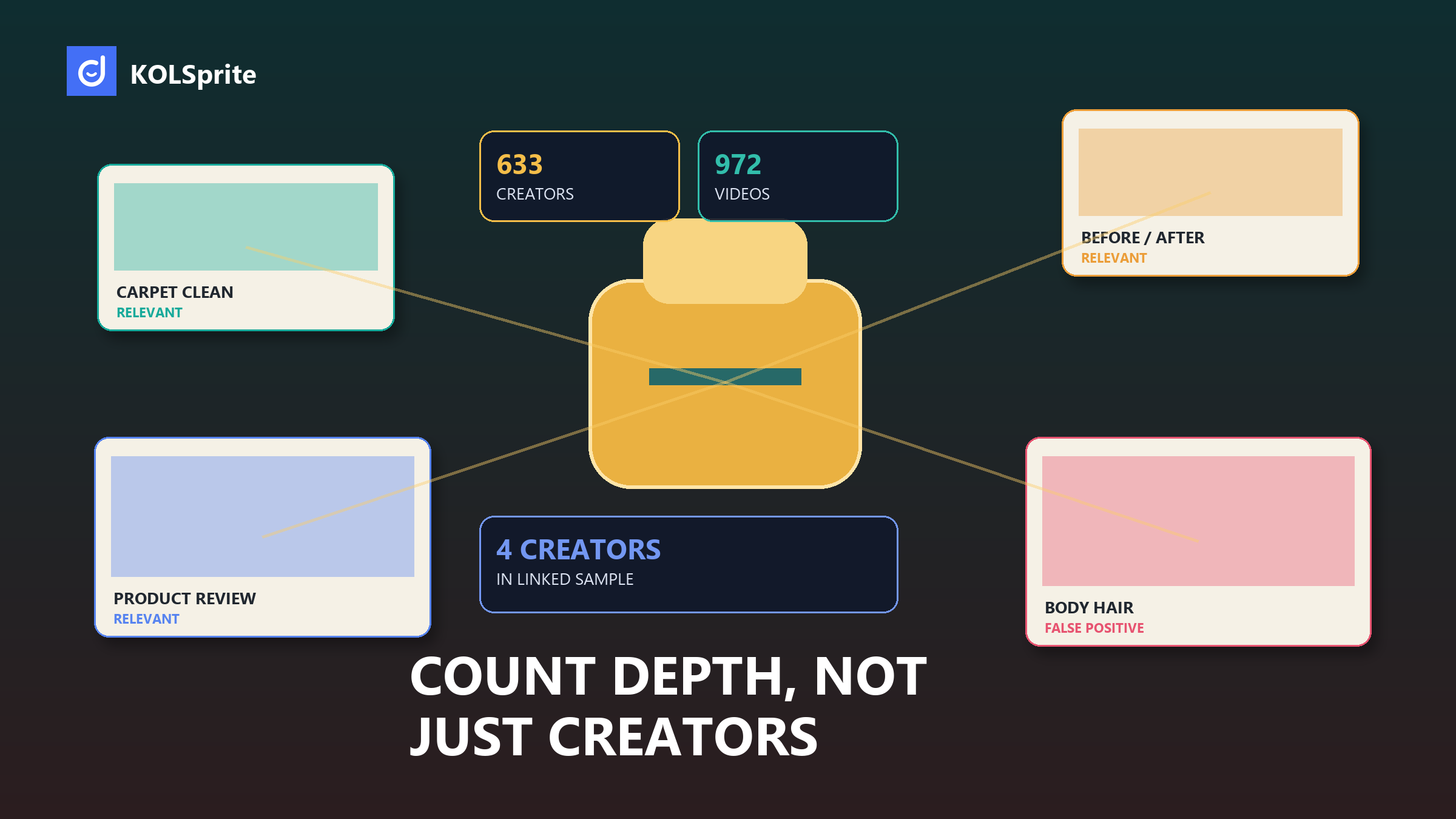
Picture a product search that returns a large creator count. It looks like supply. A closer look finds facial and body hair results mixed into a search meant for a pet-hair-removal product. The count is still a count, but it no longer answers the sales question. A campaign does not need every creator who shares a word with the product. It needs relevant people who can fill a distinct proof role.
That is the first discipline in creator research: contamination is not a nuisance to hide in the notes. It changes the choice. If the useful-result share is unclear, then the headline creator count cannot support an outreach-capacity estimate.
| Connected case observation | Observed result | Review implication |
|---|---|---|
| Retained product | 1 pet-hair-removal product | Keep the case bounded to one product |
| Linked influencers | 633 | A starting count, not a cohort size |
| Linked videos | 972 | Enough context to inspect proof variety |
| Stable join | Product ID joined to 5 videos from 4 creators | Inspect connected evidence rather than loose keyword matches |
| Observed proof formats | Carpet cleaning, before-and-after, and review formats | Define potential roles, not performance claims |
Scope: connected product-to-video case for one retained pet-hair-removal product. Market: US. Access date: 2026-09-01. Sample: 1 product with 633 linked influencers and 972 videos, joined by product ID to 5 videos from 4 creators. Cleaning: facial and body hair false positives excluded. Limit: one product is not a market census; counts do not prove availability, willingness, audience fit, price, or results, and currencies are not aggregated.
The value of the join is not that five videos settle the market. It gives the investigator a way to replace a broad count with linked examples. Carpet cleaning, before-and-after, and review formats suggest distinct proof situations. That is enough to ask whether a cohort needs more than one type of creator.
Useful result share asks how much of the returned set actually belongs to the product problem. The false positives here show why that check must happen before any count is repeated in a planning meeting.
Creator mix asks whether a small number of creators appear to carry much of the shown activity. A large row total can still be shallow if the same accounts dominate the activity. This is a manual review question; it is not a claim from the count alone.
Proof range asks whether useful creators bring distinct ways to make the product problem visible. The linked sample included carpet cleaning, before-and-after, and review formats. Those are likely roles for a test, not proof of results.
Real-world fit asks what the public record cannot settle: audience and brand alignment, supply, intent, sales terms, and the campaign's timing. These unknowns decide whether supply can become outreach capacity.
Register for KOLSprite and claim a three-day trial to clean a product result, follow the retained product ID into linked videos, and manually review creator roles.
Register and claim a three-day trial
A small cohort should be designed around the question the campaign needs answered. One creator may be reviewed for a cleaning demo. Another may be reviewed for a before-and-after structure, subject to the campaign's claim standards. A third may be reviewed for an independent-style product walkthrough. The aim is not to make every creator say the same thing. It is to see which proof role is missing from the current pool.
For each likely member, record useful result share, any mix concern, the proof role, audience and brand unknowns, the outreach role, and the next manual check. A creator can enter the cohort only when that row has a reason beyond a large linked count. This makes the cohort small by design and easier to review with stakeholders.
TikTok Shop offers official deal guidance for sellers and creators, including guidance on deal options. Use it for the program's platform rules. Do not use it as proof that a returned creator is listed. TikTok Shop collaboration guidance and its related seller material set that boundary.
KOLSprite can support the proof path. Clean the product result, follow a stable product ID into linked videos, and manually review creator fit. It can support product and creator comparisons. But its output here is a small, role-based test cohort, not a promise that creators are listed. Start with the job-first strategy in this TikTok influencer marketing guide. Then apply the shortlist standard in a defensible creator database shortlist.
The workflow matters because it preserves the stable link between product and video. A broad keyword set can surface adjacent categories. A linked case tells the team why the video is under consideration. The final manual review should still check content fit and campaign fit before contact.
KOLSprite keeps the product-to-video trail clear. The team can explain why a creator made the shortlist without treating a count as availability.
Before outreach, turn the role map into a brief review sheet. For each candidate, state the product link, the observed format, the reason that format answers a current proof need, and the unresolved manual check. A cleaning role may be useful because it shows the product problem in context. A before-and-after role may require special scrutiny because the campaign needs to define what is honest and supported. A review-format role may be useful for explanation, but it is not a proxy for authority or sales intent.
Use the resulting sheet to select a small number of candidates, not to predict a response rate. A creator who appears useful in a linked video may still be unavailable, outside the target buyers, unsuited to the brand, or working under terms that do not fit the test. The row remains valuable because it tells the deal lead what must be learned before a message is sent.
The linked case also gives the lead a way to keep the product choice and the creator choice aligned. If a video is linked by stable product ID, the team can explain the relationship without relying on a loose search phrase. If the content then fails the manual fit check, remove it from the cohort without rewriting the product's creator count as though the count were a strength measure.
Join the KOLSprite Discord to compare the evidence limits and the next test with other ecommerce operators.
 +
+
Join the KOLSprite Discord community
The earned choice is not “633 linked influencers means enough supply.” It is “this product has enough linked context to investigate a small cohort.” Continue only if useful results remain after cleaning and each chosen creator fills another proof role. If that role map is thin, do not turn the count into an outreach plan. For a cohort that does clear this review, keep sales assumptions separate and test them with an affiliate commission-rate test. The tradeoff is that role-based selection takes longer than sorting by count. But it gives the deal lead a cleaner reason to contact each creator and a clear reason to stop.
There is an important gap between a supply map and a contact list. The map makes the campaign's uncertainty clear: which proof roles exist, which roles are missing, and which facts need manual confirmation. The contact list begins only after the lead decides those open questions are small enough to ask directly. Keeping the two artifacts separate prevents a returned count from silently becoming a promise about real-world room. That is why TikTok creator supply needs a strength map before it becomes outreach. After the first outreach round, record only what the team in fact learns: whether the role was useful, whether the creator could be considered for the test, and which proof need remained uncovered. Do not retroactively turn a response or a completed deal into proof that the original count measured supply or likely results. That distinction keeps the next search cleaner.
The manual check should also look for duplicated creators and shallow variations of the same format. A cohort with several accounts repeating one proof role may look diverse in a row count while offering little creative learning. The most useful small test has enough gap between roles to show which kind of proof a buyer needs, subject to brand and campaign constraints. When the map cannot produce that gap, the right move is to pause outreach and refine the product question. More searching is not automatically more supply. The choice should stay anchored to the product, the proof role, and the unknown that outreach could reasonably answer. A large TikTok creator supply count cannot replace that reasoning.
For example, a lead may find several cleaning demos but no credible role for explaining the product's use limits. That is not a reason to force a broad-reach creator into the cohort. It is proof that the current supply map cannot answer the campaign's proof question. The team can either change the test question or wait until a useful role is found. When a cohort does open, use the map as a brief, not as a script. Each creator should have room for their own appropriate execution within the campaign's requirements. The point of the role is to prevent duplicate learning, not to dictate language, promise outcomes, or assume that the same public format will work again.
Review the first cohort as a set of proof gaps. Which role produced a usable content conversation? Which role revealed an audience or brand-fit issue? Which role could not be staffed? Those results can improve the next map, but they do not retroactively change the scope of the original one-product sample.
Latest Articles

As an essential, data-driven toolkit for TikTok influencers and marketers, KOLSprite provides powerful features for effortless creator discovery, trending content identification, and actionable real-time insights.
It empowers users to make smarter decisions and significantly boosts their TikTok business.

 Refer & Earn