 +
+
A TikTok creator marketing strategy should begin with the job the program must do, not a target number of creators. A team that needs believable product demonstrations will choose and brief creators differently from a team that needs new buyer language or a fresh launch angle. This article helps you write a Creator Program Job Statement, select public proof that matters, and avoid building a large program before the first learning loop is clear.
Ten-second answer: Name one business or learning job, define the proof a viewer needs, then recruit creators whose public work can plausibly make that proof. Measure the decision the program informs, not only views or a roster count.
“We need twenty creators” sounds like a plan because it is easy to count. It does not explain the audience question, the product behavior that must be shown, or what a good result would change. A roster can be large and still produce ten versions of the same unhelpful claim. A smaller program can be valuable when each creator has a distinct proof job and the team knows what it will do with the result.
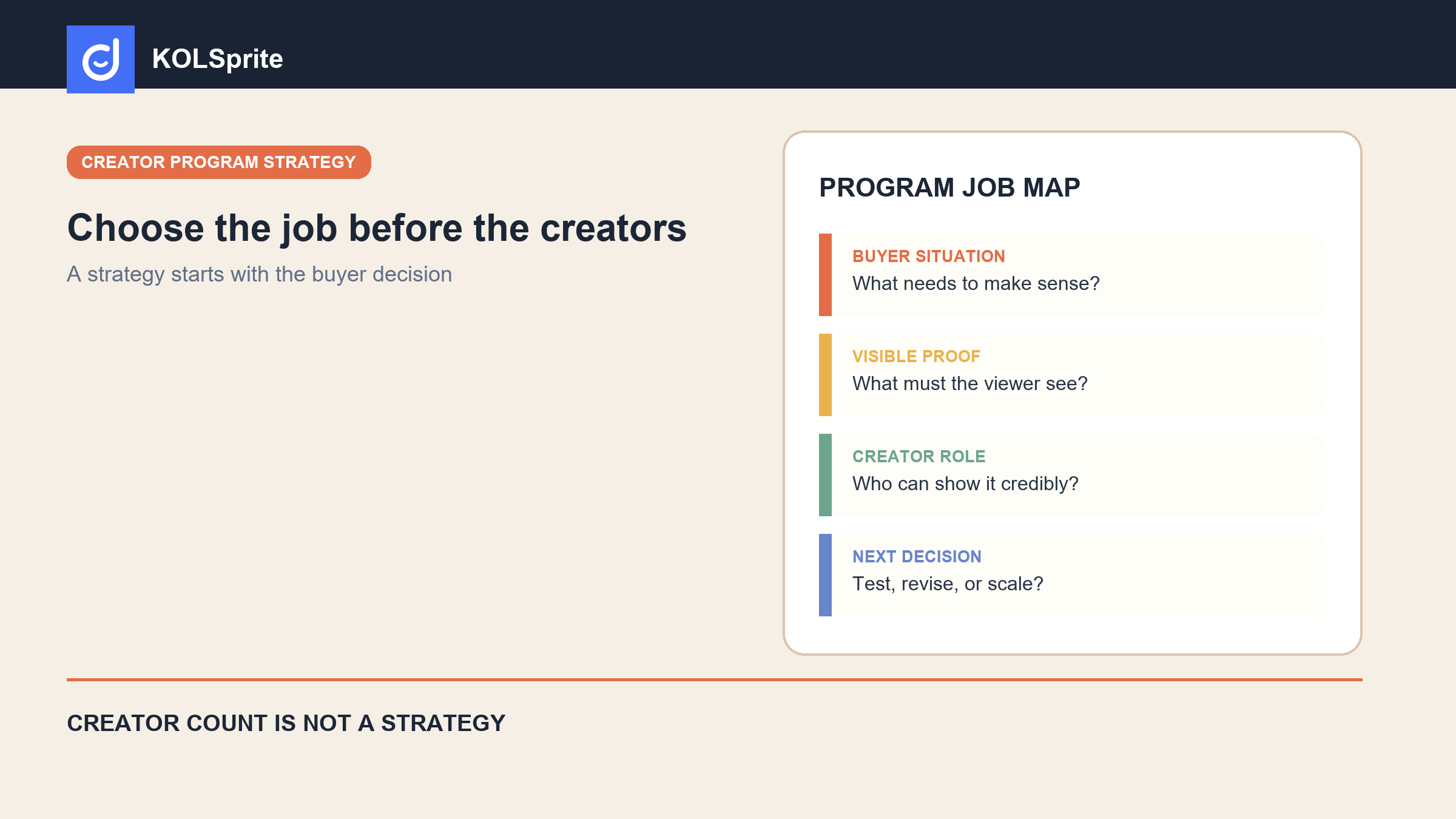
Start by choosing one of four jobs: show a hard-to-explain product use, test a buyer objection, find language that makes a category clearer, or build credible current status around a launch. These jobs can work together over time. They should not be blended into the same first brief. When the job changes halfway through production, creators receive mixed signals and reviewers cannot tell which proof mattered.
A useful statement has five parts: the buyer situation, the decision the viewer is making, the proof needed, the creator behavior that makes the proof believable, and the team decision after the test. It should fit on one page. If it requires a slide deck to explain, it is probably asking a first cohort to do too much.
For a kitchen-storage product, the job might be to show whether the product solves the “where does this go after use?” question in a small apartment. That is different from “drive sales.” The latter is a business result. the former gives a creator a scene, gives a reviewer a proof standard, and gives the team a way to decide whether the angle deserves a second test.
| What to record | What it can support | What it cannot settle |
|---|---|---|
| Buyer situation | The scene a viewer recognizes | Every reason someone might purchase |
| Proof moment | What must be visible or explained | A result guarantee |
| Creator fit signal | Why this creator can show the situation credibly | A prediction of conversion |
| Review question | What the team will look for after publishing | A full attribution model |
| Stop condition | When not to expand the cohort | A judgment on the creator as a person |
Decision table based on a practical creator-program planning method. Public creator proof helps frame a hypothesis. private sales, margin, and rights details must be reviewed separately.
The job comes first. The list comes next. That order keeps the first invite clear.
Keep the note in view. It should name the job, the proof, and the next call. That makes the first review less vague and more fair to the people doing the work.
Keep the first cycle small. Give it one job, two partners, and one review meeting. The point is not to prove a whole channel. It is to learn which proof belongs in the next brief. If the answer is weak, change the scene before you add more names.
Public videos can help a team see how a creator explains a problem, whether their audience responds with setup questions, and whether a product category appears naturally in their usual scenes. That is more useful than treating a follower count as a fit score. It also creates a fairer outreach conversation: the team can explain the exact task instead of sending a vague request for “a viral video.”
KOLSprite supports this research close to the TikTok browsing flow. Use supported public creator and video context to compare examples, note the content pattern, and save a shortlist with the proof that prompted it. Similar-creator discovery can help broaden an initial reference point. The product help is the research trail. the hiring, rights, claim approval, and business decision remain human work.
Use KOLSprite to examine supported public creator and content context while your team chooses the proof job and the first creator cohort.
Register and claim a three-day trial
A strategy is incomplete if it treats clear sponsorship note as a post-production checkbox. The FTC says a brand link needs to be clear and conspicuous, and the guidance is especially relevant when a creator receives payment, free product, or another benefit. A clear clear sponsorship note belongs with the endorsement, not buried in a profile or a stack of hashtags. Build that expectation into the brief and review it before approval.
Source: FTC: Disclosures 101 for Social Media Influencers. Scope: This is U.S. consumer-protection guidance, not legal advice for a specific campaign or market.
After a first set of posts, do not ask only which creator got the most views. Reopen the job statement. Did the planned proof appear? Did comments reveal the buyer question the team expected? Did the creator's usual format make the answer easier or harder to believe? Did the post create a reason to test another angle? A strategy earns its name when it improves the next decision.
KOLSprite's comment and content-analysis surfaces can help teams organize supported public signals after a post is live. AI Comment Analysis can structure discussion themes, pain points, and use cases. But the example comments still need human review in their original thread. That boundary keeps a summary from becoming a false market claim.
The practical first program may be two creators, one product question, and one review meeting. That is not a weak version of creator marketing. It is often the fastest way to learn whether a message, scene, or creator type deserves further investment. The strategy is the connection between the job, the proof, the research, and the next decision.
Run one plain check before the first invite. Read the Creator Program Job Statement aloud. A person who was not in the planning meeting should be able to say what the buyer needs to see, why this creator is on the list, and what the team will do with the result. If they cannot, the plan is still a wish list.
A TikTok influencer marketing strategy needs that plain test because a creator can make a fine video and still miss the job the business set. The strategy should tell the team what to keep, what to change, and what to stop. It should not make a creator carry every sales goal at once.
Use the same short note at the end of the test. Did the video show the planned proof? Did the viewer's questions change? What would the next creator need to do in a new way? This keeps the program based on what the team learned, not on a vague sense that it should now do more.
TikTok influencer marketing strategy works best when the creator brief, review notes, and next decision all point back to the same buyer job.
Join the KOLSprite Discord to discuss creator program jobs, proof requirements, and the learning loops that prevent vague campaign planning.
 +
+
Join the KOLSprite Discord community
Creators should have room to make the work theirs. A clear job statement protects that room because it separates the non-negotiable proof from the parts that can remain creator-owned. It also gives a team a respectful basis for saying no to a concept that does not answer the buyer question. That is a stronger foundation than asking for more content and hoping the strategy appears later.
When a program has more than one creator, assign roles that are meaningfully different. One creator may be best placed to show an unfamiliar product in a real setting. Another may be better at answering a careful buyer's setup question. A third might make a category comparison understandable. The roles should not be “top creator,” “mid-tier creator,” and “micro creator.” Those are audience-size labels, not jobs.
Role clarity makes the program easier to manage. It tells each reviewer what to look for and prevents a team from judging every post against the same vague expectation. It also gives creators a better starting point. They can decide whether the assignment fits their actual content instead of guessing which version of a sponsored post the brand has in mind.
Before the campaign begins, write one sentence explaining what the team will do if the role succeeds and one sentence explaining what it will do if the proof is mixed. A success outcome might be a second creator cohort with the same proof job. A mixed outcome might mean changing the scene before adding more spend. The point is not to pre-judge a result. It is to prevent the review meeting from inventing a new goal after the posts are live.
Creator content can make a product easier to understand. It does not answer every business question. Margin, inventory, returns, unit economics, regional policy, and attribution belong alongside the content review, not inside it. A team that separates these lanes is less likely to overreact to an appealing video or dismiss a useful learning signal because it did not settle a finance question.
That separation is also what makes KOLSprite's research workflow useful. The product can help preserve public content and creator context while the seller's own systems hold the private business proof. Together, those inputs support a decision that neither one can make alone.
A program job statement should also name the outcome it is not designed to deliver. A small proof cohort is not a full-funnel media plan. A product demo series is not a substitute for customer support. A buyer-language study is not a guarantee of sales. Those limits make the strategy easier to explain to leadership and fairer to the creators asked to participate.
When priorities change, write a new statement instead of stretching the existing one. That keeps the proof legible and prevents a modest first test from being evaluated against an unrelated revenue target.
Keep the statement visible in every review meeting. It is the fastest way to detect a program that has drifted from learning about a viewer problem into producing content simply because a roster exists. When the job stays clear, the next creator decision becomes smaller, kinder, and easier to defend.
At the end of the first cycle, compare the work to the job statement, not to the loudest internal opinion. This keeps the team focused on what the program was meant to learn and gives the next cohort a more credible reason to exist.
Useful next reads: Pair this strategy with the creator brief template, the creator search decision guide, and the TikTok Shop affiliate program system.
This strategy page ties a real buyer job to a creator cohort and a deliberate follow-up decision.
Latest Articles
As an essential, data-driven toolkit for TikTok influencers and marketers, KOLSprite provides powerful features for effortless creator discovery, trending content identification, and actionable real-time insights.
It empowers users to make smarter decisions and significantly boosts their TikTok business.

 Refer & Earn