 +
+
A partnerships team can find thousands of profiles in an afternoon and still have no defensible reason to brief twenty of them. Follower filters are not the missing piece. The team first needs to define what a creator must prove on camera. Write that proof task, run competing public searches against it, and record why each candidate stays, needs investigation, or leaves the list. The result is a five-creator shortlist test with a rationale card an outreach owner can use.
Picture two tabs. The first query asks for creators in a broad category with a follower range. The second asks for recent public videos where someone demonstrates the product problem in a recognizable format. Both may return useful people. The second query gives the team a reason for every result.
Follower filters can help control a large list, but they do not show whether a person can make the required proof feel natural. A creator may have the right audience size and no visible habit of teaching, comparing, testing, or showing the kind of result the campaign needs. The search should discover that before outreach, when the cost of a rejection is low.
TikTok One offers tools for finding creators and taking a creator collaboration forward. Its public help material describes creator discovery inside that ecosystem. Read TikTok’s guidance on finding creators who work with TikTok One and finding creators in TikTok One before treating a public search as a complete procurement process.
A proof task describes the job the audience needs to see done. It might ask a creator to show a storage change without hiding the tradeoffs. Another task could compare two ways to solve a cleaning problem. A third could explain a routine to a doubtful beginner. It is not a slogan or a list of preferred creator traits.
Write the task in a single sentence with four parts: the viewer’s problem, the visible action, the proof standard, and the category boundary. For example: “For apartment renters with a cable-management problem, show a setup in use, state one limitation, and avoid unsupported safety claims.” The sentence gives the team a basis for reviewing public work.
The proof task also keeps the brand from asking creators to reproduce a particular successful clip. A brief can ask for the same audience problem and a comparable level of demonstration. It should leave room for the creator’s own format and judgment.
Use this line when a list starts filling too quickly: “Keep a creator only when recent public work shows the proof task in a fitting context.” That rule does not judge talent or worth. It gives this campaign search a testable boundary.
TikTok creator search improves when the team looks for demonstrated proof behavior before treating reach as a signal of fit. A candidate can be promising and still require investigation. A public sample may show the right format but leave questions about audience demographics, availability, fees, disclosure practices, or brand-safety review. Those questions belong in the next stage.
KOLSprite helps teams inspect public creator profiles and recent content, compare proof behavior, and save the reason a creator stays on the shortlist.
Register and claim a three-day trial
Review a small, recent set of public videos for each candidate. Record the format, the opening, the product or problem context, and any visible evidence that the creator handles the proof task. Then record the limitation. A reviewer who cannot name a limitation has probably written a profile description instead of a decision record.
The public pass asks practical questions. Does the creator show process or only a finished result? Does the explanation match the reading level and category boundaries in the brief? Do recent posts suggest a one-off experiment or a format the creator uses with some consistency? Are comment questions answered in a way that fits the product’s risk level?
Do not infer private audience quality from a public feed. Do not guess response rates, conversion, or willingness to work. TikTok’s business material on creator marketing describes the platform’s creator collaboration context; it does not turn public observations into a guarantee of campaign results. See TikTok’s creator marketing overview for that platform context.
| Search starting point | Likely public result | What the reviewer can explain | What remains unknown |
|---|---|---|---|
| “Home creators, 10K-100K followers”. | A broad profile list. | Category presence and visible audience-facing style. | Whether the person can perform the needed proof task. |
| “Recent renter cable setup demonstration with tradeoffs”. | Videos attached to a visible use case. | Format, proof behavior, and product context. | Private audience data, pricing, availability, and results. |
| Reference-video expansion. | Creators with a related public format. | Why a comparison is worth a closer look. | Whether similarity equals campaign fit. |
Source date: 2026-08-20. Scope: an illustrative comparison of public search starting points and the quality of the rationale they can produce. Limitations: no creator identities, performance data, private audience demographics, availability, fees, compliance status, or outcome predictions are represented.
The lab result is not a claim that one query is universally better. A broad filter may be appropriate after the proof task is clear. The point is sequence: the team needs a visible reason for selecting a person before it needs a long list of people who match a numerical range.
Choose five candidates from the public pass. This small number forces comparison. Give each person a rationale card. Add the proof task, one or two useful public examples, and the visible format fit. Then name the risk or unknown and set a status: keep, investigate, or reject.
A keep status means the public evidence is strong enough to justify the next diligence step. Investigate means there is a specific question to answer, such as whether the creator can meet a disclosure requirement or has a relevant audience segment. Reject means the visible work does not fit the proof task, even if the creator has a large following or a polished feed.
Use the TikTok creator vetting suitability check to separate a promising public match from a ready-to-brief creator. The shortlist card should travel with the candidate so the original reason does not vanish during handoff. The TikTok influencer analytics fit questions can help the team state what it still needs to verify.
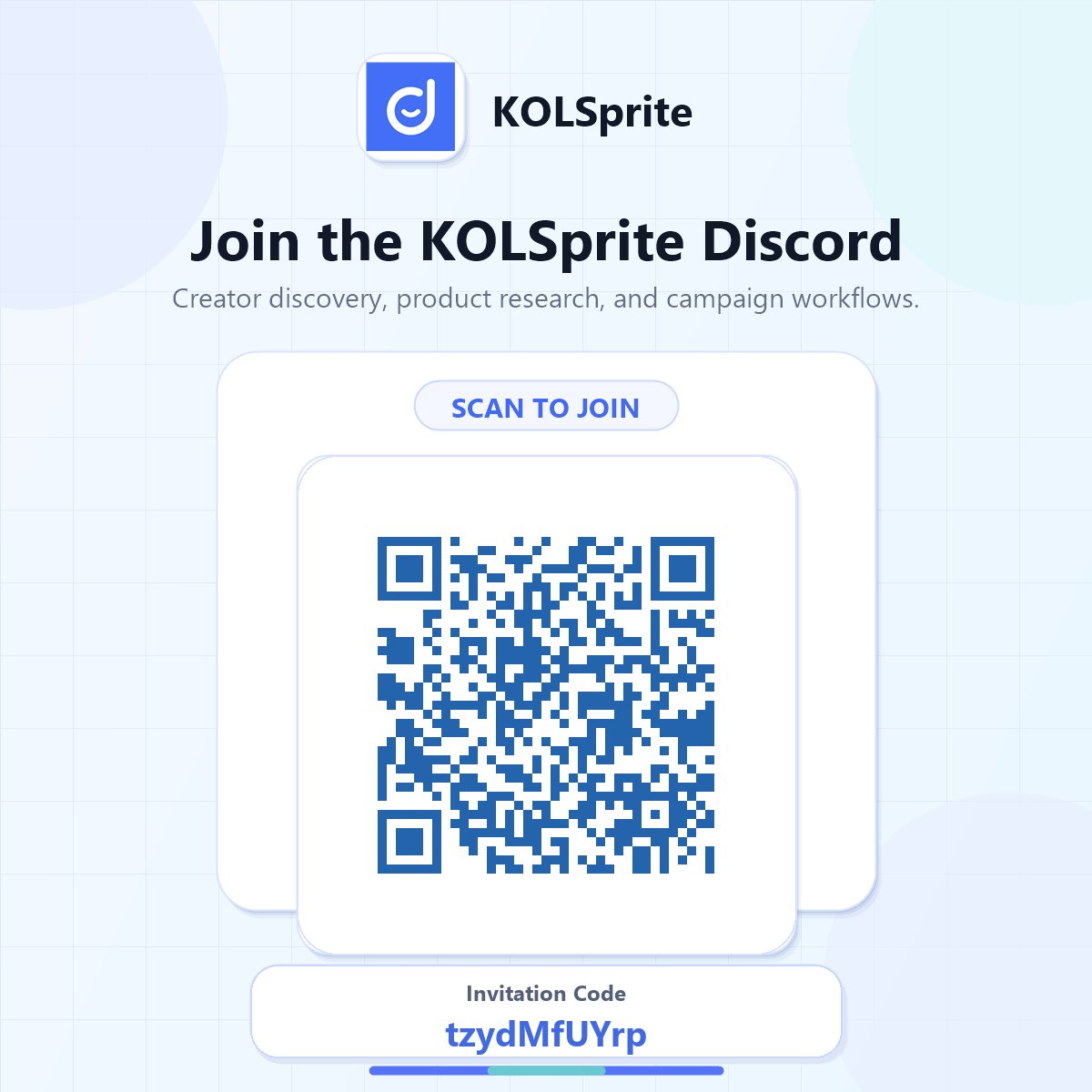
Join the KOLSprite Discord to compare creator-search prompts, rejection reasons, and the evidence needed before outreach.
 +
+
Join the KOLSprite Discord community
Give each card a simple heading: “Why this creator, for this proof task, now.” Use four short paragraphs below it. Cover the task and the public evidence. Then state the limit and name the next owner. Avoid scores that hide the reasoning. A partnerships lead should be able to challenge the choice without rebuilding the search.
The card also protects creators from vague outreach. When the handoff is clear, the brief can explain the audience problem and the proof required without pretending that the brand has already decided every creative choice. That makes the initial contact more honest and gives the creator a useful basis for response.
KOLSprite can support the public research in this process. Define the proof task, search public creators and recent videos, and compare visible formats with the product context. Save the evidence with its limits. Similar creator discovery can also expand the search from a useful reference creator.
Its output does not prove audience authenticity, private demographics, availability, response, fees, compliance, or results. The shortlist still needs human review and a proper outreach or TikTok One handoff. For the next operational stage, see the TikTok creator management handoff system.
A list becomes defensible when it can explain the rejections. “Right category, no demonstration habit” is useful. “Strong visual format, but the product context is too far from the brief” is useful. “Recent work leaves a sensitive-category question unresolved” is useful. Those notes improve the next query and stop old assumptions from becoming hidden requirements.
The final handoff does not need to call the five candidates the best creators on TikTok. It needs to say why they are the next five people worth evaluating for this exact proof task. That is a standard the team can repeat without reducing TikTok creator search to a follower filter.
Keep the rejected candidates in a separate record for a short time. The point is not to build a permanent list of bad fits. The point is to show what the current search excluded. A creator may be a poor match for a product demonstration and a strong match for another brief. The note belongs to the task, not to the person’s value.
When a candidate moves to investigate, give the next reviewer a tight question. Ask for confirmation of a relevant audience segment. Ask whether the creator has a conflict. Ask whether a proposed product claim can be handled. Do not pass along a vague label such as “seems good.” Vague handoffs make each person repeat the same public review.
Before outreach, read the rationale card as though you were the creator receiving the brief. Does it explain the audience problem? Does it leave room for the creator’s own method? Does it avoid claiming that public clips prove private facts? If the answer is no, the search has not yet produced a usable handoff.
A five-person list is also a check on team bias. It makes the group compare reasons instead of collecting names. One person may have a more polished edit. Another may show the product problem with more care. The difference should be visible in the cards. The team can then choose the next diligence step with its eyes open.
Search quality improves when every outcome stays tied to its proof task. A later campaign can reuse the method without copying the old list by writing a new task, inspecting current public work, and making a fresh decision.
The final record should help the next owner act while showing exactly where the public evidence stops.
Three questions are enough to expose a weak card: Does recent work show the proof task? Is the product context clear? What remains open? Missing answers call for more research.
A public feed may show skill in one kind of proof while saying little about private audience details or work terms. Record those gaps as diligence items rather than filling them with assumptions.
Dates matter because formats and posting habits change. A six-month-old clip may be relevant background, but recent examples give the team a sounder basis for a current brief.
Give every reviewer the same four card fields: the proof task, two relevant examples, one limitation, and one next action. The shared format makes reasoning easier to compare without turning creators into scores.
A reject status only means the current task does not fit. Its reason should identify the public pattern that missed the brief, which makes the next search more precise.
When two candidates look close, compare the proof rather than their apparent popularity. The stronger card is the one that gives the team a sound reason to continue.
For an investigate status, send one clear question to the next owner and save the answer with the card. That prevents the handoff from repeating the same public search.
Latest Articles
As an essential, data-driven toolkit for TikTok influencers and marketers, KOLSprite provides powerful features for effortless creator discovery, trending content identification, and actionable real-time insights.
It empowers users to make smarter decisions and significantly boosts their TikTok business.

 Refer & Earn