 +
+
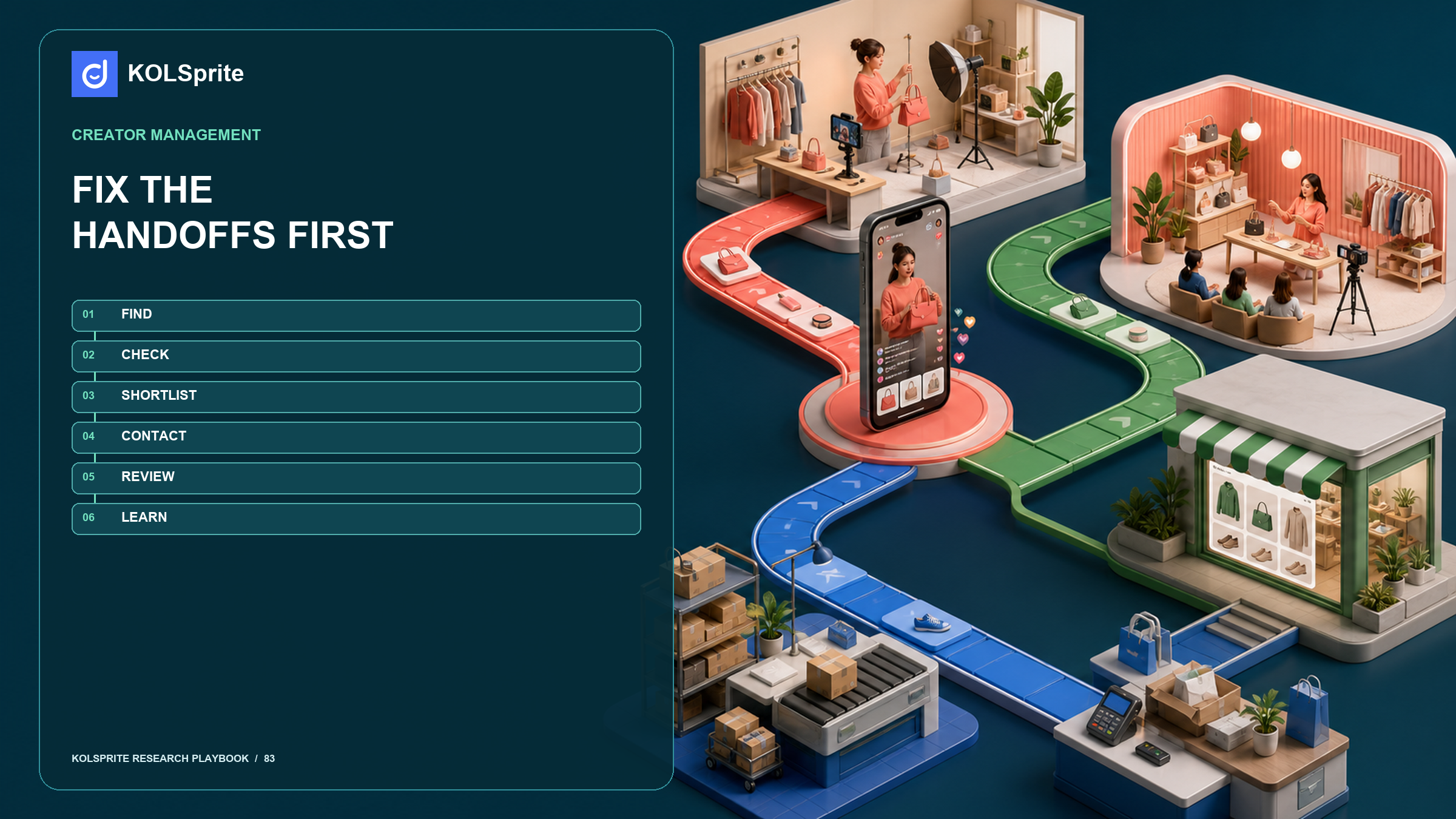
Brand and agency teams rarely lose creator work because they cannot find another profile. They lose it in the gaps. A good fit leaves the shortlist, a sample has no owner, a draft waits in an inbox, or a final post gets no follow-up. Define each handoff before you add more creators. This guide gives you a six-stage Creator Handoff Board with entry and exit rules, owners, and an exception lane. It gives teams shared context without adding more red tape.
TikTok creator management works when each active creator has a current stage, one owner, a clear next step, and the proof the next person needs. A database is not a workflow. The handoff is the workflow.
TikTok One includes creator search and project workflows. These can help a team plan its work on the platform. Check the current steps in TikTok’s project creation guidance. Keep your own board focused on owners and shared context.
Start with the last three creator projects that felt messy. The goal is not to assign blame. The useful question is where the record stopped helping. A researcher may save a name but not the fit reason. An outreach owner may not see the proof request. A sample lead may not know the content date. A manager may find the final post but not know what was promised.
Each break points to a missing handoff field. Extra columns are rarely the answer. A good record gives the next owner enough context to act without running the search again. That is the standard.
For example, “Creator is a good fit” is not a handoff. “Creator regularly shows small-space resets; their recent format includes a visible before-and-after; we need a demo of the storage setup” is a handoff. It tells the outreach owner what to say and tells the content reviewer what to look for.
| Stage | Entry rule | Exit rule | Accountable owner |
|---|---|---|---|
| 1. Discover | A creator is visible through relevant public research. | Profile and recent content have been reviewed. | Research owner |
| 2. Assess | There is a product or campaign question to test. | Fit reason, proof format, and uncertainty are recorded. | Partnership lead |
| 3. Contact | The outreach message and contact route are ready. | Response, follow-up date, or no-response decision is recorded. | Outreach owner |
| 4. Confirm | There is interest and an approved commercial path. | Scope, required approvals, and logistics are handed to approved systems. | Partnership lead |
| 5. Produce | Brief, sample, or required inputs are available. | Content outcome or production exception is recorded. | Content owner |
| 6. Learn | Content or a closed outcome exists. | Relevant evidence and the next relationship action are saved. | Program lead |
The stages do not rate a creator’s value. They show the team what happens next. A creator can leave at any point. Make the exit clear: pause, decline, no response, change scope, or move ahead.
Use KOLSprite to preserve public creator and content context as your team moves from discovery to a shortlist and then into outreach.
Register and claim a three-day trial
Every stage needs a small, stable record that people can read. Include the creator name or handle, current stage, owner, date of last action, next step, fit reason, campaign question, and any known hold. Link to the public example or approved business record when needed.
Two rules prevent clutter. First, keep what you saw apart from what you think it means. “Recent videos show product setup in a small apartment” is a fact you can see. “Likely strong fit for our audience” is your view. Second, name what you do not know. “No public example in this exact product category” says more than a blank field.
That habit gives a new teammate a fair view of the work. It also makes a no-contact choice easier. A short no with clear support can be better than a vague maybe that stays on the list for months.
Shared responsibility often means no one owns the follow-up. The owner does not have to do every task. They must make sure the record can move to the next stage. A research owner may ask someone else to find a public example. A partnership lead may need legal or finance review. The board still shows one person in charge at the handoff.
Do not make the board a substitute for contracts. Use an approved agreement process for terms, rights, payment, and legal requirements. This TikTok influencer contract template guide can help teams distinguish a formal agreement from an operating note.
Real work rarely follows the normal flow. A creator may ask for a new format. A sample may arrive late. A product claim may need review. The team may learn that the original fit was wrong. An exception lane keeps these cases from getting lost in direct messages.
Each exception needs three fields: the type, decision owner, and due date. Examples include “sample late; logistics owner; update by Thursday,” “new claim request; compliance owner; hold brief,” or “creator asks for new scope; partnership lead; decide before reply.” Do not use “waiting” as an exception. It does not say who is waiting or what they need.
Negotiation belongs in a clear decision path, too. When a creator asks for new terms or a different output, preserve the original campaign need before changing the scope. This guide on negotiating with TikTok creators is useful when the handoff requires a commercial conversation rather than a simple status update.
Use KOLSprite early on the board. Review public profiles and content to find and assess creators. Then save the fit reason, proof format, and limits. This context makes the move from research to outreach much cleaner. The outreach owner should not have to guess why a creator made the list.
KOLSprite can also support promotion work and follow-up by keeping the public research reason in view. It is not a universal CRM, contract system, payment rail, email delivery platform, or first-party source for attribution. Put private business records in the approved systems your team already uses.
That line matters. A workflow gets weak when one tool is asked to hold facts it cannot check. Keep public research, business commitments, and results linked. Do not turn them into one source of truth that lacks support.
Join the KOLSprite Discord to compare creator operations, ownership rules, review queues, and the small process changes that reduce dropped context.
 +
+
Join the KOLSprite Discord community
Review the board once a week with the owners. Start from the exceptions, then move to records with no next action or an overdue date. Ask four questions: What moved? What is blocked? What needs a decision? What should leave the board?
Next, review one completed project from the Learn stage. Did the fit reason hold up? Was the proof request clear? Did an owner have to rebuild the context? Make one process change only if the facts support it. A weekly review that adds ten rules will make the next handoff worse.
Use the same meeting to choose whether the creator relationship needs another action: thank-you, follow-up, new product consideration, or closure. This is where your creator outreach SOP should meet the real history of the relationship instead of restarting from a generic template.
TikTok creator management cannot live on a board alone. People, platforms, and business terms change. KOLSprite does not replace contracts, payments, email systems, legal review, or attribution. TikTok One’s current creator search guide can inform your work on the platform. It does not define who owns work inside your team. Use TikTok’s creator discovery documentation to check the product workflow.
The durable decision is simple: do not expand the roster until the team can move one creator from research to learning without losing the reason for fit, the current owner, or the next action. Once that path is reliable, more creators add capacity. Before then, they only add more dropped handoffs.
A stage change should be a short handoff note, not a meeting. Write what changed, what proof is linked, who owns the next step, and when it is due. For example: “Moved from Assess to Contact. Fit reason and proof example saved. Outreach owner will send the approved message by Tuesday.” This wording does not claim more than the team knows.
Use the same discipline when work does not move. “No response after the planned follow-up; partnership lead will close or extend by Friday” is clearer than leaving the creator in Contact indefinitely. A visible pause is also a decision. It makes capacity real and gives the program lead a chance to see whether a lane is producing unnecessary friction.
Over time, the board shows how the team works. You can see which handoffs take too long, which problems return, and which campaign beliefs cause extra work. That is enough proof to improve the process in small steps. Do not add a tool or stage until you can name the handoff problem it will fix.
Good status writing is generous. It saves the next owner from guessing whether the relationship is active, why it matters, and what may happen next. It also helps the creator receive a more coherent experience. When research, outreach, logistics, and content teams share the same basic facts, creators do not have to repeat themselves or resolve internal confusion.
That is the practical value of a six-stage board. It is not more admin work. It means less repeated research, fewer surprise requests, and a clearer path from the first fit signal to a useful lesson.
Latest Articles
As an essential, data-driven toolkit for TikTok influencers and marketers, KOLSprite provides powerful features for effortless creator discovery, trending content identification, and actionable real-time insights.
It empowers users to make smarter decisions and significantly boosts their TikTok business.
 Refer & Earn