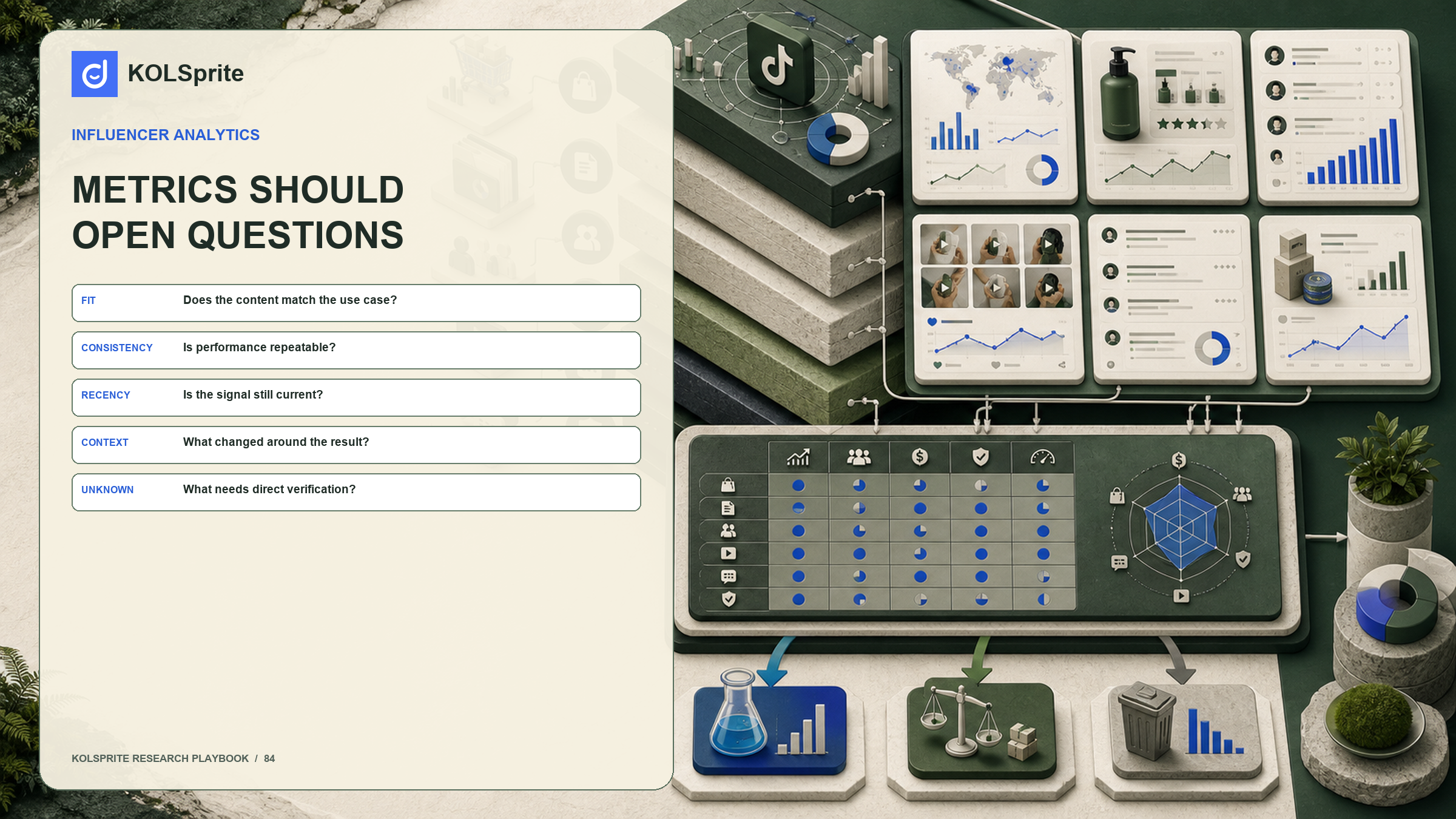
 +
+
Creator partnership managers often compare a shortlist that looks the same on a dashboard. One creator has more followers. Another has strong recent response. A third has a polished feed. None of that shows who can present this product in a way a buyer will trust. Use metrics to raise fit questions, not to build one ranking score. This guide gives you a five-question Analytics-to-Fit worksheet and a shortlist memo. They help you choose who needs a closer look or a small test.
TikTok influencer analytics should narrow the next question. A public metric can tell you where to look. It cannot prove product fit, future results, or sales. Pair each number with recent content and the proof task you need the creator to do.
TikTok’s creator search materials show how teams can find creators in TikTok One. The current guide covers the product steps. The same fit rules can then apply to each person. TikTok One creator discovery guidance is the main source for that feature.
| Visible signal | Bad conclusion | Better fit question |
|---|---|---|
| Follower count | “They are the best choice.” | Does their current audience-facing format give this product a believable role? |
| Recent views | “They will drive the same result for us.” | What topic, hook, and proof format made those recent posts useful to viewers? |
| Engagement | “Their audience will buy.” | Are comments asking questions that this product can answer honestly? |
| Posting cadence | “They are available and reliable.” | Does the cadence show a repeatable format, and have we confirmed availability separately? |
| Category overlap | “They fit because they mention the category.” | Can they demonstrate the specific buyer problem our item solves? |
The table turns a scorecard into a review. It keeps the team from treating a number as a verdict. The metric still has value. It points to the recent posts, comments, or comparisons that need a closer look.
The review begins with one sentence that states the buyer proof you need. “Show how the item fits into a weekday reset without saying it solves every storage problem.” “Compare setup steps for a beginner.” “Show what a small household can see after normal use.” This sentence is your anchor.
The next check is whether a creator has a clear way to show that proof. A format match matters. Do they show, explain, compare, test, or tell a routine in a way that fits the task? A great creator can still be wrong for this proof. That is not a judgment of the person. It is a reason to choose a different role.
The limits of any brand-suitability signal should be clear before use. TikTok says its Creator Suitability Report supports creator review. It does not promise a result or guarantee a creator. TikTok’s Creator Suitability Report overview should sit beside your own review, not in place of it.
KOLSprite puts public creator and video signals in the browsing workflow so you can capture what each metric suggests and what still needs proof.
Register and claim a three-day trial
Worked comparison: Creator A has more reach but mostly makes quick product roundups. Creator B has a smaller public audience but often explains setup choices in the exact home setting your product needs. The worksheet may put B first for a proof test, even though A has the larger headline number. You can explain the choice because it follows the task, not a vanity rank.
Save the worksheet with the creator record. It helps when a teammate asks why someone came first. It also helps when a reply changes the choice or when you check if the first idea held up.
In KOLSprite, public creator and recent-content signals can be reviewed against the product job. Useful formats, the fit reason, and any limit stay together. This creates a clear trail from a public signal to a team choice. It also makes the shortlist easier to hand to the outreach owner.
When a shortlist moves into outreach, KOLSprite keeps the public reason for fit visible beside the next action. That context helps the partnership owner ask a focused question instead of restarting the research or relying on a single dashboard score.
Do not ask this workflow to answer what public metrics cannot. They do not show private audience details, rates, open dates, authenticity, future results, or direct sales impact. A profile comparison cannot tell you who will sell more.
For the next step after a shortlist, pair the worksheet with this guide on how to negotiate with TikTok creators. You can also use this guide to creator engagement benchmarks by niche. It gives context for normal shifts by category and helps you avoid comparing unlike formats.
Your final memo should fit on one screen. It should not look like an analytics report.
Creator: name or handle.
Proof task: the buyer question they may be able to show.
Public evidence: one or two relevant recent formats or signals.
Fit interpretation: why the evidence supports a deeper look.
Limitation: what the evidence cannot establish.
Next step: deeper review, outreach, limited test, or pass.
This memo makes a debate useful. A teammate can question the proof task, your reading, or the next step. No one has to argue from follower count alone.
Join the KOLSprite Discord to compare shortlisting logic, analytics limits, and the evidence teams request before contacting a creator.
 +
+
Join the KOLSprite Discord community
After a small test, return to the worksheet. Did the creator use the proof format you expected? Did viewers respond to the buyer question? Did the business or content process reveal a limit that public evidence missed? Update the fit note, not just the result.
That review guards against hindsight. A polished post may not answer the buyer’s question. A modest post may expose a product limit early enough to save later spend. Both can teach you something. State what happened and what choice comes next.
When the next step is outreach, carry the proof task into the message. A creator should understand why the product is relevant to their work, not feel like they were selected by a generic score. This creator outreach SOP can help preserve that context through follow-up.
TikTok influencer analytics is a public starting point. It is not a background check or a system for attribution. It cannot prove private audience details, rates, open dates, rights, authenticity, future results, or direct sales. Those questions need direct talks, the right review, and approved business records.
A more modest standard works better. Let the metric raise a sharper question. Use recent content to check the answer. Then take a limited next step to learn what public evidence cannot show. This turns analytics from a score contest into a sound creator choice.
A fast creator match can hide large format gaps. A person who posts deep explainers does a different job from one who makes quick roundups. A person who shares a daily routine does another job. Their public metrics may reflect different kinds of attention. Keep them in separate groups until the proof task gives you a reason to compare them.
Compare a fair set of recent posts, not one peak. One strong post can reveal a useful hook or topic. It may not show the creator’s usual format. Look for a pattern. Does the creator often make content where a viewer can grasp the setup, limit, and result? That matters more for a product demo than one spike.
Write down the comparison rule. For example: “We will compare only recent routine-format content from creators who explain product use on screen.” A written rule keeps the shortlist from drifting toward the profile people recall most.
A limited test is not a small full campaign. It has one main question. Can the creator make the product benefit clear? Does the brief leave room for their own format? Does a buyer question lead to useful comments? Set the question before terms, content work, and measurement pull the team apart.
Give the test a firm limit. Set the largest scope, needed approvals, evidence to collect, and a decision date. On that date, choose to continue, revise, or stop. This keeps an early signal from growing into a commitment before you answer the fit question.
A fair result record covers the creator’s work and the team’s lesson. If the product was hard to show, that may be a product or brief issue. It is not always a creator issue. If the creator’s format did not fit the proof task, update your fit idea. Learn enough to make the next shortlist better.
Before outreach, have one reviewer read the worksheet aloud in under a minute. Can they identify the product proof task, the evidence, the limitation, and the next step? If not, the note is still a dashboard summary, not a decision document.
After outreach or a test, review the same four fields first. Do not add a long recap unless a major business choice needs it. Short reviews that you can repeat help the team ask better questions. They also keep the creator relationship clear and respectful.
Latest Articles
As an essential, data-driven toolkit for TikTok influencers and marketers, KOLSprite provides powerful features for effortless creator discovery, trending content identification, and actionable real-time insights.
It empowers users to make smarter decisions and significantly boosts their TikTok business.

 Refer & Earn