 +
+
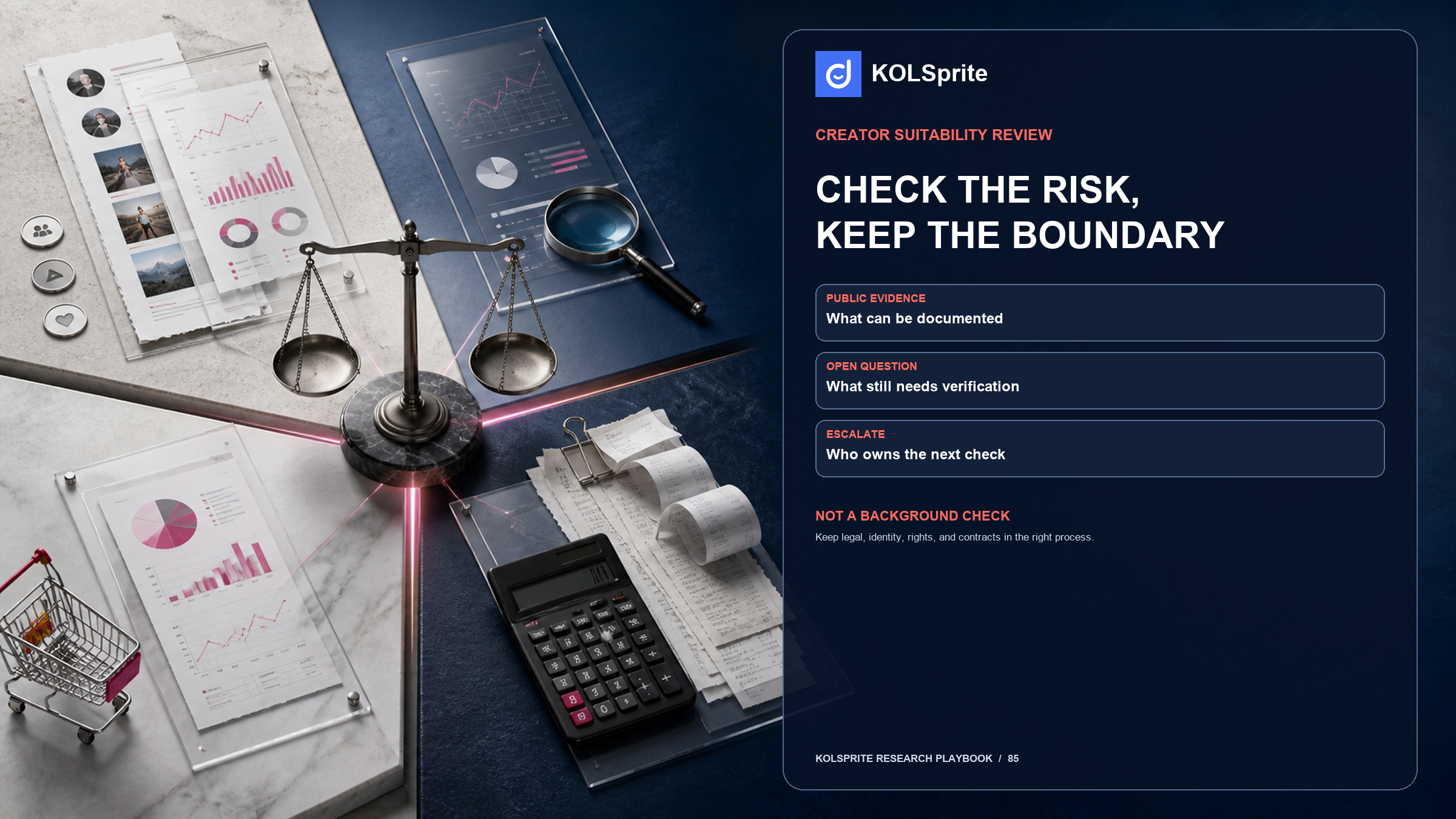
Small and mid-sized brands need a fair check before they contact or brief a creator. Yet public browsing cannot prove everything about a person. Keep the review within clear limits. Record relevant public evidence, separate what you saw from what you think it means, list open questions, and choose the next step. This guide gives you a five-part Suitability Review Card and an escalation path. It helps a team proceed, ask one focused question, seek specialist review, or stop. It does so without invasive or unsupported claims.
TikTok creator vetting should review public fit for the work, not a person’s private life. Read relevant content in context. Record what you saw and when. State what you do not know, then make a narrow choice. The result is a fair record, not a hidden score.
TikTok’s Creator Suitability Report supports creator review within the platform. Brand judgment still decides the action, and the report offers no promise of a good outcome. TikTok’s Creator Suitability Report overview explains the scope of that product.
Write the work question first. It may be: “Can this creator show this everyday product in a credible way?” “Does a public content pattern conflict with our stated brand rules?” “Do we need to ask about a disclosure or claim before the brief?” One clear question keeps the review tied to the work.
Private facts are outside the scope. Protected traits, guessed motives, and claims that public material cannot support are also outside it. Collection stays limited to material that matters to the planned work. The goal is a fair review of public work risks and open questions, with a written record.
TikTok gives creator and business accounts rules for promoting a brand, product, or service. Use the current rules as a guide for paid or promoted content. You still need your own fair review process. TikTok’s promotion guidance is the right source for that platform rule.
Bounded example: Observation: a recent video shows a very broad result for this type of product. Interpretation: the creator may need clear claim limits before discussing our item. The post says nothing reliable about intent, past conduct, or future conduct. Route: ask one focused question and share approved product claims before the brief.
That wording matters. It records a work risk without turning one fact into a judgment about character. It also gives the creator a fair and specific chance to respond when a response makes sense.
KOLSprite can support the public-content review and shortlist stage while your team keeps legal, rights, identity, and contract checks in the right systems.
Register and claim a three-day trial
Use two short fields for each key note. In the first, state the fact you can see: “Video posted on [date] includes a paid promotion label,” or “Recent content often uses broad claims for similar products.” In the second, state your working view: “We need a clear approved-claims brief,” or “Send the public brand-context question to the named reviewer.”
Never blend the two fields. When fact and inference share one sentence, a team can forget what it knows. Keeping them apart also makes the review more fair. Another person can see the same evidence and disagree with your reading. Both people can still work from one record.
Use a fair review window that fits the planned work. Do not dig through years of unrelated content. Context matters. Format, date, role, and the rest of the creator’s relevant work can change what one post means.
Creators who endorse a product should make material ties clear. The FTC’s guide for social media influencers explains why clear disclosure matters and gives practical examples. Keep FTC Disclosures 101 for Social Media Influencers in your set of compliance sources.
A suitability review leaves legal issues with the right specialists. Its job is to spot the question early. Does this product need set claim wording? Does the brief need disclosure steps? Does the planned use involve rights or a category rule that needs specialist approval? Each question goes to the right owner.
Keep the message to the creator plain. Explain the product claim limit, what disclosure you expect, and where questions should go. Do not send a long risk memo when one clear brief and one honest question will do.
Use KOLSprite to review public profiles and relevant videos in context. Save dated evidence and say why it matters. Keep facts apart from your inferences. This creates a clear research trail from profile review to outreach, a question, specialist review, or a stop.
Before the suitability step, use these creator engagement benchmarks by niche to keep public analytics in context. They keep the review on public work tied to the campaign. The system can support evidence capture and handoff. It leaves judgments about character or legal status outside the workflow.
KOLSprite supports the public research step rather than legal due diligence, private background checks, identity checks, rights review, disclosure approval, or a brand-safety guarantee. Those choices belong with approved specialists and processes. That tool limit is part of a fair review. It is not a minor admin point.
| Route | Use when | Required record |
|---|---|---|
| Proceed | Public relevance is clear and no material unanswered issue is visible. | Fit reason and normal brief requirements. |
| Ask | A narrow, answerable question would clarify the collaboration. | Question, owner, and response deadline. |
| Escalate | A claim, rights, policy, or brand-safety issue needs specialist judgment. | Observed evidence, scope of question, and decision owner. |
| Stop | The public evidence conflicts with a clear, relevant collaboration boundary. | Proportionate reason and review date if appropriate. |
Do not use “monitor” as a final route. It often hides a choice. If you need more evidence, state what you need, who will review it, and by when. If a key concern cannot be settled fairly with public facts, seek specialist review. Do not guess.
Join the KOLSprite Discord to compare practical public-signal reviews, escalation rules, and the questions that still require direct verification.
 +
+
Join the KOLSprite Discord community
Ask four questions. Does this evidence matter to the actual work? Did we record a fact instead of a rumor or impression? Did we state the limits of our inference? Would another reviewer know why we chose this route?
Then ask if the review fits the size of the choice. A small product seeding may need a simple public relevance and claims check. A larger paid deal or rights-based use may need a broader formal process. Let the work set the size of the review. Curiosity should not set it.
Keep contract terms separate from suitability notes. When the work moves ahead, use an approved agreement process. Put scope, items due, rights, payment, and required disclosure there. This TikTok influencer contract template guide is a useful first source for that line.
The final record should include the campaign question, dated public evidence, fact, inference, open question, route, owner, and review date. Leave out labels based on guesswork, private details, and claims the evidence cannot support.
TikTok creator vetting is more reliable when the team can explain what it saw and what it chose not to assume. This protects creators from unfair treatment. It also protects the brand from casual choices with no record.
Once a creator moves ahead, return to the work they can do for the buyer. A campaign still needs a product proof task, not just a clearance status. This guide to TikTok UGC strategy for ecommerce brands can connect the approved brief to a useful role for the audience.
For routine work, keep the review short and focused. In the first minute, state the campaign question and read the most relevant recent public work. In the second, separate facts from inferences. Flag any claim or disclosure question. In the third, choose the route and name the owner. Speed is not the main goal. This short path keeps a fair review from growing into an unsupported probe.
When the route is “ask,” make the question narrow and respectful. Ask about an item due, a product claim limit, or a disclosure process. Do not ask a creator to explain private matters or defend a broad impression. A key question may be hard to ask fairly. If so, send it to the right specialist instead of doing more public browsing.
A good card lets another reviewer see what happened without doing the search again. Save relevant public links or references, dates, the fact, your inference, the owner, and the final route. Do not save unrelated material just because it is public. It may confuse the record or be unfair when someone reads it later.
Set a review date when a choice depends on current public context. Content can change. Product needs can change. An old fact can lose its link to the work. A dated record stops the team from treating an old note as a lasting label. It also gives the team a calm way to reopen the choice when the campaign or evidence changes.
Sometimes the right choice is to stop. The note should say only what is needed: the work boundary, the relevant public fact, the limit of that fact, and the owner of the choice. Do not make a broader claim about the creator. A fair, limited record serves the brand and respects the person under review.
This standard helps with more than brand safety. It improves daily judgment because the team states what it knows, what it does not know, and what comes next. That is the core of a sound suitability process.
Latest Articles
As an essential, data-driven toolkit for TikTok influencers and marketers, KOLSprite provides powerful features for effortless creator discovery, trending content identification, and actionable real-time insights.
It empowers users to make smarter decisions and significantly boosts their TikTok business.
 Refer & Earn