 +
+
A skincare content lead reviews high-view rival videos to choose the next set of content tests. The goal is not a swipe file of claims to copy. A TikTok competitor video audit should keep the buyer problem and proof question. It should inform the framing and test setup. The result is a five-column Content Test Slate: observed buyer problem, proof device, format tension, new test idea, claim owner, success signal, and stop rule.
Ten-second answer: use a rival's reach to find a question worth examining, then make a new claim-safe test. Views alone do not show repeatability, proof, paid support, sales, or a clear causal link.
A video with a large play count can make the content choice feel obvious. In skincare, that feeling creates two risks. The first is that the team mistakes reach for a sound business result. The second is that a narrow promise becomes a copied health or efficacy claim. The useful move is to split the buyer problem from the rival's work. A buyer concern can be real even when the rival's precise wording, implied result, or proof standard should not be reused.
TikTok's beauty materials can help a marketer know the category's content setting, but they are not proof for product claims. TikTok's beauty playbook belongs beside content planning, while claim substantiation remains separate. The FTC's health-products compliance guidance makes the limit clear: health-related claims require appropriate support. A rival's video is not that support.
| Observed video pattern | Scoped signal | Creative tension | What stays unproven |
|---|---|---|---|
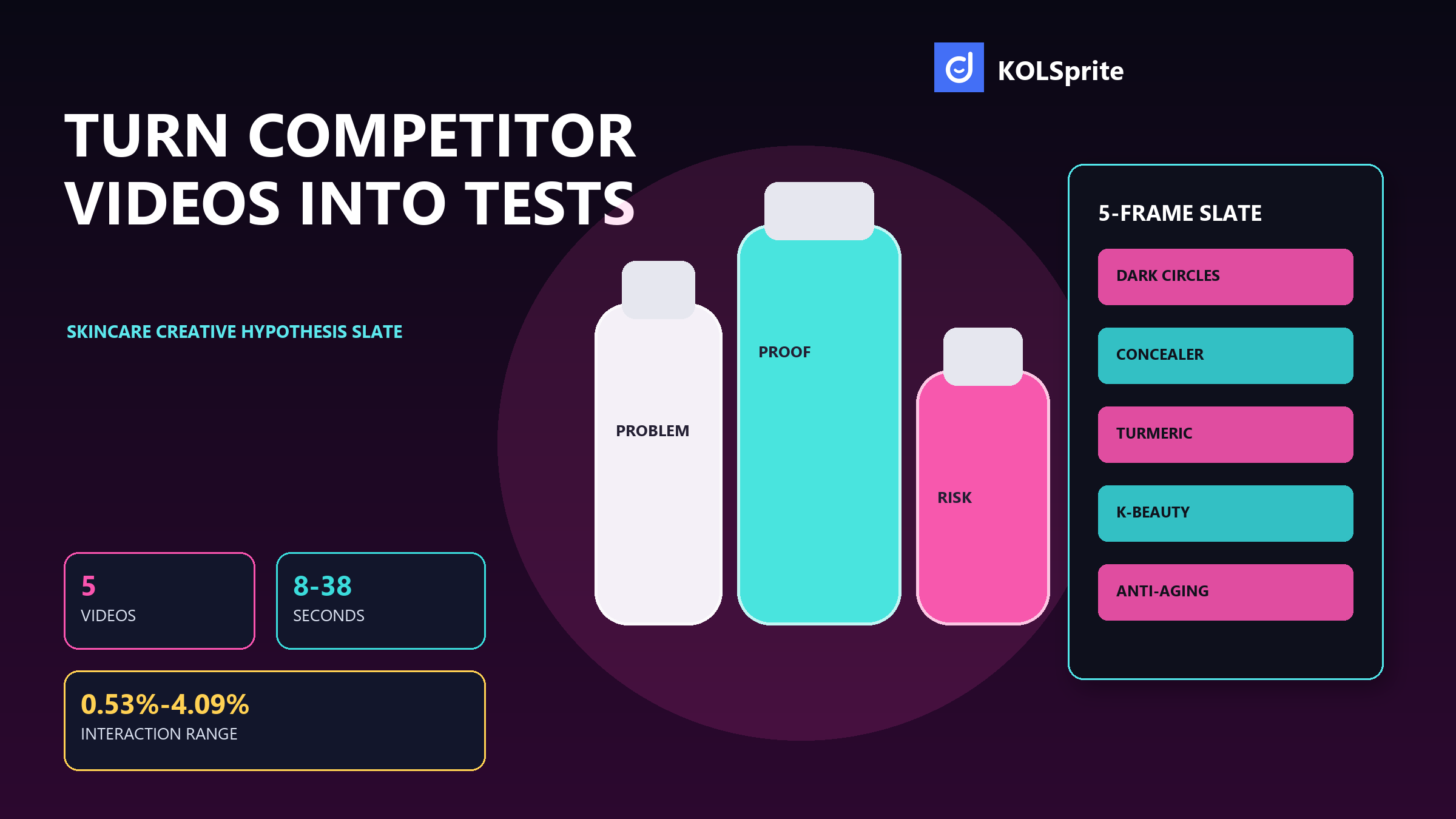
| Narrow buyer problem | 5 US commerce videos | Specificity can make a hook clear | That the claimed outcome is substantiated |
| Short outcome framing | 8-38 seconds | Speed can sharpen a proof question | That the result is repeatable |
| Wide reach | 1.7M-29.3M plays | Reach and interaction may diverge | Paid support, conversion, margin, or sales effect |
| Interaction range | 0.53%-4.09% | A pattern can invite review, not a winner label | Audience intent or creative causation |
Scope: public US commerce-video pattern board for skincare creative research. Market: US. Access date: 2026-09-01. Sample: 5 videos, 8-38 seconds, 1.7M-29.3M plays, and 0.53%-4.09% interaction. Cleaning: extreme sales outlier excluded from public use; observed narrow problems and outcomes retained as pattern context. Limit: titles and structured metrics do not show full visuals, paid support, comments, margin, conversion, or substantiation; no medical or efficacy claims may be copied.
The table does not find a formula. It shows why a lead should be cautious with surface trust. A video can have more plays and lower response than another returned video. A concise title can sound like proof without revealing the visual context, the comments, or the support behind the claim. The sample provides candidate tensions, not a leaderboard.
Clear problem versus broad promise. A narrow buyer problem may create a clearer entry point than a generic beauty claim. The new test should describe a product-use question the brand can support, rather than repeat a rival's promised outcome.
Fast format versus enough proof. An 8-38 second frame can give a test discipline: what must a viewer know in a short time? The answer may be a visible product-use moment, a texture cue, or an honest limit. It cannot be a compressed claim with no proof owner.
Reach versus response context. The 1.7M-29.3M play and 0.53%-4.09% response ranges show that reach and response are not the same signal. They should lead to a review of the framing, not a conclusion that one result will transfer to another product or buyer.
Register for KOLSprite and claim a three-day trial to search public commerce videos, compare patterns and outliers, and record original test hypotheses.
Register and claim a three-day trial
Before writing a test idea, find any sentence or implied claim that may need support. A rival's framing may imply that a product treats a state, changes a bodily function, or produces a clear result. Do not use that framing as a test idea. Ask the claim owner if the brand has proper support and if the wording is allowed. If the answer is no or unclear, revise the test idea. Focus it on an observable product-use question, not an unsupported result.
This does not make the work bland. It makes the proof question more useful. Instead of reusing a promise, the team can test whether a particular use, routine moment, texture, or use constraint helps a buyer know the product. The limit keeps the content team from using a rival's reach as a substitute for claim review.
Each row begins with an observed buyer problem, stated without reuse language. Next, name the proof device: a visible use moment, a routine context, a review that the brand can support, or another honest demo. Add the format tension that makes the test meaningful, such as a tight opening against a fuller explanation of a use case.
Then write the new test idea. It should say which content approach the team will test, not what result the product will guarantee. Add the claim owner, a success signal that the team can measure in its own program, and a stop rule. The stop rule may be lack of approved proof, a claim concern, a poor fit with the buyer problem, or a result that does not justify further iterations.
| Observed buyer problem | Proof device | Format tension | New test idea | Owner, signal, and stop rule |
|---|---|---|---|---|
| State the buyer question without reusing a claim | Name an honest product-use demo | Define the content choice being tested | Test a content approach, not a guaranteed outcome | Assign claim proof; use the program's signal; stop when proof or fit fails |
For example, the row can say: observed buyer problem: a customer wants to know how a product fits into a routine. Proof device: a clear, ordinary use context. Format tension: a narrow opening with enough context to avoid overclaiming. New test idea: test whether a routine-focused demo improves understanding of the use moment. claim owner: brand or regulatory team. This is a usable test idea without borrowing an efficacy promise.
KOLSprite can help search and compare public commerce videos, find patterns worth testing, and keep the limits attached to the review. It does not create a leaderboard, certify a claim, or supply full visual, paid-support, comment, margin, sales, or proof. Start by mapping claim boundaries with this competitor claim map, then use a views-based review shortlist to keep reach in its proper place.
The workflow is bounded: search returned public videos, compare the observed framing, state the limit, and turn only the defensible tension into a new test. A human team still needs to inspect the actual video, apply brand standards, and obtain any proof required for the final claim.
A useful review note states the finding and the limit as one. A narrow product-use problem appears in the returned titles and context. The public record does not prove the claim, visual conditions, or sales effect. This note is more useful than a list of viral examples. It tells the content team exactly what it may review and what it must not infer.
KOLSprite keeps that review note tied to the returned public context, while claim approval and the final creative decision stay with the brand team.
Join the KOLSprite Discord to compare the evidence limits and the next test with other ecommerce operators.
 +
+
Join the KOLSprite Discord community
The choice is earned when the slate names a buyer problem, a new proof device, a claim owner, and a stopping point. That is more valuable than selecting the highest-play rival video, because it leaves the lead with a test that can generate learning without importing another brand's language or risk. When the test idea is ready for a creator brief, move it into creator-ready tests. The tradeoff is clear: a safer, new test idea may be less dramatic than a copied claim. But it creates proof the brand can examine rather than a borrowed impression of trust.
Use the slate to make the content review more exact. “Observed buyer problem” should be a plain description of a question a viewer may have, not an imported diagnosis. “Proof device” should be something the brand can show or explain honestly. “Format tension” should describe a real content choice, such as whether a short opening leaves enough room to make a use case clear. These fields keep the team focused on what the observed pattern actually supports. The new test idea should be narrow enough to fail. A broad statement such as “educational content will work” cannot teach the lead much. A bounded premise about one routine moment, one shown product question, or one approved review gives the team a state it can test. The success signal belongs to the brand's own program and should be chosen by the person responsible for the test. It is not supplied by the returned public response range.
Claim review should happen before production, not after a persuasive edit exists. The proof owner needs to assess the planned words, visuals, implications, and any review in the intended context. Where support is missing, change the test idea or remove it. That process protects both the brand and the reader from treating rival framing as a shortcut around proof. The excluded extreme sales outlier is another useful restraint. A single unusual result can dominate a conversation and pull a test slate toward imitation. Keeping it out of public use preserves the bounded pattern board: five videos with observed play and response ranges, not a claim about sales or a model for reproducing an odd case. The point is to learn from a pattern without pretending the pattern explains every outcome.
After a test, retain the test idea, approved claim limit, execution state, and stop decision as one. That record lets the next lead distinguish a test result from a claim choice and from a distribution effect that the public sample could not show. A well-kept slate becomes a source of new learning precisely because it does not borrow trust from a rival's metrics. Use a slate review to challenge any row that sounds interchangeable with another brand's ad. If changing the product name would leave the sentence intact, the row probably needs a clearer buyer problem or proof device. If the line depends on a result the brand cannot support, it is not ready for a content test. Those checks make a TikTok competitor video audit practical rather than decorative.
The lead's next move is therefore modest and useful: select the test idea whose buyer question is clearest, whose proof can be shown honestly, and whose limit has an owner. That test may not repeat the most visible rival pattern. It will, however, give the team a result that it can review on its own proof and decide whether to develop or stop. A TikTok competitor video audit earns its place when it leads to that new choice.
Latest Articles
As an essential, data-driven toolkit for TikTok influencers and marketers, KOLSprite provides powerful features for effortless creator discovery, trending content identification, and actionable real-time insights.
It empowers users to make smarter decisions and significantly boosts their TikTok business.
 Refer & Earn