 +
+
An ecommerce creative lead staring at an AI-generated TikTok script has one decision to make before it reaches a creator: approve the idea, rewrite it, or throw it out. The direct answer is simple: treat the output as a test draft, not finished copy. A TikTok script generator can get a team to a useful starting point fast, but it cannot tell whether a claim is proved, whether a real person would say the line, or whether the scene can be shot with the brief at hand. This clinic gives you a Script Reality Check, then shows how to turn a polished but stiff draft into a creator-ready test without sanding off the evidence that made the idea worth testing.
Read the first ten seconds aloud. If the speaker sounds like they are delivering a product page, the draft needs work. If the hook makes a clear observation, points to a visible problem, or promises a demonstration the creator can actually make, it may have a viable core. That is the standard. The purpose of a TikTok script generator is to reduce blank-page time. It does not remove the editor’s job of deciding what can survive contact with a camera.
TikTok’s own Creative Assistant material describes AI help as a way to develop ideas and creative direction. Its Creative Center playbooks also put the emphasis on native, creator-led creative and the way an ad feels in feed. Those are useful boundaries for a review room. Generation can suggest a shape. The team still has to judge proof, voice, and the action the viewer should take.
Consider this common output for a skincare product: “Say goodbye to dull skin with our revolutionary balm. Its powerful formula delivers radiant results in seconds. Click now and transform your routine.” The copy has a hook, benefit, and call to action. It also gives a creator almost nothing honest to perform. “Revolutionary” cannot be shown. “Radiant results” has no defined proof. “In seconds” invites a claim the scene may not support. The final command lands as a paid line because it is one.
Keep the underlying opportunity if the product has a real use moment: a person applies a balm before leaving the house, notices its finish, and wants to show the texture. Cut the inflated language. Rewrite the claim around what the camera can capture and what the creator can say in their own words. A working script is a short set of conditions for a test, not a miniature commercial.
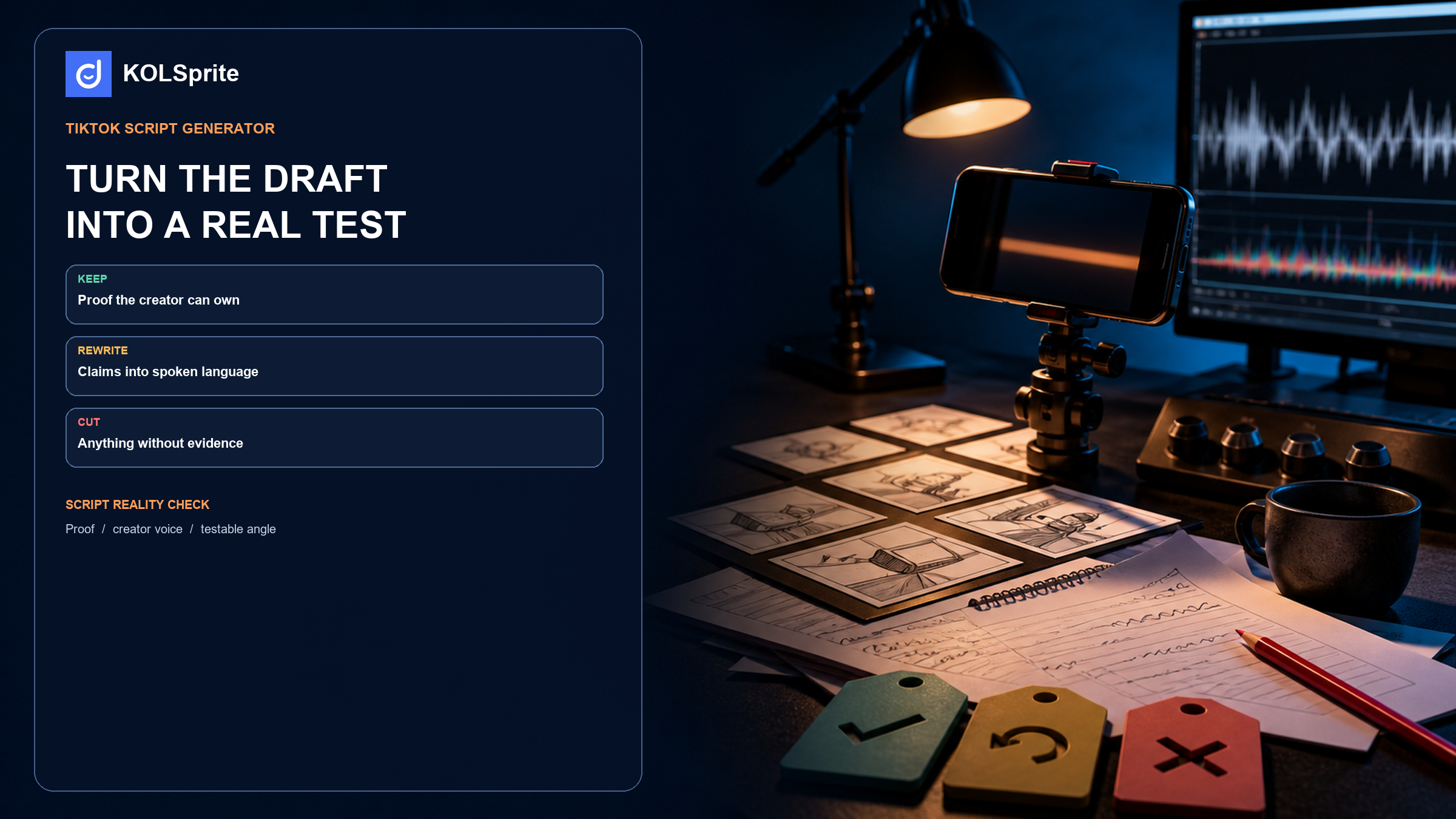
Use three marks in the margin: keep for a specific, observable idea; rewrite for an idea that needs plain language or a better scene; and cut for a claim with no evidence, a borrowed creator voice, or a line that only exists to fill a template. This is faster than polishing every sentence. It also keeps the team from saving a bad premise through better adjectives.
| Draft line | Editor’s mark | Reason | Creator-ready direction |
|---|---|---|---|
| “Say goodbye to dull skin.” | Rewrite | The problem is broad and sounds scripted. | Open on the creator’s real pre-event routine and name the moment in their language. |
| “Revolutionary formula.” | Cut | No camera proof or defined meaning. | Show the balm texture and application if that is the product fact being tested. |
| “Radiant results in seconds.” | Rewrite | The timing and result need support. | Describe only the visible finish in the recorded scene; route product claims through approved copy. |
| “Click now.” | Keep, softened | A next action can be useful after proof. | Let the creator close with the product name and the offer language supplied for the test. |
Source and scope: the review principle is informed by TikTok’s Creative Assistant guidance and Creative Center materials on Spark Ads creative and creative acceleration. The table is an editorial example, not a performance prediction or claim approval.
Use KOLSprite to inspect public videos and language patterns before you decide which proof a creator can make their own.
Register and claim a three-day trial
The rewrite begins with the one fact that deserves to stay. It might be a visible texture, a before-and-after process that is permitted to show, a price point supplied by the brand, or a customer question that the product can answer. Put that fact in the brief. Then leave space around it. Specify the opening situation, the proof beat, any non-negotiable disclosure, and the offer language. Do not write every breath between them.
For the balm example, a usable direction could read: “Film your usual getting-ready moment. In the first few seconds, show why you reach for this balm. Include a close shot of application and describe the finish only as you see it. Use the approved product and offer details at the end. Do not promise a medical result or copy this wording.” That direction protects the test while leaving performance to the creator.
Join the KOLSprite Discord to share a creative review question with people who also need scripts that can survive a real recording session.
 +
+
Join the KOLSprite Discord community
This distinction matters when a team compares creative later. A script with one fixed line, one fixed camera angle, and one fixed result cannot tell you much about the creator’s contribution. A compact brief makes the variable clearer: did the hook earn attention, did the proof make sense, and did the creator’s interpretation fit their audience?
Hand the draft to someone who did not write it and ask four questions. Can they explain the product without reading the text? Can they picture the first shot? Can they replace the hook with a natural version while preserving the point? Can they identify a line they would refuse to say? A “no” to any of these questions is a signal to revise the brief, not pressure the creator into a stiff take.
Look for borrowed rhythm too. Many AI drafts use compressed superlatives, tidy lists, and generic turns such as “here’s the secret.” A creator may make those phrases work, but a brand should not assume they will. The test should make room for a personal routine, a genuine objection, or a more direct observation. That is where the video becomes recognizably theirs rather than an ad read with a familiar face.
Before approval, score the draft against five editorial questions. Is there one clear claim that can be supported? Is the first scene shootable with ordinary creator equipment? Does each required line have a reason to exist? Can the creator change the phrasing without changing the test? Is the final action tied to the proof rather than pasted on? A script that fails two questions should go back to the brief. A draft that fails the first question should be discarded, because strong delivery cannot rescue a claim without a basis.
Write the decision beside the script: approve the core idea, preserve only the evidence, or start again. This prevents a familiar failure mode: a team keeps revising wording for an hour after it has already decided the premise is wrong. The label also gives the next reviewer context when the result comes back.
A useful review starts before the generator runs. Inspect public videos, subtitles, and comment language around the problem you want to test. The goal is not to copy a creator’s script. It is to notice the words people use for the moment, the questions that repeat, and the kind of proof viewers ask for. KOLSprite can support that public-content research by helping teams inspect videos and related text, analyze hook, proof, and call-to-action patterns, and organize the findings into a new brief. For a closer look at the inputs, see the TikTok video analyzer creative-brief workflow, using comment questions for UGC scripts, and TikTok transcript research.
The order matters. Observe the public material, write the test condition, draft the script, then let the creator perform it. Generation comes in the middle of that process. It should never become the source of proof.
Do not ask KOLSprite or a script generator to certify originality, rights clearance, transcription accuracy, creator performance, or viral results. Those are separate questions, and several require a human, a contract, approved claims, or a post-publication review. Public examples can inform a creative hypothesis; they cannot transfer permission to reuse a person’s words, footage, or identity.
Approve the next test when the brief names what viewers will see, what the creator may change, and what result will count as useful learning. The cleanest script on the page is rarely the best reason to send one.
When the video returns, place the original draft, the marked-up revision, and the creator’s final interpretation beside one another. The purpose is not to grade the creator for changing a line. It is to see whether the change protected the proof or changed the test. A concise record might say that the creator replaced the opening phrase, kept the visible application, omitted an unsupported benefit, and used approved closing language. That lets the next editor learn from the version that was actually filmed.
It also stops a team from treating a weak result as a verdict on “AI scripts.” The hook may have been wrong, the offer may have been unclear, the creator may have had too little room, or the product fact may not have been compelling on camera. Mark the uncertainty honestly. The better review question is whether the draft produced a clean enough test to teach the team something.
Latest Articles
As an essential, data-driven toolkit for TikTok influencers and marketers, KOLSprite provides powerful features for effortless creator discovery, trending content identification, and actionable real-time insights.
It empowers users to make smarter decisions and significantly boosts their TikTok business.
 Refer & Earn