 +
+
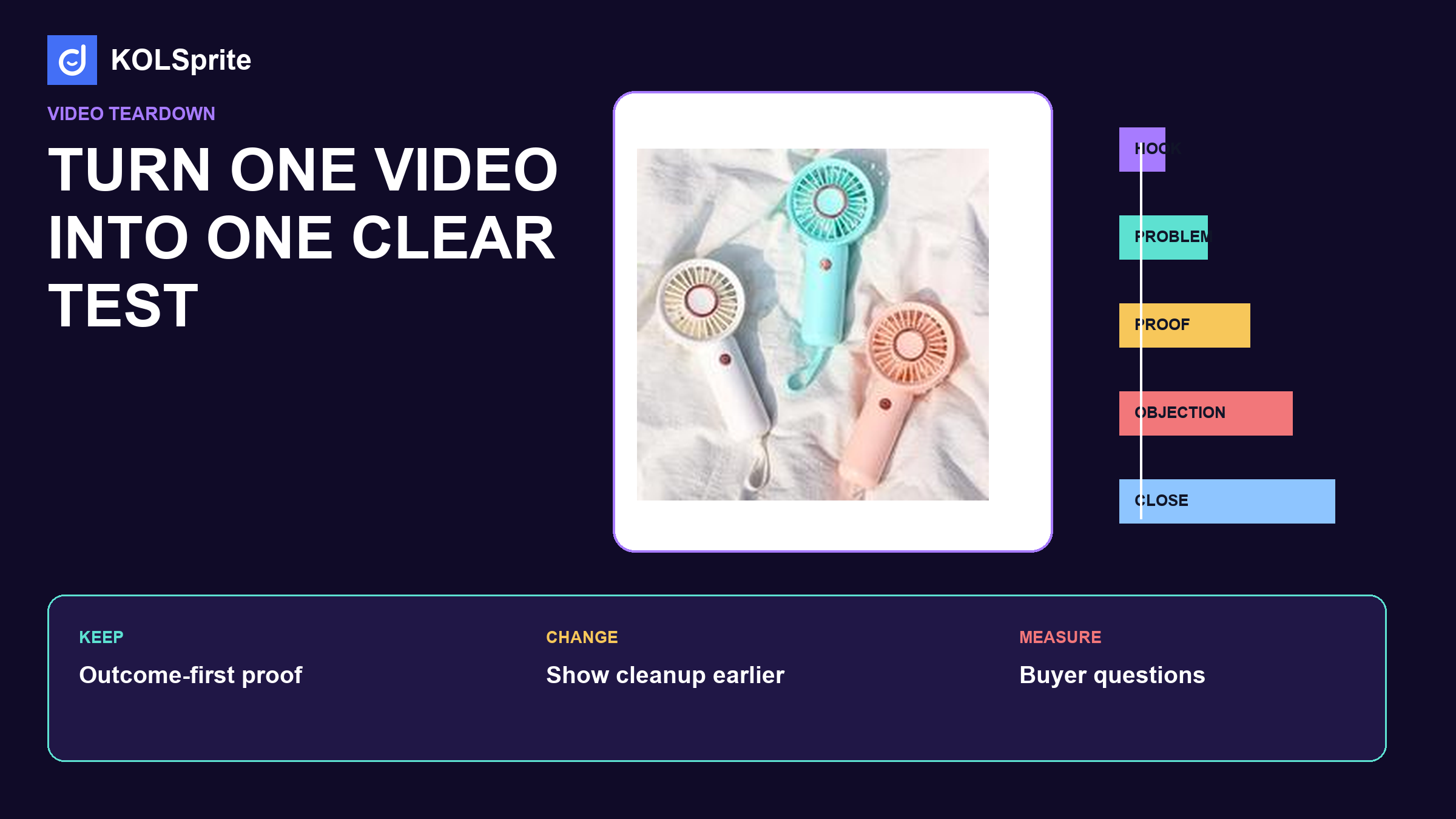
If you lead ecommerce content, you do not need another tool that says a video has a good hook. You need to know what to keep, what to change, and what the next creator should film. This guide uses a TikTok video analyzer as a decision process, not a score. You will break one video into five parts: opening, buyer problem, proof, objection, and close. Then you will produce a testable brief with one controlled change. The rule is to copy the job each scene performs, never the creator's words, face, or exact sequence.
“Fast pace,” “strong hook,” and “authentic style” are descriptions, not instructions. A useful analysis names the buyer question, the proof shown on screen, the time it appears, and the one variable the next test will change.
Do not ask why the video went viral. Ask what the viewer understood before deciding to stay.
Start with a business question. You may need a better first three seconds, a clearer product demo, a shorter explanation, or a safer way to answer one objection. Choose a video that appears to solve that exact problem. A top-played clip may be useful, but it is not automatically the best teacher.
Use KOLSprite to filter and sort relevant videos while you browse. Save the product, creator, length, publish date, visible metrics, caption, and source URL. If the video is linked to a product, keep that product ID with the record. This prevents the team from analyzing a clip after losing the offer and item that gave it context.
Create a simple five-row timeline. The opening earns attention. The problem gives the right viewer a reason to care. The proof makes the claim visible. The objection lowers doubt. The close tells the viewer what to do or remember. A video may change the order, combine two jobs, or skip one. Your analysis should record what happened, not force every clip into the same shape.
| Video job | What to record | Question for the next brief |
|---|---|---|
| Opening | First image, first words, and implied viewer | Will the target buyer know this is for them? |
| Problem | Daily friction or desired result | Is the problem specific enough to recognize? |
| Proof | What changes on screen | Can another creator repeat it honestly? |
| Objection | Price, setup, size, trust, or effort | Which doubt is answered and which is ignored? |
| Close | Action, summary, offer, or unresolved loop | Does the next step match the viewer's readiness? |
A video record may show plays, likes, comments, length, creator size, and product-linked sales fields. Those are observations. “The hook caused the sales” is a guess unless you have a controlled test. Keep the two columns separate. This makes the analysis more honest and more useful.
In a handheld-fan sample, five product-linked videos ranged from 7 to 38 seconds. Visible plays ranged from about 1,500 to 119,600, while creator accounts ranged from about 10,900 to 96,200 followers. The shortest video had the most plays in this small set, but it did not have the strongest recorded product result. That contrast shows why a team should not treat length or reach as the answer. The next brief must test a scene and a buyer question.
Research note. KOLSprite product-linked video records for one handheld fan, product ID 1730926681274159119; US market; accessed July 28, 2026. Five records were used to compare length, reach, creator size, and visible product fields. This small set does not provide a controlled causal test or a category benchmark.
A transcript helps you see the promise, sequence, and repeated phrases. Comments can reveal questions the video created or failed to answer. Neither should be pasted into a report without a task. Highlight only the lines that affect the next creative choice.
KOLSprite can support this work while the team stays close to TikTok. Use video search and filtering to select the right example. Use subtitle or script analysis when it is available for the video, then compare the words with what the screen proves. If comments are part of the decision, use the AI comment analysis workflow to cluster buyer questions, and verify important themes against the original comments.
Assume the chosen clip opens with the fan next to a makeup bag, then shows three speeds and a short outdoor use moment. The opening job is situational attention. The problem is heat during makeup, travel, or a long day outside. The proof is visible speed control and use close to the face. The likely objections are noise, battery life, size, and whether the airflow is strong enough. If the clip does not show sound or charge state, those remain open questions.
The next brief should not repeat the creator's wording or setting. It should preserve the quick use case and change one variable: show a simple sound comparison before the lifestyle scene. The team can then compare whether that objection answer improves qualified comments, product-page visits, or conversion.
| Observed choice | Why it may work | What remains unknown | Next test |
|---|---|---|---|
| Fan and makeup bag appear first | Names a real heat moment fast | May be too narrow for outdoor buyers | Keep the moment, test a second use later |
| Three speeds are visible | Turns a feature into proof | Airflow strength is still hard to judge | Use one simple visible comparison |
| Outdoor use appears | Connects the item to a day | Noise and charge concerns remain | Show sound or battery state |
| Short close | Keeps pace | May leave one key question unanswered | Answer one objection before CTA |
The brief needs six fields: target viewer, buyer moment, opening promise, proof shot, objection answer, and one test variable. Add claim boundaries and the product facts the creator must confirm. Leave room for the creator's voice. A brief that writes every sentence often removes the reason you selected that creator.
For the fan example, the target viewer is a traveler who wants fast relief without carrying a large device. The opening promise is “cool air when your day does not stop.” The proof is a speed change plus a close-use shot. The objection answer is noise. The test variable is whether the sound comparison appears before or after the lifestyle scene. Everything else stays as steady as the channel allows.
Use a five-point check for the output: the right viewer is clear, the proof is visible, the main claim is supported, the objection answer is easy to find, and the final action fits the message. This score evaluates whether the brief worked. It does not turn a creator into a permanent number.
If the result fails, identify where the instruction broke. Perhaps the buyer moment was too broad. Perhaps the proof required a condition the product could not meet. Perhaps the creator improved the idea in a way the scorecard did not expect. Keep that learning in the next brief.
Do not copy the creator's script, jokes, visual identity, home, or personal story. Do not download a video and treat it as free commercial footage. Do not claim that an observed product-linked sales field proves the video caused the purchase. Research gives you a pattern to test, not ownership of someone else's work.
TikTok's official creative solutions overview is a useful reference for the platform's current creative tools and services. Use official product pages for feature boundaries, then keep your own teardown tied to the exact source video and business question.
The TikTok UGC strategy guide helps turn several ethical teardowns into a broader content system. Use it after you have two or three distinct buyer moments, not before. A large strategy deck cannot rescue a weak proof shot.
A useful TikTok video analyzer can speed up the first four steps, but judgment still matters. The team must decide which proof is honest, which idea fits its product, and which change is worth testing. That is why the analysis should end with a brief, not a page of labels.
The best result is often modest. One clip may teach the team how to show a hard detail or answer one common doubt. That is enough. A clear small lesson can improve the next shoot more than a broad claim about why a video became popular.
Target a traveler who needs quick cooling in a small bag. Open with the fan beside the real use setting. Show the speed change, then test a sound comparison before the lifestyle scene. Keep the creator's own words. Compare qualified product questions and product-page actions against the current version. This is the value of a TikTok video analyzer: one source video becomes one clear experiment.
For a neck fan, the proof may be airflow, noise, comfort, and battery display. For a storage item, it may be size, setup, and the before-and-after. For apparel, fit and movement matter more than a static reveal. The five jobs remain useful, but the evidence changes with the buyer's risk.
Keep a library of completed briefs, not copied videos. Tag each one by buyer problem, proof type, objection, and result. Over time, your team will learn which forms of proof travel across creators and which depend on one person's style. That is a durable content advantage.
Create a KOLSprite account and claim a three-day trial membership. Use the trial to inspect TikTok content signals, save useful examples, and plan the next creative test.
Register for a three-day KOLSprite trial
Share the five-job teardown and the single variable you plan to test. Feedback is most useful when it improves the next shoot instead of guessing why the source video became popular.
 +
+
Workshop the creative brief on Discord
Latest Articles
As an essential, data-driven toolkit for TikTok influencers and marketers, KOLSprite provides powerful features for effortless creator discovery, trending content identification, and actionable real-time insights.
It empowers users to make smarter decisions and significantly boosts their TikTok business.

 Refer & Earn