 +
+
If your content team keeps asking creators to “make something like the viral one,” start with the questions under the content instead. A repeated buyer question gives the next video a job. This guide shows ecommerce teams how to turn TikTok questions into a UGC script without copying a creator or inventing claims. You will get a question-ranking method, a completed pet-hair-remover example, a six-scene script, and a simple way to test one variable at a time.
The best starting point is one repeated question that the product can answer on camera. Write the proof before the hook. Keep the source record, mark the claim boundary, and change only one major variable between versions. The script should help a creator show an honest answer, not recite marketing copy.
A good script closes one buyer gap in a way the camera can prove.
Hook lists are easy to produce and hard to trust. “You need this” or “TikTok made me buy it” can attract a second of attention, but they do not tell the viewer what will be learned. A real question already contains a buyer, a doubt, and a desired answer.
TikTok says its Comment Insights can surface common topics, viewer questions, and content ideas. Questions also expose missing proof. “Does it work on a couch?” asks for a surface test. “Will it pull the fabric?” asks for a risk demo. “Can you wash it?” asks for maintenance. “How loud is it?” asks for an operating condition. Each can become a scene.
Not every popular comment deserves a script. Jokes, unrelated requests, and platform chatter can dominate engagement. The team needs a filter that protects the product and the production schedule.
| Question type | Buyer choice | Camera proof | Priority |
|---|---|---|---|
| Compatibility. | Will it work on my surface, size, device, or routine? | Show the exact condition and result. | High when it blocks purchase. |
| how it works. | How does it remove, seal, charge, or attach? | Show the action without hidden edits. | High when the product is unfamiliar. |
| Risk. | Will it damage, irritate, stain, snag, or fail? | Use a bounded test and state limits. | High, with claims review. |
| check. | Why this format instead of another? | Compare the buyer job, not a broad “best” claim. | Medium to high. |
| Price or offer. | Is the value worth the cost? | Show included parts and repeat use. | Depends on current offer. |
Give each candidate a yes or no for four checks: repeated, useful to the intended buyer, answerable by the product, and safe to demonstrate. If one check fails, do not build the next shoot around it.
We used KOLSprite's US Video Search for “pet hair remover.” The returned records included a grooming vacuum, a washing-machine dissolver, reusable laundry balls, a steam brush, a long-handle fabric tool, and a mini lint roller. These items share words but not mechanisms.
Visible plays in the retained records ranged from about 144,600 to 1.7 million. One washing-machine dissolver video showed 1.3 million plays and 197 comments in the accessed record. A reusable laundry-ball video showed 720,400 plays and 262 comments. A 4-in-1 long-handle tool showed 1.7 million plays and 102 comments. The numbers do not tell us which question belongs to which product. Product identity does.
If a team combines all comments, it may ask a fabric brush to prove what a laundry additive does. The first script step is therefore not writing. It is locking the exact product ID, source video, and buyer job.
Research note. KOLSprite US Video Search for “pet hair remover,” accessed August 4, 2026. Eight records were retained to inspect format and use-case range. Public video fields can change. The MCP did not provide public comment text in this research call, so the worked questions below are clearly labeled as a production exercise, not quoted audience data.
Turn one product-linked question into a visible proof job and an original creator brief. Create a KOLSprite account to claim a three-day trial membership.
Register for a three-day KOLSprite trial
A useful question card has five fields: source, exact question, buyer situation, proof job, and boundary. For the exercise, choose a reusable long-handle pet-hair tool and the question “Does it work on a couch without damaging the fabric?” The buyer situation is a pet owner cleaning a fabric sofa. The proof job is to show hair pickup on one labeled fabric area. The boundary is that fabric types vary and the seller must confirm the approved surfaces and care instructions.
This card is more key than a clever opening. It gives the creator something to solve. It gives the product owner a fact to confirm. It gives the editor a result that must remain visible.
| Scene | Viewer job | Picture | Plain-language line |
|---|---|---|---|
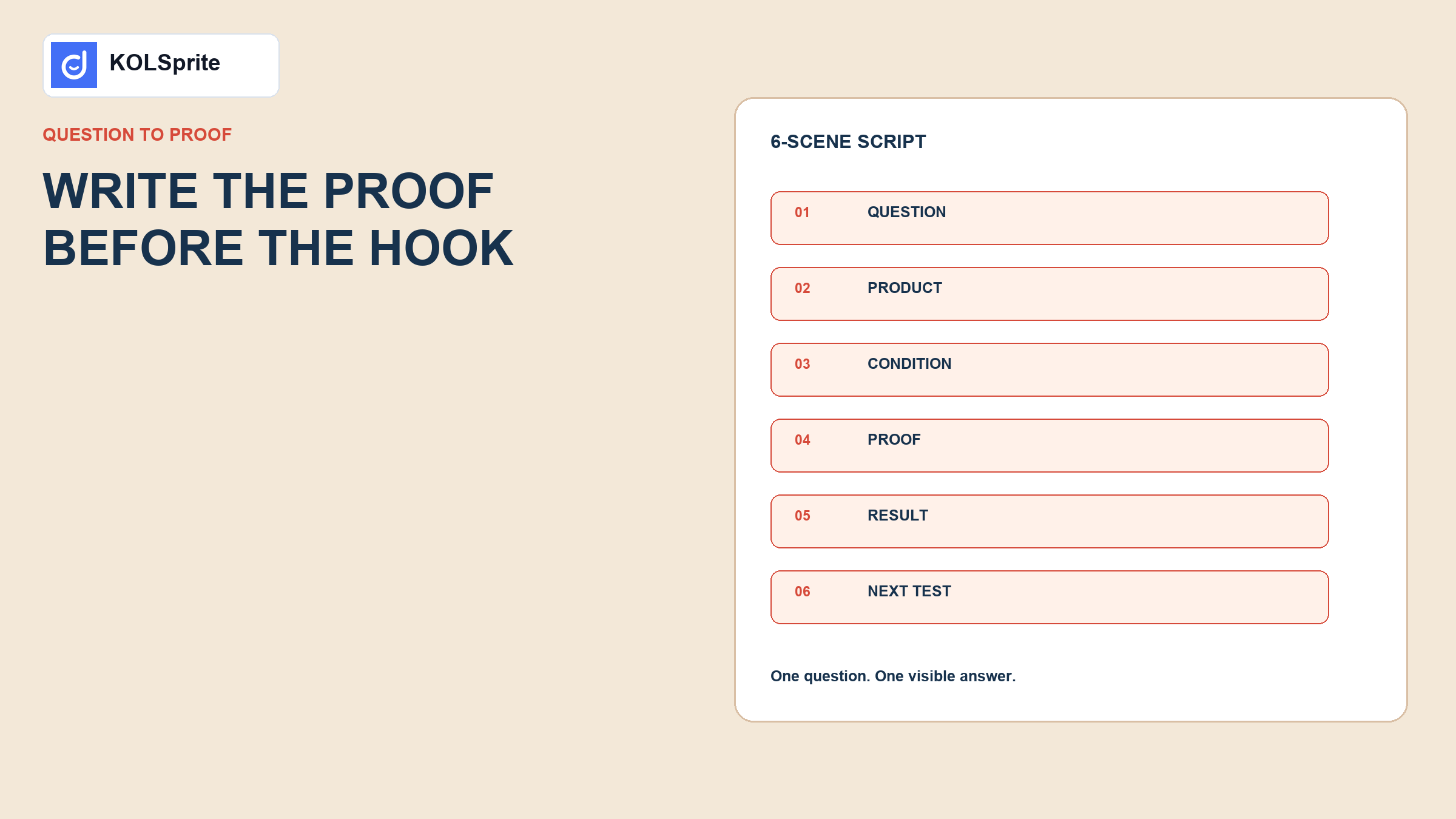
| 1. Question. | Know what will be answered. | Hair on the labeled sofa cushion. | “Will this pick up pet hair from a fabric couch?”. |
| 2. Product. | See the exact tool. | Handle, cleaning edge, and direction of use. | “This is the reusable fabric tool we are testing.”. |
| 3. Condition. | Understand the limit. | Fabric label or approved surface note. | “Check your fabric care guidance first.”. |
| 4. Proof. | Watch the work. | One continuous pass at normal speed. | “Here is one pass with no cut.”. |
| 5. Result. | Judge the answer. | Before and after in the same light. | “It lifted this visible hair from this surface.”. |
| 6. Next question. | Choose the next test. | Tool cleanup and another surface card. | “Next we will test the car seat.”. |
The script avoids a universal claim. It does not promise that every couch is safe. It shows one bounded result and tells the buyer what to check. That is more credible and more reusable than “works on everything.”
Creators need the job, proof, limits, and deliverables. They do not need a paragraph of positioning language to memorize. Mark which facts are required and which words are flexible. Let the creator phrase the question naturally as long as the meaning stays intact.
A stiff line such as “This innovative multi-surface solution efficiently eliminates unwanted pet fibers” will sound like an ad. “I am testing it on this couch because that is where the hair collects” sounds like a person with a reason to film.
Teams can use KOLSprite to study how useful creators normally explain products, but do not copy their wording, edit pattern, music, or identity. Learn the communication job: show scale, reveal setup, compare a condition, answer an objection. Then make an original execution.
Create two or three versions only after the base proof works. Keep the product, question, proof, and offer stable. Change one major variable such as the opening picture, buyer situation, or creator profile. If everything changes, the result will not teach the team what to keep.
For example, version A opens on the hair-covered cushion. Version B opens on the cleaned strip beside the untouched area. Both answer the same question with the same test. Compare qualified watch behavior, item-page actions, or useful comment responses rather than views alone.
Share the question card, six scenes, and claim boundary. Feedback works best when it improves the next shoot rather than copying the source creator.
 +
+
Workshop the script on Discord
Start with KOLSprite Video Search to isolate useful product-linked content and see which formats are being demonstrated. Use Product Search when broad words mix several mechanisms, while browsing TikTok, use KOLSprite's comment-analysis workflow to summarize repeated questions, then open sample comments before treating a topic as buyer proof.
Move the selected question into your own brief with its source and access date. Verify product facts with the supplier, sample, instructions, and claims owner. KOLSprite speeds discovery and setting. It does not prove that a generated summary is full or that a product claim is true.
Include the buyer, exact question, product and variant, proof job, required shot, approved fact, prohibited claim, disclosure, format, deadline, rights request, and one-variable test. Add two examples of what must remain visible, not five competitor links to imitate.
The creator should flag anything that feels unnatural or impossible to prove. A strong creator can improve the scene while respecting the proof. Sign-off should check the answer, disclosure, claim, product match, and final edit.
The first failure is answering three questions in one short video. The second is hiding the proof behind fast cuts. The third is turning a comment into a claim the product has not earned. The fourth is polishing the language until no buyer would say it. The fifth is keeping the comment but losing the product setting.
Another failure is measuring only the hook. A high hold rate can coexist with a weak answer. Track whether the viewer reaches the proof, understands the result, and takes the next action. Read new questions as research for the next script.
Spend five minutes locking one product and buyer. Spend ten minutes reviewing useful videos and sample questions. Spend five minutes selecting one question with a camera answer. Spend five minutes writing the six scenes. Spend five minutes checking the claim, boundary, disclosure, and test variable.
The finished deliverable should fit on one page. If the brief needs several pages of explanation, the question is probably too broad. Narrow it until the creator can describe the task in one sentence.
Use the TikTok content proof-test guide when the team needs a stronger proof rule. The TikTok comments product-research guide helps keep questions separate from broad engagement labels. Before outreach, the influencer vetting workflow helps match the proof job with a creator the public proof can support.
After the video runs, do not ask whether the team likes it. Ask whether the question was clear, the proof stayed visible, the result was honest, and the next buyer action improved. Keep or revise each part separately. A weak opening may need a new first frame. A weak result may need a better test or a different product promise.
Write one sentence for the next shoot: “Keep the continuous couch pass, move the fabric limit earlier, and test the cleaned-strip opening.” That sentence turns content into a learning loop.
A useful UGC script begins with a buyer question and ends with visible proof. Use KOLSprite to find the exact product, useful videos, creator context, and comment themes. Keep the source and its uncertainty. Then give the creator one honest job, one clear boundary, and enough freedom to sound like a person.
Latest Articles
As an essential, data-driven toolkit for TikTok influencers and marketers, KOLSprite provides powerful features for effortless creator discovery, trending content identification, and actionable real-time insights.
It empowers users to make smarter decisions and significantly boosts their TikTok business.

 Refer & Earn