 +
+
If you manage creator samples, affiliate recruitment, or paid TikTok partnerships, incomplete analytics should slow one decision, not stop every decision. The mistake is to treat an unknown field as zero or to hide it inside a single creator score. This guide gives partnership teams a five-gate influencer vetting process for incomplete public data. You will see three creators connected to the same handheld-fan product, learn which facts can be compared now, and leave with a pass, verify, or stop card for the next sample or fee approval.
Use public facts to narrow the list. Turn every missing decision-critical fact into a named verification task. Stop only when a known fact conflicts with the brief, a required check cannot be completed, or the risk is too high for the size of the test.
Unknown is a workflow state, not a bad score.
A spreadsheet can rank three creators even when the inputs are incomplete. That does not make the ranking fair. A creator with missing sales data may receive a zero and fall below a creator with reported sales. A creator with no audience-geography field may be treated as a poor US fit even though the account region is US. A high follower count may compensate for weak recent product behavior simply because the formula allows it.
Scores are useful after the facts share the same definition and the missing-data policy is clear. Before that point, use gates. A gate asks whether the available evidence is enough for the next commitment. A free product sample, a $500 fee, a six-month usage license, and a health claim should not use the same evidence threshold.
Write the creator's job in one sentence: "Show a handheld fan in a realistic hot-weather situation, demonstrate the feature without unsupported health language, and deliver a usable vertical video by the launch date." Add the market, buyer, product, format, due date, compensation type, disclosure requirement, usage request, and one success decision.
This sentence protects the research from a common drift. Without it, the team starts choosing creators it likes and later invents reasons they fit. With it, every field answers a job.
| Gate | What public data can show | What may remain private or unknown | Decision state |
|---|---|---|---|
| Identity and activity. | Stable ID, handle, region, recent posting, visible account. | Identity documents or management authority. | Pass or verify. |
| Product behavior. | Recent product categories, exact linked videos, demonstration style. | Whether the creator still accepts the category. | Pass, verify, or stop. |
| Audience fit. | Public language, themes, and visible community signals. | Current audience geography and buyer composition. | Verify before a market-specific fee. |
| Commercial readiness. | Commerce activity, product count, visible sales fields when returned. | Rate, availability, delivery reliability, conflicts. | Verify. |
| Rights and risk. | Content history and public category context. | License, disclosure process, music rights, claims approval. | Verify or stop. |
Each gate has a purpose. Identity prevents a handle mix-up. Product behavior prevents category labels from replacing recent evidence. Audience fit prevents creator region from being mistaken for viewer location. Commercial readiness prevents a public performance field from being treated as a contract. Rights and risk prevent a downloadable file from being mistaken for permission.
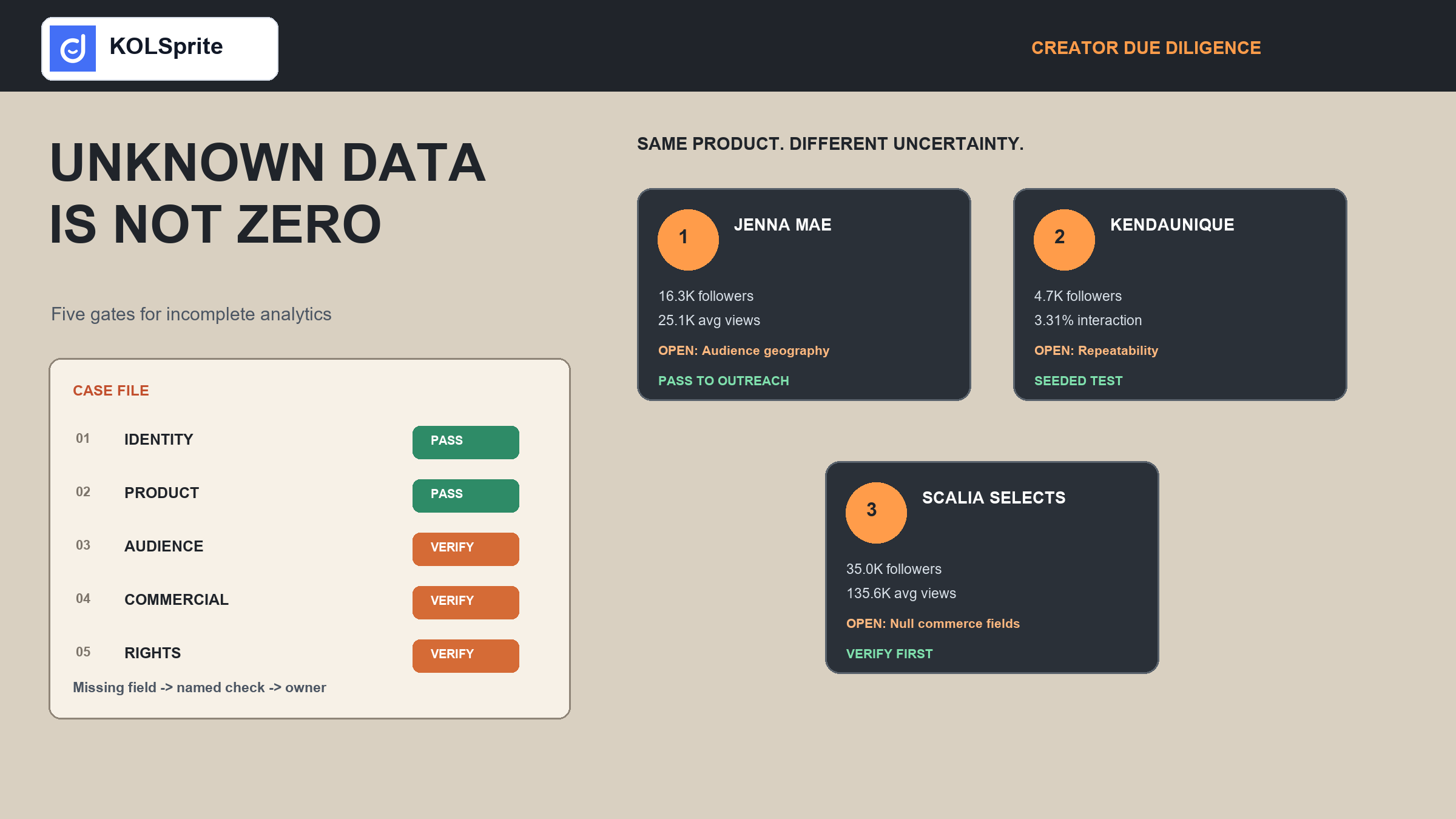
We opened a CoolHill handheld-fan product in KOLSprite and retained three linked creators from high-play video records. We then used exact-handle Creator Search to review the public fields available for `jennam4e`, `kendaunique`, and `scaliaselects`.
The selected records create a useful comparison because each account has different strengths and gaps. Jenna Mae's captured creator record reported 16,309 followers, 25,059 average views per video, a 1.39% interaction-rate field, 348 product categories or product records in the returned count, and a reported commerce-sales field. Fans appeared in the product-category history. Kendaunique's record reported 4,703 followers, 1,912 average views, a 3.31% interaction-rate field, 27 products, and a smaller reported sales field. The selected CoolHill video, however, showed 9.6 million visible plays in its video record. Scalia Selects showed 35,013 followers and 135,597 average views per video, but the returned creator record had null category labels, null commerce sales, null GPM, and null currency while still showing a large product-category history that included fans.
That last record is the test. A careless model turns each null into zero and punishes the creator. A careless manager ignores every null and approves the creator because one video is large. The correct response is narrower: retain the known product behavior, mark the missing fields, and match the verification cost to the commitment.
Research note. KOLSprite US exact product-linked video records and exact-handle creator records, accessed August 3, 2026. Three creators were retained because they were tied to the same product. Public fields can change and do not establish audience geography, availability, rates, rights, delivery reliability, or partnership suitability. Email addresses returned by the tool were excluded from the public article.
| Creator | Known product signal | Known public pattern | Critical unknown | Next decision |
|---|---|---|---|---|
| Jenna Mae. | Fan category present; selected fan video used a theme-park problem. | Broad product history and active commerce context. | Current audience geography and launch availability. | Pass to outreach; request audience and timing proof. |
| Kendaunique. | Selected video demonstrated the same fan and reached a large visible audience. | Smaller account, higher returned interaction-rate field, narrower product count. | Repeatability beyond one outlier and current buyer fit. | Pass to a low-risk seeded test with a defined proof job. |
| Scalia Selects. | Fan appears in product history and selected video. | Strong returned average-view field and broad product behavior. | Null commerce fields, category labels, rate, and audience proof. | Verify before ranking; do not enter zero for missing fields. |
This card does not crown a winner. It assigns a next action. If the campaign needs a theme-park specialist, the content fit matters more. If the team needs a low-cost creative test, a smaller creator with a clear demonstration may be useful. If the fee or rights request is large, missing audience and commercial facts deserve more verification.
Start in Video Search when the content job is specific. An exact product-linked video tells you what the creator actually demonstrated. Move to Creator Search with the stable handle or ID. Compare recent behavior, category evidence, account activity, and returned commerce fields. Save the source and access date.
Then leave the public-data lane. Request the current audience evidence that matters to your market. Confirm fee, deliverables, due date, revision terms, disclosure, usage rights, music, exclusivity, and conflicts. KOLSprite improves discovery and public research. It does not negotiate the agreement, verify a private audience screenshot, or grant rights.
A free sample with no posting promise can use a lighter gate than a paid campaign. A whitelisted ad, health-related claim, long license, or large production fee deserves more checks. Use a simple commitment ladder:
The location screening guide explains why creator market and audience geography need separate checks. The audience and category-fit audit shows how to move from a public creator record to a sample decision. Before reusing any delivered asset, follow the asset-level usage-rights control.
Do not send a generic message and expect verification to happen later. Keep the first note short, but ask for the next fact the decision requires. For example: "We are testing a handheld fan for US commuters and outdoor visitors. Your recent fan demonstration fits the proof job. Are you open to a paid 25- to 35-second demo in August? If so, please share your current US audience percentage, rate for one organic post, and paid-use options."
The note explains why the creator was selected. It does not quote a private-looking estimate as truth. It asks only for facts needed at this stage. Keep sensitive contact information and deal terms out of public research decks.
Pass when known evidence fits the job and remaining unknowns are normal pre-contract checks. Verify when a missing field could change the market, price, claim, or rights decision. Stop when identity is inconsistent, recent behavior conflicts with the category, required proof cannot be supplied, the requested claim is unsafe or unsupported, or the license and campaign cannot be reconciled.
Do not use "stop" as punishment for a small account. Do not use "pass" as a reward for a viral clip. Both states describe campaign fit at one moment.
Suppose the team wants Jenna Mae for the fan test. The identity gate is clear. The stable ID, handle, and fresh post are in the record. The product gate is also clear. The source clip shows the same fan in a theme-park scene. That does not clear the full deal.
The team still needs a fresh view of the US share of the audience. It needs the fee, due date, and post terms. It needs to know if the creator can film at the right place. It must also ask who can use the final file, for how long, and in which ads.
Write each open item on the card. Give it one owner. Set a date. Do not hide it in a note field. If the creator sends a clear answer, move the gate. If the answer does not fit the brief, stop that route. If the fact is not needed for a small seed test, leave it open and cap the risk.
Now run the same card for Kendaunique. The smaller fan count does not end the review. The source clip is real and tied to the same item. The large clip may be an outlier, so the team should read a few recent posts. It should also ask if the same style can be used for this brief. A small seed test can answer that at low cost.
Scalia Selects needs a different path. The public record has strong view data, but some shop fields are blank. Mark them unknown. Ask for the facts that matter to this deal. Do not add a zero. Do not guess from the size of the account.
One more check applies to all three names. The US FTC disclosure guide says a material tie to a brand should be clear. A free item can count as such a tie. Put the disclosure step in the brief and final check. This is a work step, not a score.
The card should now be easy to read. Green means the known fact fits. Amber means one check has an owner. Red means a fact clashes with the job or the risk is too high. Blank is not a fourth state. It means the team has not done the work.
Good influencer vetting does not remove every unknown. It makes the unknown visible, gives it an owner, and prevents the team from spending more than the evidence supports. Compare public creator behavior in KOLSprite, verify private decision facts at the right commitment level, and approve only the next step the evidence can carry.
Build a creator shortlist that keeps unknown fields visible instead of scoring them as zero. Create a KOLSprite account to claim a three-day trial membership.
Register for a three-day KOLSprite trial
Bring the creator job and the pass, verify, or stop card without posting private contact details or deal terms.
 +
+
Latest Articles
As an essential, data-driven toolkit for TikTok influencers and marketers, KOLSprite provides powerful features for effortless creator discovery, trending content identification, and actionable real-time insights.
It empowers users to make smarter decisions and significantly boosts their TikTok business.

 Refer & Earn