 +
+
If you are launching an Amazon product in the United States, a US creator filter is a useful first gate. It is not proof that most viewers live in the United States, that the creator reaches your buyer, or that the account is ready for a partnership. This guide shows how to find TikTok influencers by location and then finish the work that a location filter cannot do. You will build a four-layer launch screen, use a real camping-gear search to see where broad results fail, and leave with a shortlist brief your team can send without pretending public data answers private questions.
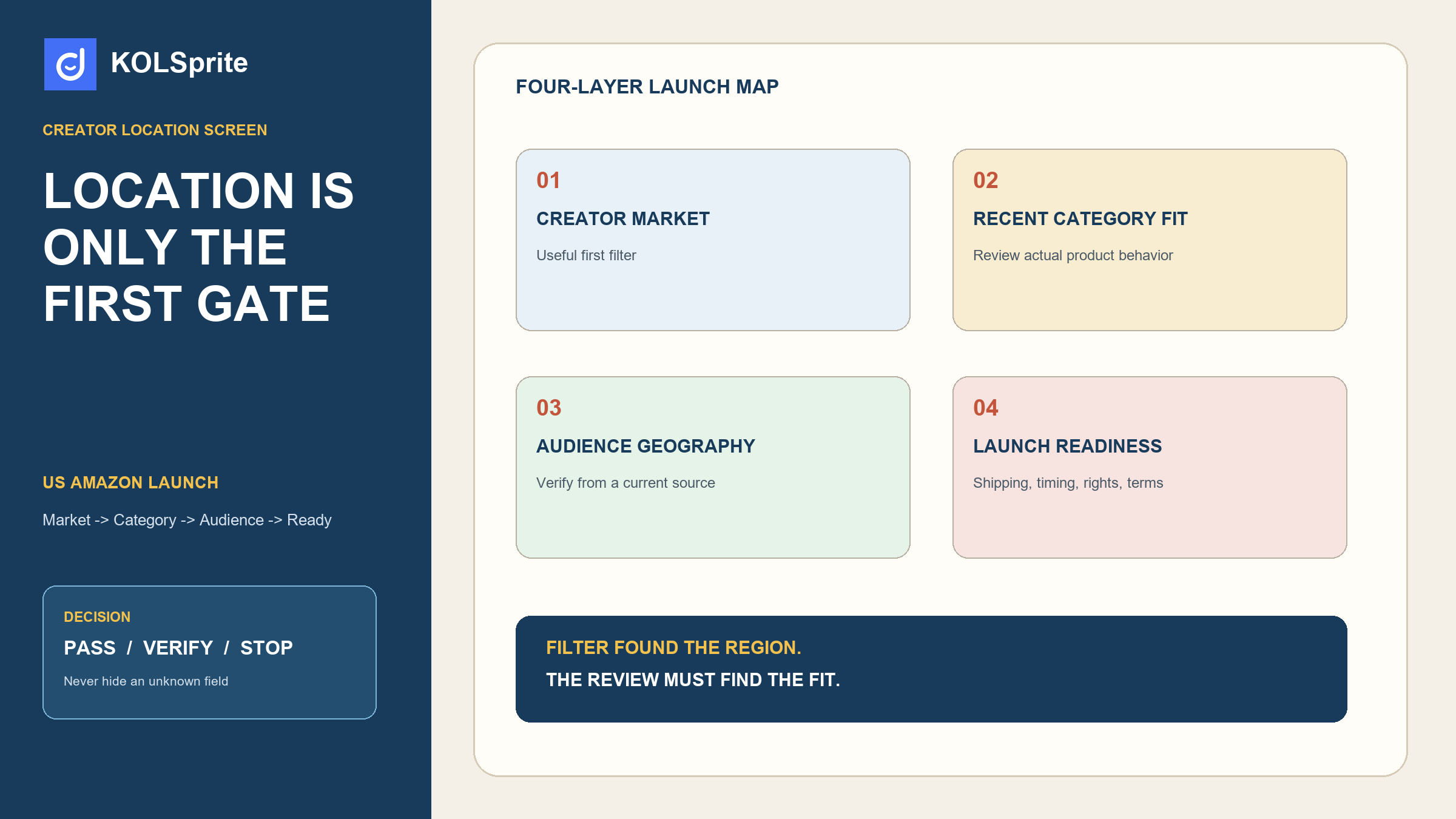
Filter for the creator's market first. Then verify recent category behavior, ask for audience geography from an appropriate first-party source, and confirm logistics, rights, timing, and commercial terms directly. A local handle is a search result. A launch-ready partner is a verified decision.
Location narrows the map. It does not finish the match.
Teams often place several different questions under the word "location." That creates bad shortlists. A creator may live in Florida, register a platform account from the United States, reach a large audience in another country, and ship product from a management address in California. Those facts are not interchangeable.
| Location field | What it means | Why it matters | How to verify |
|---|---|---|---|
| Creator market | The market or region attached to the creator record | Useful for the first search gate and local context | Platform record plus current public profile |
| Audience geography | Where the creator's viewers or followers are located | Determines whether the campaign can reach the target market | Current first-party audience analytics or authorized platform data |
| Shipping location | Where a sample can be received | Affects timing, customs, and cost | Confirm privately with the creator or manager |
| Production location | Where the content will be made | Affects season, setting, retail references, and launch timing | Confirm in the brief |
TikTok One's official creator search guidance makes a similar distinction. Its search filters describe creator location separately from audience location, and it notes that creator location can reflect the IP location at registration. That is a useful warning: do not turn a technical location field into a full audience claim.
A location search works only when the product job is clear. "Find outdoor influencers in the US" is not enough. A stronger brief might say: "Find US-based creators who have recently shown compact camping equipment, can demonstrate setup in a real campsite or backyard, and can deliver a truthful product test before our Amazon inventory push."
The sentence names the market, recent behavior, proof setting, product job, and timing. It also reveals what the search cannot decide. The team still needs audience geography, rates, availability, disclosure practice, usage terms, and a product-safety review.
Set the launch decision as well. Are you selecting three creators for samples, one creator for paid production, or ten names for outreach? The evidence required for a free sample can be lighter than the evidence required for a paid media license. Do not build one universal score for every commitment.
We ran a KOLSprite creator keyword search in the US market for "camping gear." The returned profiles were large enough to look attractive at a glance. Several had hundreds of thousands of followers, and some passed one broad Sports & Outdoor category label. A closer review told a different story.
One profile with about 530,590 followers carried sports and outdoor context, yet its leading product categories were eyeshadow, sunscreen, and skin care. Another profile with about 1.08 million followers showed phone accessories, projectors, and small mobile fans. Other results leaned toward beauty, fashion, general deals, coffee tools, or broad consumer tech. The region filter had worked. The product-behavior filter had not.
This is a common failure. A broad keyword may match a caption, bio phrase, historic product, or platform category without proving that the creator can demonstrate your product well today. Follower count makes the false positive look more convincing, not more relevant.
Research note. KOLSprite US creator keyword search for "camping gear," accessed July 31, 2026. Eight returned records were reviewed from a much larger result pool. The sample was used to test screening quality, not to rank the US camping-creator market. Public records did not supply verified audience geography, shipping address, rate, rights, or availability.
The first layer is creator market. Keep the requested region and remove accounts whose public activity clearly points elsewhere. This is where teams usually stop. The next three layers determine whether the shortlist is useful.
Record the region field, current handle, stable creator ID, language used in recent content, and any obvious location context. Treat the field as a search gate. Do not write "US audience" unless you have separate audience evidence.
Review recent videos and product-linked activity. Ask whether the creator has shown the same product job, not merely the same broad category. A creator who films campsite setup, packing constraints, weather tradeoffs, and product cleanup may be more useful for a camping launch than a large deals account with one outdoor hashtag.
Request a current audience geography view when geography changes the economics of the campaign. Define what you need: top countries, US share, language, age range if relevant and lawful, and the reporting period. Keep the screenshot or authorized record with the date. Do not demand private data that the campaign does not need.
Confirm sample address, delivery timing, production location, availability, rate, deliverables, revisions, disclosure, product-claim limits, usage rights, and any category conflict. A strong audience fit can still fail the launch if the creator cannot receive the item or publish before the inventory window.
A practical shortlist can use three labels: pass, verify, and stop. Avoid a precise score that hides missing facts. "Verify" is often the most honest and useful status.
| Candidate | Market | Recent product behavior | Audience proof | Decision |
|---|---|---|---|---|
| Creator A | US record and current US context | Recent compact camping setup videos | Current US share supplied | Pass to commercial review |
| Creator B | US record | Strong outdoor label, but recent content is beauty-led | Not requested | Stop for this launch |
| Creator C | US record | One relevant product demo; otherwise broad deals | Pending | Verify with one low-cost sample or a direct question |
| Creator D | Unclear current context | Excellent product behavior | Strong US audience evidence | Verify creator and shipping location; do not reject automatically |
The last row protects the team from another error: rejecting a creator because the person is not physically in the target country even when the campaign job and audience fit. A local production requirement may make location essential. A remote product tutorial may not.
In KOLSprite creator search, set the region, then use category, product category, follower, average view, interaction, video, product, and sales filters only when they relate to the brief. Start wide enough to learn how the market is labeled. Tighten the filters after reviewing false positives.
Open each candidate's recent content and product history. Save the stable creator ID, current handle, reason for the match, strongest relevant example, and the missing proof. KOLSprite is most useful here as a browser-connected research workbench: it reduces tab switching and keeps public creator evidence near the shortlist decision.
It should not be used to invent audience geography or a campaign guarantee. If the creator's audience panel is not available through an authorized source, mark the field unknown and ask. If a manager supplies the information, record the source and date rather than replacing the public record.
Do not ask for a full media kit before explaining the opportunity. A short message can name the product, intended market, content job, timing, and the one location-related fact that matters.
Example: "We are planning a US Amazon launch for a compact camping light. Your recent campsite setup videos look relevant to the proof we need. Before we scope a paid test, could you share your current top audience countries and confirm whether you can receive a sample in the next two weeks? We can send the full product and usage brief after that check."
The message is specific without pretending the partnership is already approved. It also avoids a vague request for "demographics." If the campaign requires a US production setting, add that question. If it does not, leave it out.
The final shortlist should be readable by someone who did not run the search. For each creator, include the stable ID, handle, creator market, relevant content link, product-fit note, audience-geography source and date, shipping status, proposed role, open questions, and next owner. Place commercial terms in the restricted campaign record, not a public research deck.
Use the creator outreach SOP after the shortlist passes its evidence gate. The creator engagement benchmark guide can then help the team frame a second performance check without turning one metric into a fit score. Those steps form a clean path: discover, verify, contact, and negotiate.
For a regional retail event, production location may be the hardest gate. For a digital product, language and audience geography may matter more than shipping. For a heavy sample, customs and delivery time can dominate the decision. Keep the four layers, but change their weight to match the job.
The method also improves negotiation. When the team knows exactly why the creator is on the list, it can price the right package instead of buying generic reach. The TikTok influencer pricing worksheet continues from this point by defining the deliverable, rights, risk, and internal budget range.
Choose one real launch. Write the market at the top. Add the buyer, the product job, the due date, and the type of deal. Keep each line short.
Run the region search. Save five names at most. Open the latest posts for each name. Remove anyone whose recent work does not match the job. Do not keep a weak match because the fan count is large.
For each person left, write four rows. Row one is market. Row two is recent proof. Row three is audience data. Row four is launch needs. Mark each row pass, check, or stop.
If the audience row is blank, ask for that fact. Ask for the time range too. If the sample must reach the creator in two weeks, ask where it can ship. If the post must show a US camp site, say so now.
Give each open row an owner. The research lead may check the source. The partner lead may ask the creator. The legal or brand team may check the claim and rights. Set one date for the reply.
The card should end with a next step. It may say "send brief," "send one sample," "ask one question," or "stop." It should never end with "looks good." That phrase hides the choice the team still has to make.
If the answer is no, fix the card. Do not add more scores. Add the missing fact.
The next step stays clear.
Use the US region filter to narrow the search. Reject false category matches by reviewing recent product behavior. Request current audience geography only from an appropriate source, then confirm sample delivery, production setting, timing, rights, and commercial terms. That is how teams find TikTok influencers by location without confusing a convenient filter with a launch-ready partnership.
Create a KOLSprite account and claim a three-day trial. Filter by market, inspect recent product behavior, and record the audience facts that still require direct verification.
Register for a three-day KOLSprite trial
Share the creator role, market, category evidence, and missing verification fields. Do not post private audience screenshots, rates, or contact details.
 +
+
Discuss the creator screen on Discord
Latest Articles
As an essential, data-driven toolkit for TikTok influencers and marketers, KOLSprite provides powerful features for effortless creator discovery, trending content identification, and actionable real-time insights.
It empowers users to make smarter decisions and significantly boosts their TikTok business.

 Refer & Earn