 +
+
If you buy partner content for a TikTok Shop or ecommerce brand, a follower-based rate chart cannot tell you what a fair deal is. The deliverables, usage rights, edits, niche risk, partner fit, and your own unit economics can change the value more than audience size does. This guide turns TikTok influencer marketing pricing into a negotiation worksheet. You will define the scope and review public proof without inventing a rate. Then you will set your own floor and ceiling. You will also list the questions that must be answered before signing.
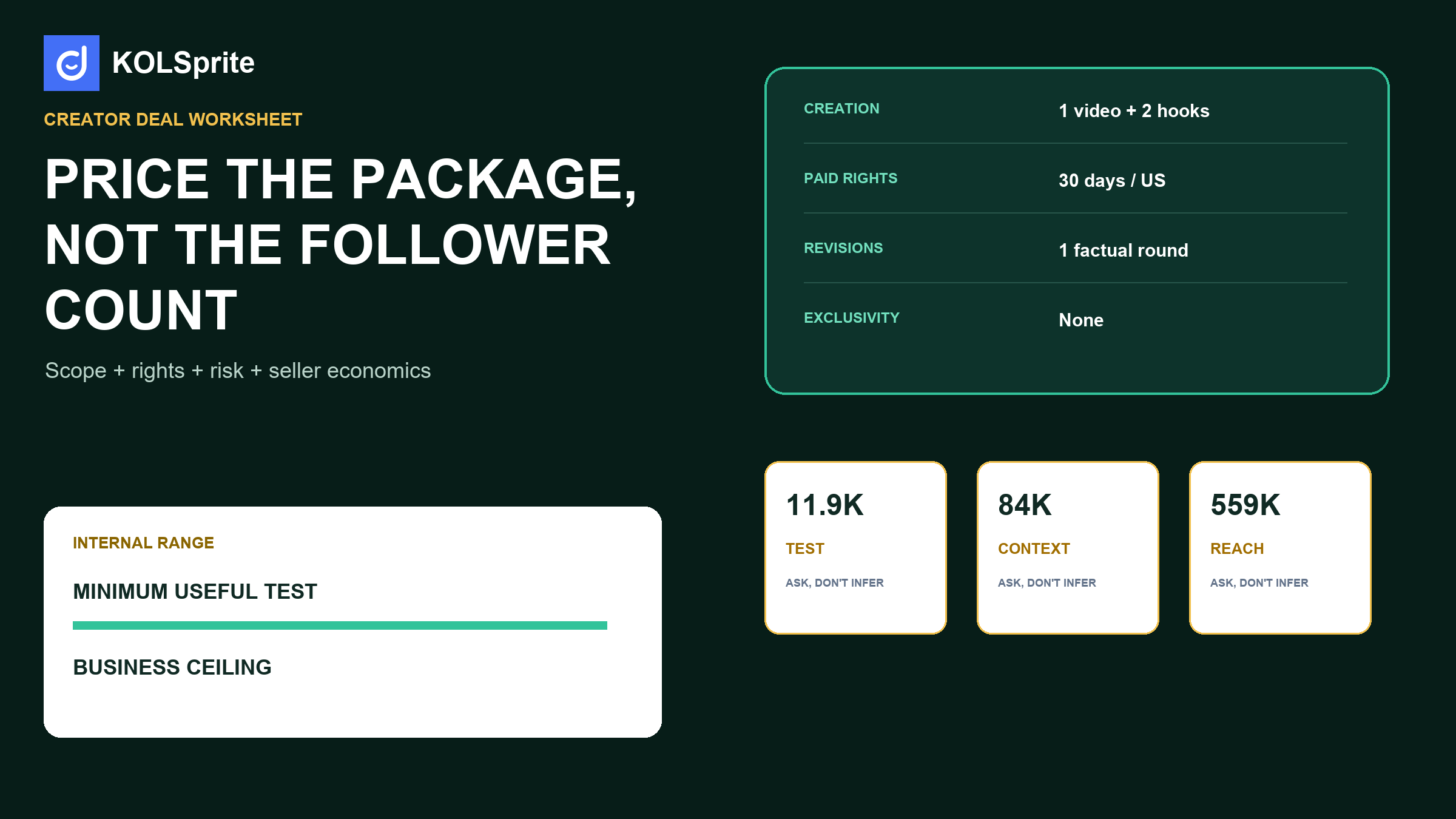
Write the exact scope first. Price content, reach, rights, edits, limits on rival work, and risk separately. Use partner data to decide which proof deserves a premium or a test, but get the actual quote from the partner. Your final range must also fit gross margin and learning value.
A follower count describes an account. A price belongs to a negotiated scope.
Rate charts usually group partners by followers and assign a broad cost range. They can help a new buyer understand that larger reach often costs more. They cannot price an exact deal. One quote may cover a single organic post. Another may include a raw file, paid usage, Spark Ads authorization, limits on rival work, edits, multiple hooks, and a rush deadline.
Shopify's updated 2026 influencer-pricing guide also notes that rates vary with platform, audience, engagement, format, scope, usage rights, limits on rival work, and test work. That is the right mental model: a range is a starting reference, while the scope creates the deal number.
The seller also needs a private limit. A partner's quote can be fair for their firm and still be too expensive for yours. A low quote can be poor value if the work does not fit the buyer problem. Fairness and affordability are related, but they are not the same choice.
Before requesting a quote, write one sentence that both sides can understand. For example: “One 30- to 45-second TikTok product demo, posted on the partner's account. The deal includes two hooks, one fact check, and 30 days of paid use in the United States. There is no limit on rival work. The draft is due within 14 days of product receipt.”
If the sentence feels crowded, that is useful. It shows the number of items that a vague request such as “What is your rate?” was hiding. Break the scope into six lines:
Ask the partner to quote the scope and price optional additions separately. This makes review easier and reduces conflict after production begins.
We reviewed three US Beauty & Care creator records returned by a broad skincare-related search. The first record was Dakota | Beauty & Life, with about 11,900 followers and 51,400 average views. Its interaction field was 2.64%. Grace & Ivy Candle Company had about 84,000 followers, 35,400 average views, and a 3.10% interaction field. Stormi Steele had about 559,000 followers, 555,200 average views, and a 5.94% interaction field.
The records also differed in video count and product history. They did not include verified rate cards, rights terms, schedule, niche conflicts, audience quality, or willingness to accept the same brief. The broad search also does not prove that every profile is a good skincare match. That means the sound output is not “Partner A should cost this much.” It is a set of better questions.
Research note. KOLSprite US partner-search logs in the Beauty & Care niche; accessed July 30, 2026. Three logs were retained to illustrate different public proof profiles. The sample is not a rate survey, and no public data field was converted into a partner fee.
| Public proof profile | Possible role | Question before cost | Do not assume |
|---|---|---|---|
| 11.9K followers; average views above follower count | Efficient creative or focused first test | Which recent posts drive that reach, and is the audience relevant? | Low rate or guaranteed efficiency |
| 84K followers; 35.4K average views; broad product history | Contextual product story or niche test | Does recent content fit the exact product and buyer problem? | Niche expertise from a search label |
| 559K followers; 555.2K average views; strong interaction field | Reach plus founder or authority-led proof | What scope, rights, and audience geography are available? | A exact quote or sales result |
The negotiation floor is not the lowest amount you hope the partner accepts. It is the minimum scope that can produce a useful test. If the brand needs a real product demo, the floor must include enough time, product access, factual review, and rights to judge the work. Cutting below that floor may save cash while destroying the learning.
The ceiling is the most your firm can responsibly commit under the current proof. A simple model for your team is:
Maximum sound spend = affordable acquisition value + reusable content value + defined learning value - execution and rights risk.
Use actual firm inputs. Affordable acquisition value depends on gross margin, expected order value, return rate, and the portion of demand you are willing to buy. Reusable content value depends on whether the scope grants the rights and file formats needed. Learning value is real only when the test answers a named choice. Risk includes weak product fit, unclear claims, tight inventory, difficult production, or unproven audience quality.
This model does not produce an objective market rate. It gives the buyer a disciplined walk-away point.
| Cost line | What to specify | Common hidden cost |
|---|---|---|
| Creative fee | Deliverables, length, hooks, raw files, and posting | Extra variants requested after approval |
| Usage rights | Organic or paid, channels, territory, and duration | Indefinite or worldwide use |
| Edits | Included rounds and what counts as a edit | New concept treated as a small edit |
| Limits on rival work | Named competitors, niche, and time | An overly broad restriction on partner income |
| Product and shipping | Samples, customs, returns, and replacements | Late or damaged product |
| Management and measurement | Briefing, review, tracking, and reporting | Your labor ignored in ROI |
Keep commission or affiliate terms on a separate line. A results component can align incentives, but it does not automatically replace fair payment for production, rights, or limits on rival work. The right mix depends on the partner, product, and amount of uncertainty each party accepts.
Start in KOLSprite creator search to find profiles that fit the niche, market, and scale needed for the role. Save the stable partner ID, current handle, access date, average-view definition, interaction field, recent activity, product history, and two content examples. Then write why the partner entered the shortlist.
The product and video layers can add context. A partner with exact product-linked work may need less guesswork about demo style, but the brand should still review the actual clips. A partner with no visible niche history may be valuable for a fresh audience, but that uncertainty belongs in the test size and brief.
Use the saved proof to ask exact questions: “Your recent process demos are the closest fit for this brief. Would you quote one posted video plus two hooks, one factual edit, and 30 days of US paid usage?” That is a natural role for KOLSprite. KOLSprite helps the buyer arrive prepared; it does not set the partner's price.
After the shortlist, use the creator negotiation guide for the talk and the TikTok influencer contract guide to document the final scope. The proof page, negotiation step, and contract should reference the same scope.
Usage rights are often where an apparently simple deal changes most. “We may use the video in sales” is not exact enough. State whether use is organic or paid. Name the accounts, channels, and countries. Set an end date. Say whether edits are allowed and whether ads may run from the partner's account.
Limits on rival work should also be narrow. Name the actual competitor set or product niche and the time period. A broad ban may need a higher fee because it prevents other work. If you do not need exclusivity for the test, remove it rather than asking the partner to discount it.
Disclosure is not optional. The US Federal Trade Commission's Disclosures 101 guidance explains that material relationships should be disclosed clearly and conspicuously. Put disclosure duties in the brief and contract. Do not bury them in a general brand-guidelines link.
A lower counteroffer should come with a smaller scope, not an argument that the partner is overvalued. Reduce paid usage from 90 days to 30, remove exclusivity, choose one hook instead of three, or make posting optional. The partner can then decide whether the revised scope works.
A higher quote can also be fair. The partner may have strong demand, production costs, a specialized audience, or restrictions created by your rights request. Ask what is included. If the scope remains above your ceiling, decline politely and preserve the contact.
The best review is not “Which partner is cheapest?” It is “Which scope creates the most useful proof within our risk limit?” That keeps price connected to the choice.
These rules reduce emotional negotiation. The buyer knows what can change and what cannot before a promising profile creates pressure to close.
After signing, save the partner ID and full scope. Add the first and final fees, rights, edits, limits on rival work, due date, product cost, test context, result, and reinvite choice. Separate creation value from reach value when the deal allows it. Log problems such as shipping delays or unclear review ownership.
Over time, your own deal history becomes more useful than a broad rate chart. It reflects your niche, briefs, rights needs, and quality of work. Public guides can still provide context, but your own log should shape the next range.
TikTok influencer marketing pricing becomes easier when the team stops looking for one correct market number. The goal is a clear scope, a clear spending limit, and a respectful talk.
Invite each shortlisted partner to quote the same clearly defined base scope, with rights and optional additions shown separately. Use public data to tailor the role and questions, not to manufacture a fee. Approve only a scope that sits above the minimum useful test and below the firm ceiling. That is a sound approach to TikTok influencer marketing pricing: paying for defined work and proof, not a follower label.
Create a KOLSprite account and claim a three-day trial membership. Use the trial to research creators, compare content signals, and prepare a stronger shortlist or brief.
Register for a three-day KOLSprite trial
Bring a scope and rights question, not a private partner quote.
 +
+
Join the KOLSprite Discord community
Latest Articles

As an essential, data-driven toolkit for TikTok influencers and marketers, KOLSprite provides powerful features for effortless creator discovery, trending content identification, and actionable real-time insights.
It empowers users to make smarter decisions and significantly boosts their TikTok business.

 Refer & Earn