 +
+
If you send TikTok Shop samples, a creator's followers and average views are not enough to approve the shipment. You need to know whether the creator can reach and persuade the buyer your product needs. This guide turns influencer audience analysis into a pre-sample check. It separates what public creator and product-linked video records can show from what still requires platform audience data or direct confirmation. You will leave with a three-status shortlist: send, verify, or reject.
Use public content to confirm category behavior and proof style. Use current audience data to confirm market, language, age, and other relevant audience traits. Treat missing audience facts as missing. Do not replace them with a broad category label or a high view count.
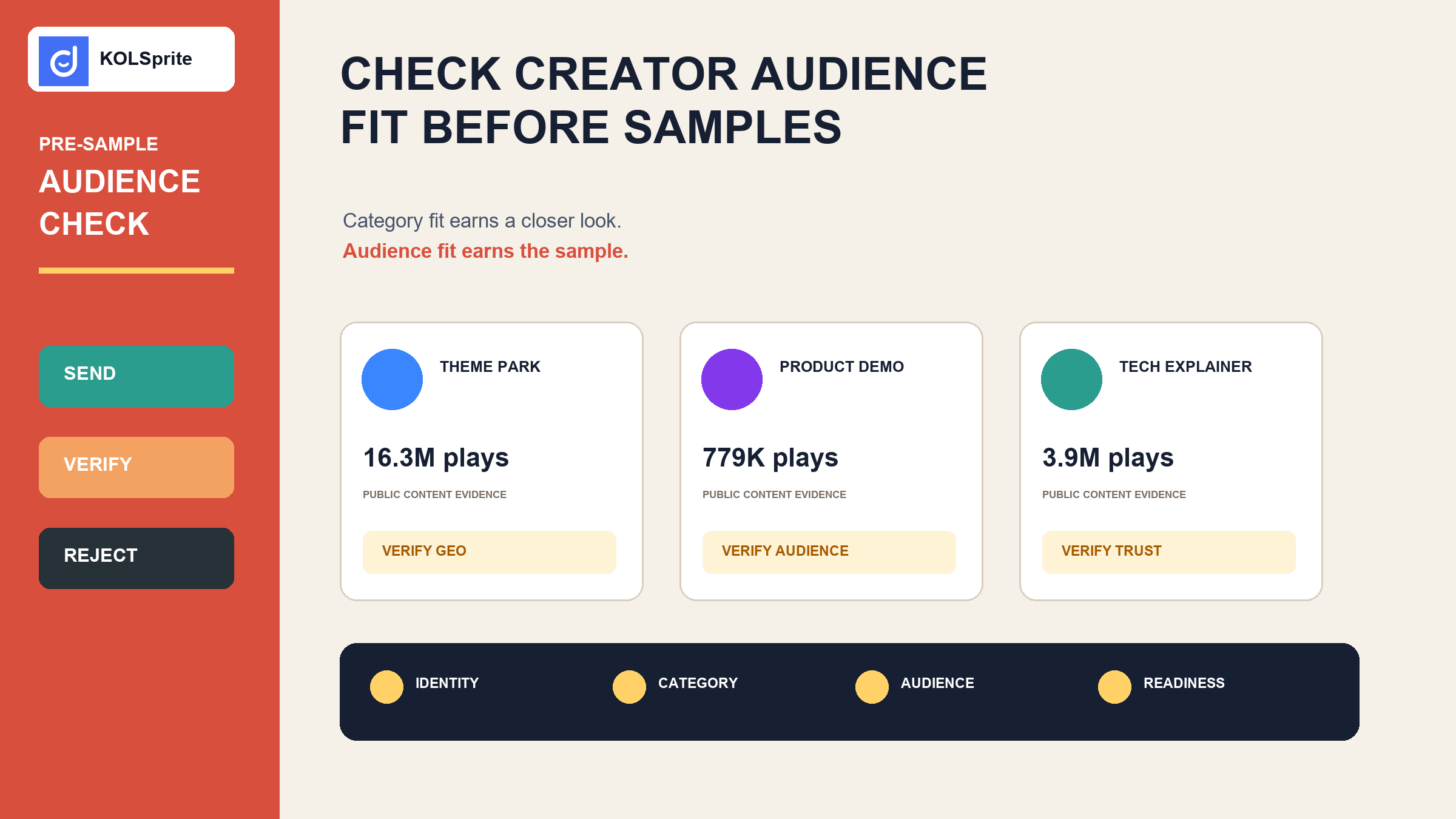
Category fit earns a closer look. Audience fit earns the sample.
Sample programs lose money in small ways. A product goes to a creator who posts in the wrong language. A broad lifestyle account has reach but no reason to explain the item. A creator can make a strong video, but most viewers live outside the shipping market. The team notices after shipping, follow-up, and content review have already used time.
The solution is not a perfect creator score. It is a clear order of checks. First confirm the account and recent content. Then confirm product and format fit. Then inspect available audience data. Finally confirm the commercial and operational terms. Each layer answers a different question.
TikTok says brands using Creator Marketplace can narrow applicants by audience demographics, follower count, location, brand affinity, and relevant experience. That is useful first-party evidence when available. KOLSprite adds browsing, product, video, creator, and workflow context around the decision. Neither source should be asked to invent a field it does not contain.
We reviewed five US commerce videos for portable fans. They ranged from 169 to 77,768 creator followers and from 26 to 103 seconds. The strongest view count belonged to a 27-second theme-park video from jennam4e. It had 16.3 million plays, 583 comments, and 2,598 recorded 30-day product units. Its creator record carried many broad category labels.
A 30-second misting-fan video from fashionistafeverus had 779,000 plays, 25 comments, and 3,802 recorded 30-day units, despite a creator follower field of 169. A 103-second product-led video from magicjohn_official.us6 had 3.9 million plays, 461 comments, and 2,065 recorded 30-day units. Its category label was Technology & Finance.
These rows show why follower count and category labels are clues, not an audience conclusion. The low-follower account had a strong recorded product result in this snapshot. The broad creator had the largest reach. The product-focused account had a longer explanation. None of those facts tells us the viewers' country mix, buying power, age, or shipping eligibility.
Research note. KOLSprite US commerce-video records for five portable-fan videos, accessed July 30, 2026. Exact video, creator, and product IDs were retained. Public fields support a content and category review. They do not supply complete audience demographics, verified rates, availability, or future results.
| Layer | What it answers | Useful evidence | Common mistake |
|---|---|---|---|
| Identity | Did we find the right account? | Stable creator ID, current handle, source video, access date | Approving a same-name profile |
| Category behavior | Can this creator make the needed type of content? | Recent posts, product-linked videos, proof style, category history | Treating a label as recent expertise |
| Audience | Do likely viewers match the target buyer? | Current platform demographics, geography, language, comments, brand records | Using followers as a substitute for fit |
| Readiness | Can the partnership run now? | Rate, commission, rights, schedule, sample terms, disclosure, shipping | Assuming public performance means availability |
A creator must pass all four layers before a high-cost sample or paid brief. A low-cost first test may move forward with one open field, but the open field should be named and controlled. For example, a brand might send one unit after category behavior passes while requiring audience geography before paid usage is approved.
Write one sentence about the buyer before searching. For the portable fan, it might be: a US shopper planning an outdoor summer trip who cares about compact size, battery handling, and useful airflow. That sentence excludes some popular accounts and makes other creators more interesting.
Next, define the content job. A theme-park creator can test travel relief. A tech creator can explain controls, charging, and airflow settings. A dorm creator can show desk and bedside use. A deal creator can compare the current offer with the normal price. These roles may reach overlapping people, but they do not make the same promise.
Use KOLSprite video search to start from exact product-linked content. Save why each creator entered the pool. Then use creator search to inspect the profile and recent context. Starting from the product reduces the temptation to approve a large account and invent a role later.
The theme-park clip makes a clear situational promise: avoid a common hot-weather mistake. That is strong category behavior for a travel-use test. The next audience questions are location, seasonal travel interest, and whether the creator's recent viewers match the seller's shipping market. The video earns verification, not automatic shipment.
The misting-fan video is a warning against dismissing a creator from follower count alone. The record shows meaningful reach and a strong recorded product field in that one context. The next review should check whether the account is active, whether the audience is real and reachable, and whether the result depends on paid distribution, a product account, or another factor the public row cannot show.
The longer MAGIC JOHN clip can support a feature explanation. A product-led account may fit a detailed demonstration, but the brand must check whether viewers trust the account, whether recent content is repetitive, and whether the audience needs the exact fan. Product focus is not the same as independent endorsement.
This is the value of a small cohort. The team can assign each creator a different test job and request the audience facts relevant to that job. A single universal score would flatten those differences.
| Status | When to use it | Required next action | Example |
|---|---|---|---|
| Send | Identity, category behavior, audience, and terms meet the test | Record shipment, brief, due date, and success rule | US travel creator with verified audience and a compact-use brief |
| Verify | Content fit is promising but one material fact is missing | Ask for the exact missing field and set a deadline | Strong fan demo, but audience geography is unknown |
| Reject | The creator fails the buyer, category, risk, or operating gate | Record a short reason so the team does not repeat the review | High reach, but no relevant content and wrong market |
Do not use "maybe" as a permanent status. Every verify row needs an owner and a date. If the needed data never arrives, the row becomes reject for the current campaign. The creator can be reviewed again for another product.
More data is not always better. A US portable-fan campaign may need audience country, language, age suitability, and recent content interest. A beauty campaign may need a more careful fit review around skin concerns and claims. A B2B product may care more about role and use context than broad age bands.
Write the minimum audience field beside the product brief. Then ask the creator or platform for current evidence. Avoid asking for screenshots that expose more personal data than the decision needs. Store only what your team can protect and use responsibly.
Comments can add context, especially when people ask about battery life, theme parks, dorms, travel, or shipping. They cannot prove the demographics of silent viewers. Use comment themes as a fit clue and a briefing input, not a substitute for audience reporting.
Once a creator reaches send, record the product, quantity, shipping status, content job, disclosure requirement, due date, and follow-up owner. The TikTok creator seeding guide covers this downstream handoff. The audience review should travel with the sample record so the campaign team knows why the creator was selected.
For a larger program, use the TikTok Shop creator discovery guide as the upstream framework. It defines the broader pool. This article owns the narrower sample gate: enough audience evidence to spend a unit and follow-up time.
KOLSprite fits naturally between those steps. The browser and research tools help the team preserve the source content, product context, creator identity, and shortlist reason. The campaign record carries the decision into outreach and sample tracking. The tool supports the handoff; it does not replace a current audience report.
A creator who reaches the right audience can still be a poor partner if disclosure, claims, or recent content create risk. The US Federal Trade Commission says material relationships, including free products, should be disclosed clearly. Put that expectation in the brief before the sample ships.
Review whether the creator makes health, performance, or comparison claims that your product cannot support. Check recent posts, not only the one source video. Confirm the creator is willing to use ordinary language and show actual product use. A trustworthy limit often helps the right audience more than an exaggerated promise.
The review is short because the criteria are written before the creator appears. It also gives the team a fair reason for each decision. A creator can be excellent and still be wrong for one product or market.
A seller opens the theme-park video. The use case is clear. The creator shows a hot day and a small fan. The product can be seen in use. That part passes.
The seller then checks the account ID and handle. They match the source video. Identity passes. The team checks recent posts. Travel and daily-life content are still active. Category behavior also passes.
One key fact is still blank. The team does not know how much of the recent audience is in the United States. The brand ships only in the US. That means the row cannot move to send yet. It moves to verify.
The partnership lead asks for a current audience screen. She asks only for the country split and main language. She does not ask for extra private data. The creator sends the screen. The US share fits the campaign rule. The creator now moves to send.
The team writes one content job beside the shipment: show the fan during a real outdoor wait. It also records the due date, disclosure rule, and stop point. If the creator cannot accept those terms, the sample does not ship.
Now take the low-follower product account. Its one video has a strong public result. The team still runs the same steps. It does not skip the audience check because the result looks good. It also does not reject the account because the follower count is small. The same rules apply to each creator.
This is the point of the gate. It turns a vague feeling into a short set of facts. The team knows why a sample ships. It also knows why another sample waits.
The five fan videos do not reveal complete audience quality or demographics. A category label can be broad. A large view count may include people outside the target market. Recorded commerce fields are not audited attribution. Rates, rights, schedule, and willingness require direct contact.
Good influencer audience analysis does not hide those limits. It puts them in the verify column. That protects sample budget and gives partnership managers a clear next question.
Check the creator ID, handle, and source video. A name alone is not enough. Stop if the account cannot be tied to the source.
Look at recent work. The creator does not need to sell the same item. They do need a clear way to show the buyer's problem and the product proof.
Check the market and main language. Ask for a current screen when the field is not in the tool. Do not guess from a creator's home or accent.
Add the unit cost, ship cost, follow-up time, and the odds of a useful post. A free sample is not free for the team. Use a small first group when many facts are still new.
Name the result that matters. It may be a clear demo, useful buyer questions, a set number of page actions, or a good fit for a paid test. The first post does not have to be a hit. It does have to teach the team what to do next.
These questions are easy to read because the choice should be easy to state. Send the sample when the facts pass. Ask for one missing fact when the fit looks good. Reject the row when the buyer, market, or work does not match.
Move the theme-park, low-follower demonstration, and product-led technology accounts to verify, each for a different test job. Request current US audience and language evidence before sending a paid or high-cost sample. Reject any profile that cannot be joined to the source record or that fails the market and content gate. The goal is not the biggest list. It is a small group whose audience and content job make the sample worth sending.
Create a KOLSprite account and claim a three-day trial membership. Use the trial to put this workflow into practice before your next product, content, or creator decision.
Register for a three-day KOLSprite trial
Bring the buyer definition, creator role, and one missing audience field. Keep private audience exports and deal terms out of the public discussion.
 +
+
Compare creator audience checks on Discord
Latest Articles
As an essential, data-driven toolkit for TikTok influencers and marketers, KOLSprite provides powerful features for effortless creator discovery, trending content identification, and actionable real-time insights.
It empowers users to make smarter decisions and significantly boosts their TikTok business.

 Refer & Earn