 +
+
If you lead ecommerce creative, saving popular clips is not the same as learning from them. A useful review ends with something your team can film, measure, and improve. This guide uses TikTok content analysis on three pet-hair products: a steam brush, a grooming vacuum kit, and a reusable fabric brush. You will compare what each clip proves, where the proof lives, and which buyer doubt it can settle. Then you will turn the observations into three new briefs without copying the creator's script, identity, or exact sequence.
Write the buyer doubt first. Analyze the source clip for the proof job, not just the hook. Use transcript data when language carries the value. Return to the screen when the clip is visual or the transcript fails.
If the transcript cannot explain the value, the proof may live on screen.
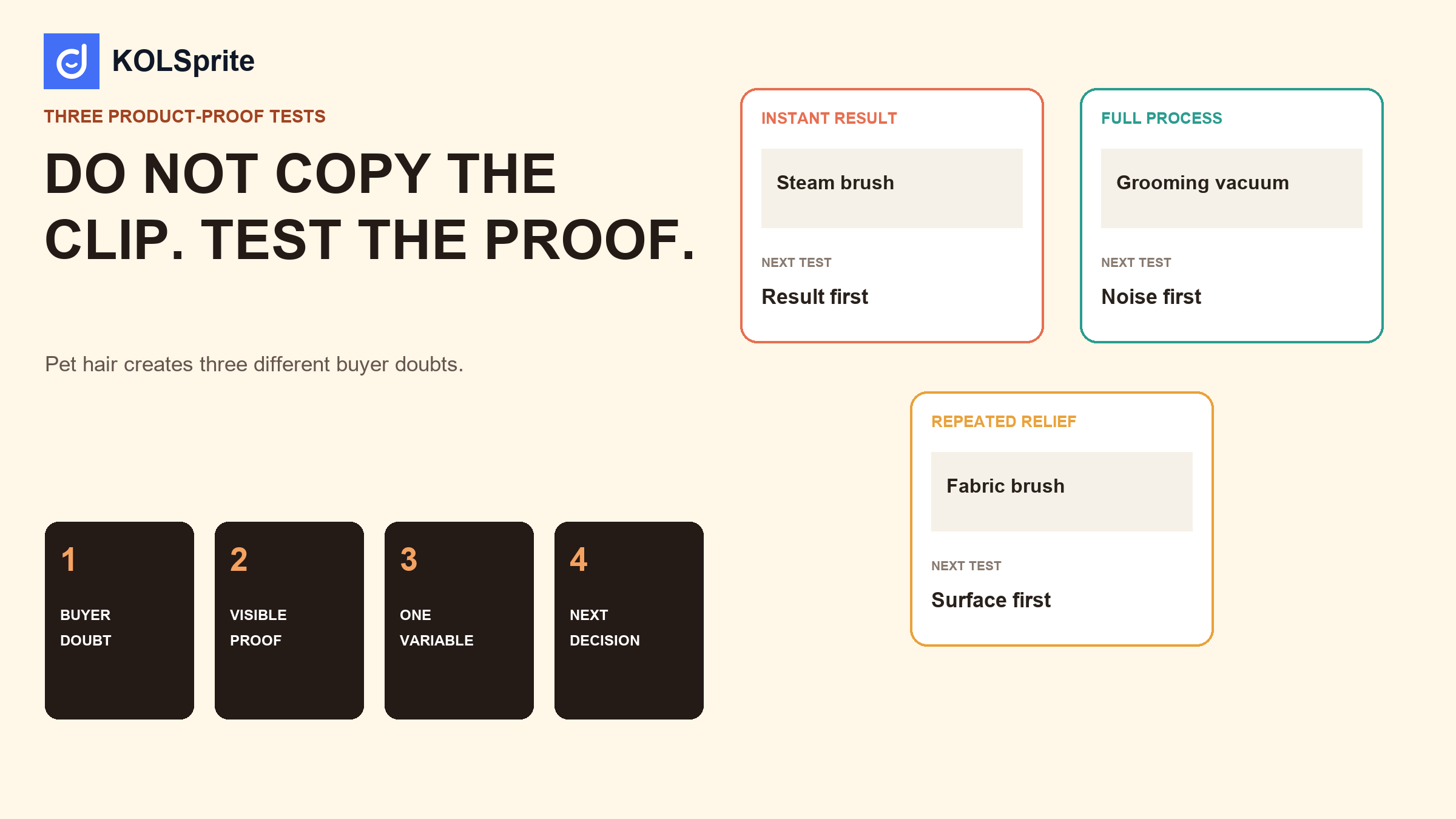
The three clips in this case are not direct competitors in a strict product sense. One removes loose hair during grooming. One combines clipping, brushing, and vacuum collection. One removes hair from furniture and fabric. That difference is useful because the content jobs are also different.
A steam-brush clip can show immediate loose-hair pickup and a calmer grooming routine. A long grooming-vacuum clip can explain setup, attachments, cost, and the full process. A reusable fabric-brush clip can make hidden hair clear in seconds. The team should not force all three into the same “winning hook” template.
TikTok's official Top Ads Dashboard guide explains that users can review relative results and second-by-second engagement moments. That can help locate attention changes. It still does not tell a seller which product claim is true or which proof can be repeated with its own item.
| Source | Length | Clear plays | Interaction field | Recorded 30-day units | Main proof job |
|---|---|---|---|---|---|
| Pet steam brush | 30 sec | 1.6M | 0.74% | 1,035 | Show loose hair removed during grooming |
| Grooming vacuum kit | 267 sec | 1.0M | 3.17% | 184 | Explain a full at-home grooming process |
| Reusable fabric brush | 12 sec | 68.6K | 0.49% | 172 | Reveal hidden hair on household surfaces |
The largest recorded unit field belonged to the 30-second steam-brush clip. The strongest interaction field belonged to the 267-second grooming story. The shortest fabric-brush clip had much lower reach but a product result close to the long vacuum clip in this small sample. These facts do not prove an ideal length. They show that each format may be doing a different job.
Research note. KOLSprite US commerce-clip records; accessed July 30, 2026. Three relevant clips and three different product IDs were retained to compare proof architecture, not to rank the products. The sample is scoped and non-causal. Product fields are platform snapshots, not audited attribution.
For each clip, write four lines: the buyer doubt, the clear proof, the language support, and the next action. This keeps the review close to the product. A hook can attract the wrong person. Proof should help the right person decide whether the item solves the stated problem.
The steam brush likely addresses “Will this remove loose hair without a full bath?” The proof is the brush moving through the coat and collecting hair. The vacuum kit addresses “Can I handle grooming and cleanup at home?” Its proof is the process: attachments, cutting, brushing, vacuum collection, and the final result. The fabric brush addresses “Is there still hair in a surface that looks clean?” Its proof is the sudden pile pulled from fabric.
These proof jobs transfer. A kitchen tool can prove speed, mess reduction, or finished texture. A beauty device can prove setup, clear application, or cleanup. A storage product can reveal wasted space. The market changes; the analytical question does not: what did the viewer get to see that reduced uncertainty?
We used KOLSprite caption extraction on two verified public URLs. The long grooming-vacuum clip produced a detailed Spanish transcript. It described the high cost of professional grooming, the tool's attachments, clipping and brushing, vacuuming loose hair, washing bedding, and the creator's learning process with two dogs. Language carries a large part of that clip's value.
The 12-second fabric-brush clip produced a repeated lyric instead of useful product meaning. That does not make the clip useless. It means transcript-led review is the wrong method for that source. The title and clear action carry the product story: the brush pulls hidden hair from couches, rugs, pet beds, and stairs.
This is a real research limit, not a reason to invent a script. Use KOLSprite video research to preserve the product, creator, duration, and results context. Use caption extraction where language matters. When it does not, return to the clip and record the clear sequence. KOLSprite helps the team move between those layers without pretending every clip is a transcript problem.
| Proof lane | Best source clue | What to adapt | What not to copy | Primary measure |
|---|---|---|---|---|
| Fast reveal | Steam or fabric brush | Immediate before-and-after under normal use | Exact opening, creator setting, or claims | Qualified hold and product questions |
| Process trust | Grooming vacuum | Setup, attachments, cleanup, and limitations | Personal story or exact script | Completion through proof steps |
| Objection test | All three | One doubt such as mess, effort, noise, or surface fit | Unsupported promise or one-size-fits-all result | Relevant comments and page actions |
The map is more useful than a list of “top hooks” because it tells the next team what to produce. It also protects newity. You can preserve the proof job while changing the buyer, setting, product conditions, voice, and sequence.
Buyer doubt: “My sofa looks clean. Is there enough hair left to justify another tool?” Open on a fabric surface that appears clean. Show two controlled passes on a marked area. Collect the removed hair in one clear place. End with the surface type and care limit. Do not imply the result will be identical on every fabric.
Test variable: reveal the collected hair at second four in one version and second eight in another. Keep the surface, passes, product, caption, and CTA stable. Measure qualified completion and questions about fabric compatibility, not just views.
Buyer doubt: “Will at-home grooming create more mess than it saves?” Show the tool setup, one attachment, hair moving into the collection chamber, and the cleanup step. State the pet type and conditions. Include one honest limitation, such as the need to introduce sound slowly or check whether the pet tolerates the tool.
Test variable: place the cleanup proof before the grooming process in one version and after it in another. Measure completion through the cleanup scene, saves, and questions about sound, attachment fit, and maintenance.
Buyer doubt: “Can I remove loose hair without turning grooming into a full event?” Show the animal before brushing, a short normal-use pass, collected hair, and the pet's response. Avoid health or comfort claims that the product evidence cannot support. Keep the creator's words natural rather than scripting a dramatic reaction.
Test variable: compare a calm routine opening with an outcome-first opening. Measure relevant comments, product-page actions, and whether viewers understand when the tool should be used.
After a brief runs, comments can show whether viewers understood the proof. Questions about fabric safety, noise, replacement filters, pet tolerance, cleanup, or use frequency can guide the next version. KOLSprite's AI comment analysis workflow can cluster repeated themes, but important themes should be checked against the new comments before they change a claim or product page.
Do not treat jokes, tags, emojis, and repeated praise as buyer intent. A useful comment theme changes a choice: add a proof shot, clarify a limit, revise a product-page answer, or remove an unsupported promise.
Three clips cannot define the pet-care market. Recorded units do not prove the clip alone caused each order. A transcript cannot describe silent visual proof, editing, music, comments, or product quality. The long clip's Spanish story may work because of the creator's audience and experience, not because long clips always win.
The method remains useful because it keeps those limits clear. TikTok content analysis should narrow the next creative choice. It should not turn a small sample into a one-size-fits-all rule.
The TikTok UGC strategy guide is a useful next step when several proof tests are ready to become a broader content system. Build the system from completed evidence, not from a folder of copied clips.
Produce three new tests: a fast hidden-hair reveal, a longer grooming-and-cleanup process, and a low-effort routine. Assign one buyer doubt and one measurement to each. Use transcript evidence where language carries the value and visual review where it does not. That is the purpose of TikTok content analysis: turn observed proof into a better next shoot.
Create a KOLSprite account and claim a three-day trial membership. Use the trial to inspect TikTok content signals, save useful examples, and plan the next creative test.
Register for a three-day KOLSprite trial
Share one buyer doubt and turn it into a focused creative experiment.
 +
+
Join the KOLSprite Discord community
Latest Articles

As an essential, data-driven toolkit for TikTok influencers and marketers, KOLSprite provides powerful features for effortless creator discovery, trending content identification, and actionable real-time insights.
It empowers users to make smarter decisions and significantly boosts their TikTok business.

 Refer & Earn