 +
+
If you work on ecommerce content, a TikTok transcript generator can save you from replaying the same clip ten times. The transcript is not the finished research, though. It is a working record of what the creator said. This guide shows you how to clean that record, separate claims from demonstrations, and turn it into an original brief your team can actually shoot. You will leave with a five-column transcript review, a proof checklist, and a short handoff for a creator. The method is useful for Amazon sellers, Shopify teams, agencies, and content managers who study TikTok videos without wanting to copy them.
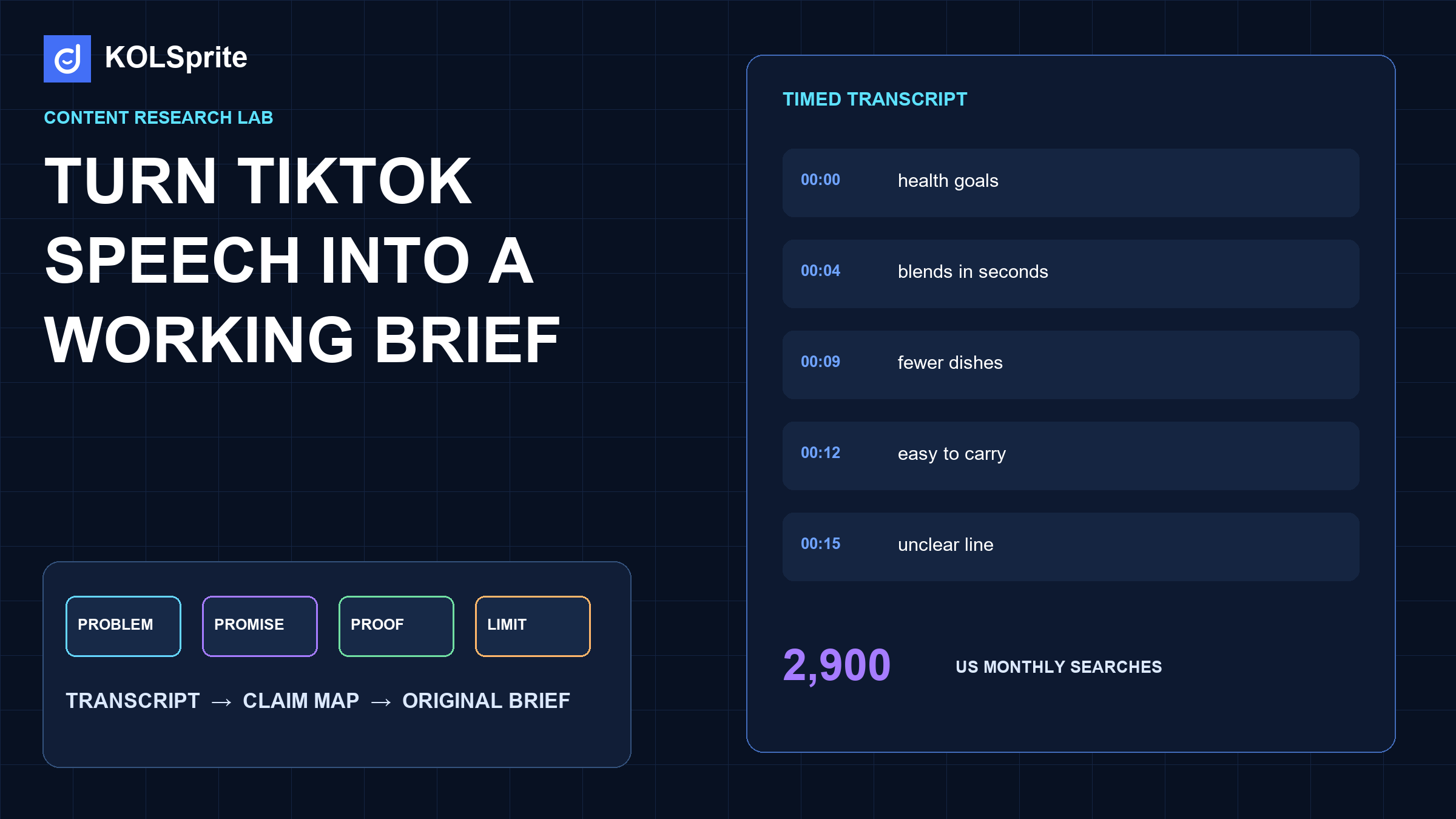
Generate the transcript and check it against the video. Mark any word you cannot confirm. Label each useful line as a problem, promise, proof, condition, or call to action. Then write a new brief around the buyer question and proof your own product can support. The transcript makes speech searchable. Human review makes it safe to use.
Short videos move quickly. A creator can state a problem, make a product claim, show a result, and ask for a purchase in twenty seconds. Written text slows that sequence down. You can see which line does each job and which job is missing. This matters because a polished clip can feel convincing even when the proof is thin.
The wrong use of a transcript is to change a few words and hand the result to another creator. That keeps the original structure, voice, and creative choices. It can also carry over a claim your product cannot support. A better use is analytical: find the buyer problem, identify the visible proof, note the limits, and build a new treatment around your own evidence.
| Label | Question | What to record |
|---|---|---|
| Problem | What situation is the viewer trying to improve? | The exact job, moment, or frustration. |
| Promise | What result does the speaker suggest? | The claim in plain language, without hype. |
| Proof | What can the viewer actually see or verify? | Action, before-and-after, measurement, or close-up. |
| Condition | When might the result change? | Product model, setup, material, time, or use limit. |
| CTA | What does the speaker ask the viewer to do? | Buy, compare, save, comment, or watch another step. |
These labels stop a common mistake: treating every sentence as equally important. A line about a morning routine may reveal the real use case. A line about price may expire. A dramatic phrase may add energy but no proof. The labels help the team preserve the useful idea while discarding borrowed language.
A transcript without the video can mislead a reviewer. Tone, gestures, text on screen, cuts, and the product itself may change the meaning. Keep the video URL, creator handle, access date, language, and product link beside the transcript. TikTok also provides accessibility guidance for captions and text. That guidance is useful background, but the team still needs to check the exact clip it is studying.
Use a short source header. Name the market and whether the video is product linked. Note whether the transcript came from creator captions, speech recognition, or a translation. This takes less than a minute. It prevents a later editor from treating translated text as the creator's exact English words.
Use KOLSprite to inspect the video, extract supported subtitles, and keep the source attached to your notes. New users can register for a three-day trial membership.
Register for a three-day KOLSprite trial
For this article, KOLSprite MCP retrieved a US portable-blender commerce video and extracted five subtitle segments. The speaker said the blender helped with health goals, changed a routine, blended smoothies quickly, doubled as a tumbler, reduced dishes, fit in a bag, and was available on TikTok. The extraction also contained likely errors: “water ball” probably meant “water bottle,” and the last line ended mid-sentence.
Those errors are not unusual. Speech recognition can struggle with brand names, fast delivery, music, accents, or a clipped ending. The useful move is not to hide the uncertainty. Mark it, replay the moment, and avoid using the line until it is confirmed. A transcript with honest gaps is more valuable than a smooth transcript that changes the speaker’s meaning.
| Observed line | Working label | Research value | Next check |
|---|---|---|---|
| “Helping me hit my health goals” | Problem and promise | Links the product to a routine, not just a feature. | Avoid a health outcome claim; name the practical routine. |
| “Blends my smoothies in seconds” | Promise | Speed is central to the pitch. | Time your own product with named ingredients. |
| “Doubles as a tumbler” | Feature | Explains why fewer dishes matter. | Show the lid, straw, cleaning, and leak limits. |
| “Easy to throw in my bag” | Use case | Portability is part of the buyer job. | Show size, weight, seal, and cup-holder fit. |
| Unclear “water ball” line | Uncertain | No safe conclusion yet. | Replay and confirm before use. |
Research note: one public US TikTok commerce video, accessed August 5, 2026. The KOLSprite record showed a 19-second video linked to a portable blender. Subtitle extraction returned five timed segments. This is a worked example, not an accuracy benchmark or a claim about all TikTok videos.
Now ask what the camera would need to show if your team used the same buyer problem. “Fast” needs a visible timer and a defined blend. “Portable” needs a bag, lid, weight, or cup holder. “Fewer dishes” needs the full process from blending to drinking to cleanup. Each promise becomes a proof job.
This is where a transcript becomes useful to an ecommerce team. It reveals the order of ideas, but the proof map decides whether those ideas belong in your content. If your product cannot support one proof job, remove the promise. Do not use editing to make a weak result look stronger.
A useful brief does not say “make a video like this.” It states the viewer, question, proof, boundary, and next action. For a portable blender, the brief might target a commuter who wants one breakfast container. The main question is whether the product can blend a normal frozen-fruit serving, travel without leaking, and clean up at work.
Opening: “Can one cup handle breakfast and the commute?” Proof: show measured ingredients, the full blend, the lid check, the bag test, and the rinse. Boundary: use the tested recipe and do not promise health outcomes. CTA: invite viewers to compare capacity and cleanup with their current routine.
That treatment grew from the transcript, but it does not reuse the original speaker’s wording or sequence. It gives the new creator room to speak naturally while keeping the test honest.
Share the buyer question, the transcript line that raised it, and the proof you plan to film. Keep private campaign data out of the post.
 +
+
Join the KOLSprite Discord community
Start with KOLSprite Video Search when you need examples around one product, use case, or buyer question. The KOLSprite extension supports subtitle extraction, translation, video breakdown, and script adaptation while you browse supported TikTok pages. Keep the original video URL in your research note so another teammate can check the context.
KOLSprite does not make an imperfect transcript perfect, clear commercial reuse rights, or prove a product claim. Your team still needs to review the source, test the sample, check permissions, and write an original brief. Its practical value is speed and connection: the words, video context, product signal, and next research step stay closer together.
Read the transcript while watching once at normal speed. Correct only what you can hear. Highlight every number, comparison, health statement, performance claim, and price. For each one, write “shown,” “not shown,” or “needs our test.” Then remove any line that survives only because the original creator sounded confident.
Finally, read the new brief without the source video. It should still make sense. The buyer problem should be clear, the proof should fit your product, and the creator should know what not to imply. If the brief depends on the original joke, phrasing, or edit pattern, it is still too close.
Send three files or links: the checked transcript, the proof map, and the new brief. Add a short list of words that were uncertain. Add the product test result when it exists. The editor should not need to reopen a large research folder to understand the choice.
Ask the editor to check four things. Does the opening name a real buyer problem? Does the camera prove the main promise? Are the limits easy to hear? Is the new treatment clearly its own work? A “yes” to all four is a stronger finish than perfect punctuation on a borrowed structure.
A strong TikTok transcript generator shortens the listening work. It does not replace judgment. The real gain comes from turning fast speech into a reviewable claim map, then turning that map into new proof. For a larger creative system, connect this process to the TikTok UGC strategy workflow. The transcript tells you what was said. Your product test and original brief decide what deserves to be said next.
Latest Articles
As an essential, data-driven toolkit for TikTok influencers and marketers, KOLSprite provides powerful features for effortless creator discovery, trending content identification, and actionable real-time insights.
It empowers users to make smarter decisions and significantly boosts their TikTok business.

 Refer & Earn