 +
+
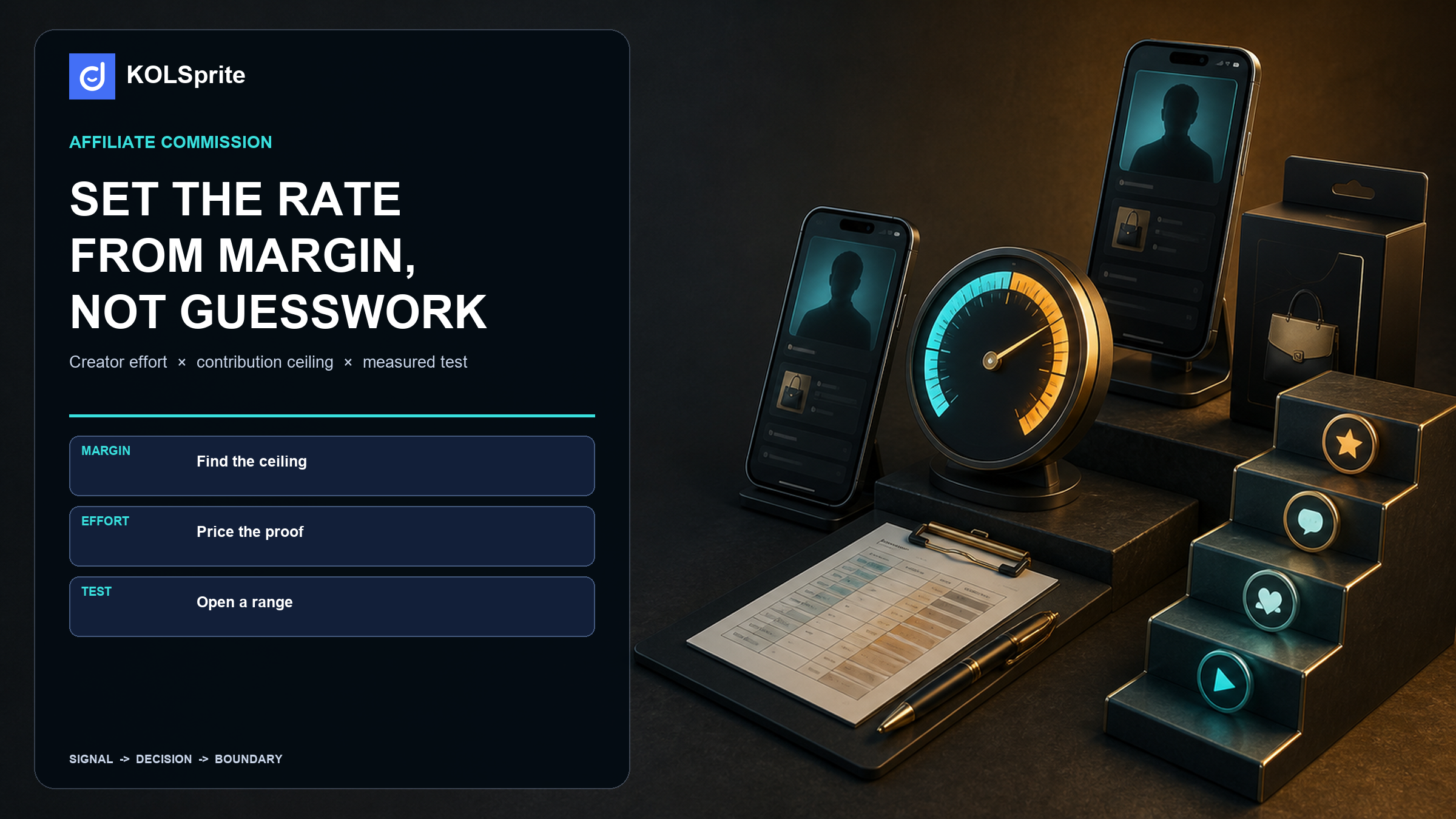
Direct response: Set the rate from the profit left on a credible order. Then pay more only when the creator must do more work. Do not copy a rate from another Shop listing. A high rate can win attention and still lose money.
Here is the 10-second answer: find the most you can pay per order, select a low, middle, or high test lane, and connect each lane to a specific content job. Run a short test, then use Seller Center and your own cost data to decide what stays.
This is a working strategy for sellers who need to set or revise a product offer, not a claim that one rate fits every product. Your product expense, return rate, sale price, shipping burden, and creator task all shape the right range.
Treat commission as money that comes from a completed order, not as a badge of how much you value a creator. TikTok Shop gives sellers tools to set affiliate offers, but those tools cannot see your expenses; check the current setup and fee criteria in the TikTok Shop Academy before you make a change.
Use the price a buyer is most likely to pay, which may be lower than the list price after a normal sale or coupon. Then subtract every expense that rises when the order ships, including product expense, packing, fulfillment, shipping support, Shop or payment fees, expected returns, and any ad expense assigned to that order.
The amount left is pre-commission contribution. Some can go to the creator, but some must remain with the business, so name that required profit floor before setting a rate. What remains is the most you can afford to pay for the sale.
For example, a buyer pays $42. The product costs $13, packing and fulfillment cost $5, shipping support costs $4, and fees plus expected returns cost $6. That leaves $14 before creator pay; if the business must keep $7, the ceiling is $7, or 16.7% of the realized price. A 20% offer breaks the model before a larger coupon or a bad return month appears.
The sample is only a way to demonstrate the method, so use your own numbers and keep a credible cushion. A rate that looks fine during a calm week can fail quickly when price cuts, returns, and shipping support stack up.
Use KOLSprite to inspect public creator and content fit for the product, then take that evidence back to your margin worksheet. New accounts can claim a three-day trial.
Register and claim a three-day trial
| Line | What to add | Why it matters |
|---|---|---|
| Order price | What the buyer is likely to pay after normal deals | It keeps the math credible |
| Order expenses | Product, pick and pack, shipping support, fees, returns, and ad costs | It captures the full cost |
| Profit before pay | Order price less order expenses | It shows the available pool |
| Profit floor | The least amount the business must keep | It is the guardrail |
| Max creator pay | Profit before pay less the profit floor | It is the cash cap |
| Max rate | Max creator pay divided by order price | It is the rate cap |
Method note: This is a planning sheet, not an accounting standard. Ask the person who owns pricing or finance to check the inputs. Shop fees, deals, and program terms can change. Check the current rules in TikTok's seller help before launch.
Make a sheet for each order type that matters because a first order, a bundle, and a repeat order can have very different economics. A repeat order may be worth more to your business, which can be a sound choice, but write that assumption down instead of hiding a long-term bet inside a creator rate.
Use this worksheet whenever you revise TikTok Shop affiliate commission for a product, because the rate should change when the order economics or required creator work changes.
Also state what event the math covers. Talk with your finance owner about sales, cancels, returns, and price cuts. Then check how the current Shop program treats those events. Do not use last year's criteria for a new evaluation.
Next, look closely at the work you want from the creator, because a quick use-case demo is not the same as a demanding evidence job. Some products need close views, side-by-side testing, a longer use period, or a credible response to a buyer fear, so define the work before you discuss a higher rate.
| Work level | What the creator may need to do | Rate choice |
|---|---|---|
| Basic demo | Show one specific use case and include the product link | Use the low safe lane |
| Evidence job | Show the product in use, add close views, or address one key doubt | Use a middle lane if margin allows |
| Extra work | Plan and test the concept, film in a new place, or make more than one piece | Set a short high lane or price extra work on its own |
| Brand reuse | Talk about paid use or other use by the brand | Do not fold rights value into commission |
Method note: This table is not a market rate card. Public videos can show the kind of evidence a creator makes. They cannot reveal private production time, past terms, or past sales.
KOLSprite helps with this research by letting a team review public creator fit, past content, and product context in one working view. Look for a genuine match: does the creator show products in a way that feels true to their life, and do they answer the same question your buyer is likely to ask? Save the videos that support that conclusion.
Public views and reactions are useful leads, not evidence of commercial value. They do not reveal private sales, refund risk, margin, or whether a creator will accept the offer, and they cannot promise that a video will work. Use them to guide a closer review.
One flat rate is easy to manage, but it can blur the work you actually need. Three lanes are usually more useful when each stays below the financial cap and has a plain, visible content objective.
For each lane, log the rate, product, deal price, evidence job, start date, end date, and stop criterion. A stop criterion may be simple: stop when profit falls below the floor, when the content misses the evidence job, or when no fitting creator responds by the end date.
Pick one product, one price state, and a limited cohort of creators with a close fit. Do not change the rate, brief, bundle, and sale price at the same time, because you will not know which change caused the result.
Before outreach, document the commercial assumptions behind the evaluation. Specify the applicable selling price, product variant, fulfillment method, expected discount exposure, and return allowance, then confirm that the creator brief does not require production work beyond the lane you selected. This protects both sides from a common problem: an offer that looks attractive in the invite but cannot support the requested demonstration once samples, shipping, and promotional discounts are included.
Use a limited, comparable cohort for the initial activation. A broad invite may create more activity, but it weakens the learning because creators can differ in audience context, content format, and product familiarity. Record why each creator belongs in the evaluation, which public examples informed that choice, and what evidence would justify moving that creator into a higher commission lane.
Bring your margin ceiling, proof burden, and proposed test band. The KOLSprite community can help you challenge the assumptions before you open the collaboration.
 +
+
Join the KOLSprite Discord community
Make a one-page test card before you send invites. Put the rate lane, max pay per order, profit floor, evidence job, creator type, dates, and data owner on it. The data owner should check the right first-party view in Seller Center. A count of samples or content pieces is not evidence that the order still pays for itself.
Use two cases in the strategy. The base case uses your normal order price and expenses. The stress case uses a lower price or a higher return allowance. If the rate works only in the base case, call it a limited evaluation. Do not treat it as a rate you can leave on all year.
At the end, choose one of three paths: keep it when the order stays above the floor and the content does the job, revise it when creators demonstrate interest but the brief or offer is off, or end it when the cap breaks or the content misses the buyer need. Record the rationale, because that note will shape the next offer.
Review this information in a short operating meeting before the offer becomes a default setting. The merchandising owner can validate price and availability, the finance owner can validate the contribution model, and the creator lead can confirm that the requested content is realistic. That shared review is especially helpful when several teams can change the offer without seeing the complete order economics.
A rate can be safe on its own and unsafe once promotions stack, so list every condition that can change what a buyer pays before you turn it on. Include seller coupons, shipping deals, bundles, gifts, samples, and ads that support the same product, then put a specific owner next to each one.
This is not busy work. It keeps a sale change from breaking a strategy that someone set weeks ago. The person who owns deals may not know the creator cap. The creator lead may not know a new ship deal is live. A short shared list closes that gap.
Keep a test record that someone else can use. Save the product and variant, rate lane, profit floor, evidence job, why you picked each creator, deal state, date range, and result. The next product may cost more, get more returns, or need more evidence. It should not inherit a rate with no context.
Review that note with both the expense owner and the creator lead. They may see a credible tradeoff. One may see a rate that is too high. The other may see work that needs a better reward or a fee apart from commission. Put the tradeoff on the table. Do not make commission solve every need.
Before approving the next cycle, document the commercial assumptions behind that conclusion, including product margin, estimated fulfillment expense, return exposure, promotional discounts, creator compensation, and the specific evidence job expected from the content. This record gives the finance and partnership teams a shared basis for revisiting the rate when any material condition changes.
A sound TikTok Shop affiliate commission is not the biggest number you can post; it is the smallest complete offer that gives a fitting creator a reason to make the evidence you need while the order can still pay its way. KOLSprite can speed public research, but your cost sheet and Seller Center data must make the final call.
Continue the decision loop. Frame the program with the TikTok Shop affiliate program operating guide. Build the candidate set with the four-step creator outreach workflow, then prepare the commercial discussion with the creator negotiation guide.
Latest Articles

As an essential, data-driven toolkit for TikTok influencers and marketers, KOLSprite provides powerful features for effortless creator discovery, trending content identification, and actionable real-time insights.
It empowers users to make smarter decisions and significantly boosts their TikTok business.

 Refer & Earn