 +
+
A TikTok creator database is valuable only when it helps a team explain why a creator belongs on a shortlist. Filters can narrow a large set. They cannot decide whether a creator can make a product believable, whether the content pattern suits the job, or whether there is a careful reason to reach out. This guide gives seller and agency teams a Defensible Shortlist Sheet: a compact record that turns a search result into a contact, hold, or pass decision.
Ten-second answer: Use a database to find candidates, then attach public proof, an open question, and a job-specific rationale to each name. A shortlist is ready for outreach when another reviewer can understand the choice without reopening the entire search.
That is an important question, especially when a team is entering a category with thousands of creators. A searchable database can surface candidates by open profile and content signals. The trap is treating the returned order as a recommendation. Search results are leads. They are not a statement that a creator is right for a particular product, market, or claim.
The practical distinction is simple. Discovery is broad and fast. review is narrow and slow. Let the first stage collect possibilities. But give the second stage more attention. Public metrics, recent videos, and category context can help you make a reasoned fit hypothesis. They cannot confirm private audience makeup, contractual current status, rights, or future business result.
Imagine a short meeting where the person who built the list is absent. Can the group see why each candidate is there? Can they tell what is unknown? Can they separate a creator who is interesting from one who is ready for outreach? If the answer depends on someone saying “trust me, I watched a lot of videos,” the list is a collection, not a decision document.
A Defensible Shortlist Sheet makes the basis visible. It includes the specific job, one or two public content examples, the fit observation, a question that must be verified directly, and a recommended next action. It does not manufacture a composite score. Scores often hide the very tradeoffs a partnership manager needs to discuss.
| What to record | What it can support | What it cannot settle |
|---|---|---|
| Creator and public examples | Gives the reviewer a reopenable starting point | Identity, audience, or compliance verification |
| Job-specific fit observation | Connects the creator to the planned proof | Guaranteed creator result |
| Recent content pattern | Shows whether the requested format is plausible | A complete historical record |
| Open question | Prevents a public signal from becoming an assumption | A reason to ignore legal or business review |
| Next action | Makes contact, hold, or pass explicit | A commitment from the creator |
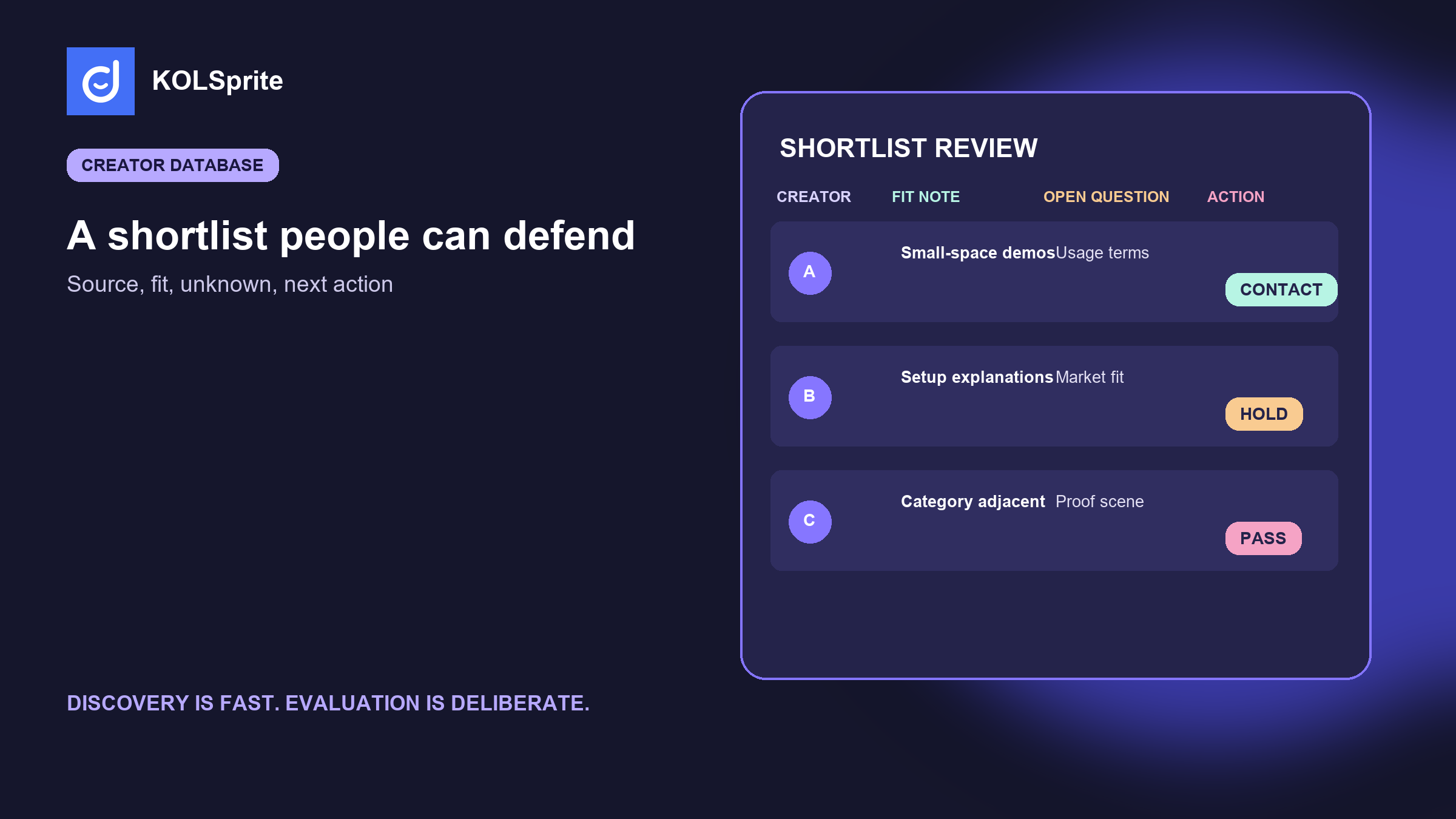
Observed-output table for shortlist review. Review each public example at the time of outreach because current status and context can change.
The best row is plain. It shows the fit. It shows the gap. It shows who acts next. That is enough for a first invite.
Make the next call easy to see. A reviewer should know why the name stays, what proof is still missing, and who must answer the open question.
A list earns its keep when it helps a new teammate make a call. They should see who fits, what is missing, and who owns the next step. If they cannot, the list needs work before outreach.
KOLSprite is useful here because it keeps the creator page, related public videos, and the saved review note in the same research pass. The team can compare visible fit, write down the missing question, and hand a smaller shortlist to the person who owns outreach.
That does not replace a direct conversation about rates, rights, or access. It gives the conversation a better starting point and makes it clear why a creator was saved.
KOLSprite can support the review stage by keeping creator and video research in the browsing workflow. Review open public profile and content signals, compare related examples, save candidates, and use similar-creator discovery when an initial reference creator proves useful. For teams using a supported AI client, KOLSprite MCP can provide structured creator, video, product, or shop research as an input to a written down shortlist. The returned data still requires relevance cleaning and human meaning.
That connected workflow matters because it preserves the “why.” A spreadsheet can store a handle. It often loses the actual content example that made the person interesting. Keeping the source context with the candidate reduces backtracking and makes internal review less dependent on memory.
Use KOLSprite to keep supported public creator and content context attached to a shortlist while the team reviews fit and open questions.
Register and claim a three-day trial
Strong sourcing includes deliberate rejection. Add a pass reason when the creator's usual setting does not support the proof, when the category fit is forced, or when public content leaves a material question unanswered. A pass is not a negative judgment about the creator. It is a way to keep a particular brief honest. It also prevents the team from recycling the same weak candidate every time a new campaign starts.
A hold column is equally useful. Use it when the public work looks promising but there is a specific question to settle: current current status, usage terms, local-market fit, clear sponsorship note expectations, or a product claim that needs approval. The next action should name the person who owns the answer.
Public research is a practical first layer. It is not an identity check, a brand-safety certification, or a legal clearance process. The FTC's clear sponsorship note guidance is a reminder that brand and creator responsibilities do not disappear because a work together began with a public search. Keep legal, contractual, claims, rights, and payment review in the right systems.
Source: FTC disclosure guidance. Scope: Use a qualified reviewer for campaign-specific legal and contractual decisions.
A good creator database becomes more valuable when its records help the next campaign. Preserve the original reason for contact, the proof job, and the final decision. Later, you can compare which creator settings made a product answer easier, which questions recurred, and which kinds of briefs created avoidable revision work. That is a learning archive, not a popularity contest.
Use a simple slate review. Put one name on screen. Read the job. Open the cited post. Then ask: does this person show the kind of scene we need? What proof can we point to? What do we still need to ask? A good TikTok creator database should make those answers easy to find.
Keep the talk short. Do not ask the group to guess sales, private data, or intent from one post. Do not turn a low follower count into a flaw by itself. Look at the work. Look at the fit. Then name the next move: contact, hold, or pass.
Use plain words in the sheet. “Shows small-home setup” is better than “strong lifestyle alignment.” “Ask about usage” is better than “validate business access.” The words in the note shape the next email. They can make the outreach feel like a real reason to talk, not a bulk pitch.
This is also fair to the team. A person can challenge a choice by pointing to the note, not by arguing from taste. The final call may still be hard. But the reason for it will be clear, and the team can learn from it later.
Use a five-minute review, not a long score sheet. Open the first post. State the job in one line. Ask what the viewer can see. Ask what is still not known. Then choose contact, hold, or pass. A TikTok creator database is most useful when that simple review can happen without a long search.
Keep one fact per line. Use the post link. Use a short fit note. Use a real question. Give the next step a name. This makes the list easy to scan on a phone and easy to hand to a new team member. It also makes weak picks show up fast.
Do not make the sheet sound more sure than it is. Public posts show public work. They do not show private terms, sales, or a future yes. A clear “not known” field is a strength. It tells the team what to ask, and it stops a neat table from turning into a false claim.
Join the KOLSprite Discord to compare creator research notes, pass reasons, and the questions that public data cannot answer.
 +
+
Join the KOLSprite Discord community
Use a TikTok creator database to make discovery faster, then slow down where the decision deserves it. A shortlist earns trust when it shows the cited proof, names the open question, and assigns the next move. That makes outreach more focused and gives the creator a clearer, more respectful assignment.
A shortlist should make it easy for reviewers to disagree productively. Instead of asking whether a creator is “good,” invite a specific challenge: does the proposed product scene appear naturally in this creator's public work, or are we projecting it onto them? Is the audience conversation around their content relevant to the buyer question, or merely adjacent? Does the public example show a repeatable answer style, or one unusually strong post?
These are useful questions because they can be answered from a record. A reviewer can open the cited video, read the note, and amend the recommendation. That is more reliable than a black-box rank or an unlabeled confidence score. It also lowers the cost of saying pass. The team is not rejecting a person. it is deciding that the current campaign job has not been proven yet.
For an agency, this note is especially important at the client handoff. The client may care about category fit, clear sponsorship note risk, usage needs, or creator voice in a different order than the research team. The sheet exposes those tradeoffs early. It gives the account lead a basis for asking which unknown must be resolved before a name moves forward.
The database is not a reason to send a broad, impersonal message. It should help the team explain why it reached out and what kind of work together it wants to discuss. A good first contact identifies the relevant product situation, leaves room for the creator to decline, and does not claim knowledge the public research cannot prove. Public context supports relevance. It does not create permission, current status, or a link.
As outreach develops, add the response and the final decision back to the record. Over time, that gives the team a more useful database: not a list of every creator it has ever seen. But a traceable history of which research signals led to which careful next actions.
A creator's public output and current status can change quickly. Refresh the cited examples just before outreach, not only when the original shortlist is created. This is not an argument for constant re-research. It is a last-mile check that the reason for contact still makes sense and that no obvious change has made the proposed work together feel forced.
Record the refresh date in the sheet. It gives the next reviewer a practical confidence boundary: this was an informed public-context decision on a stated date, not an assumption that the database is permanently current.
That is why the best database view is not necessarily the one with the most columns. It is the one that lets a busy reviewer see the source, the fit reason, the unknown, and the owner of the next action without turning public data into a false promise.
When a candidate moves from hold to contact, keep the original hold reason visible. That makes the outreach team aware of the question that still needs a direct answer and prevents a public clue from hardening into an assumption.
The discipline is simple: a creator database should leave every reviewer with less unknown about the next conversation, even when it cannot remove unknown about the final outcome. That is a meaningful improvement over a search result with no answer attached.
Use that standard consistently, and the list becomes a practical business record rather than a larger pile of names.
Build the shortlist further: Use the creator search decision guide, then the creator brief template, and finally the affiliate program system when the candidate moves toward outreach.
This shortlist record makes the source, the open question, and the next owner visible to the whole team.
Latest Articles
As an essential, data-driven toolkit for TikTok influencers and marketers, KOLSprite provides powerful features for effortless creator discovery, trending content identification, and actionable real-time insights.
It empowers users to make smarter decisions and significantly boosts their TikTok business.

 Refer & Earn