 +
+
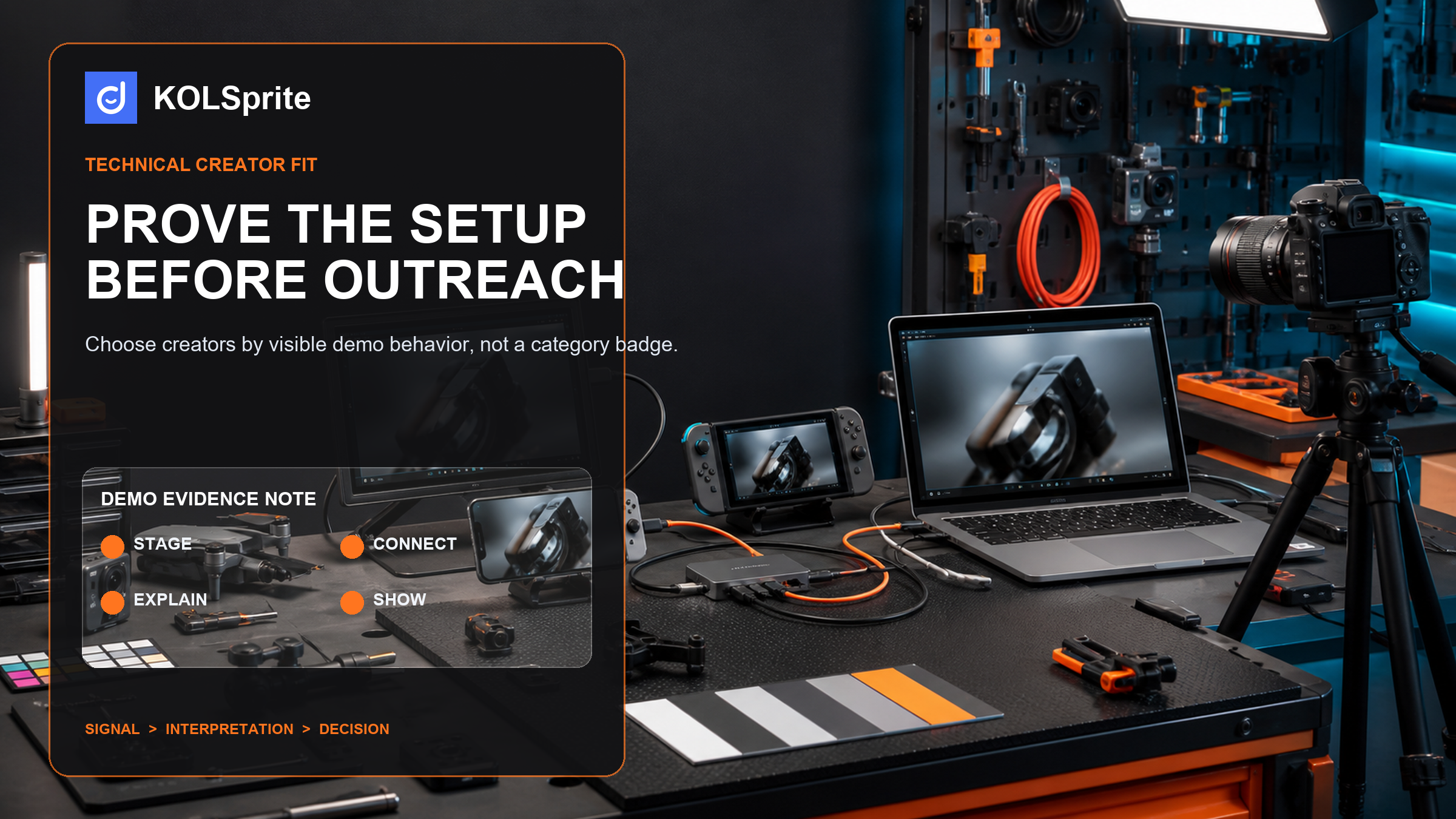
Amazon and Shopify teams selling setup-sensitive electronics face a partner choice problem. A tech label shows what someone posts, not whether they can explain setup to a buyer. For TikTok research on tech product demos, look for shown demo skill. Can the partner stage setup, name the limit, and show the result without hiding the hard step? This field note provides a Demo-Skill Proof Note, a portable-monitor example, and a way to decide whether to invite the partner, request proof, narrow the brief, or keep researching. TikTok creator research for technical product demos begins with the proof task, not the creator label.
Choose partners from observable proof skill, not niche badges. A credible demo makes the input, setup action, shown result, and unresolved limit easy for a viewer to follow.
“Tech partner” is too broad for a portable monitor, an adapter, or any product that needs the buyer to grasp device fit and setup. A partner may be excellent at reactions, news, gaming highlights, or product aesthetics without showing a cable path, a device setup, or the moment a display begins working. Those may all be valid kinds of content. They are not interchangeable proof skills.
Start with the hard part the product cannot afford to hide. For a portable monitor, it may be what device is being connected, which setup action is shown, and what the screen looks like after the setup. For an add-on, it may be fit, orientation, or a constraint that changes the result. The brief should name that proof task before the search begins. Otherwise, niche language will lead the team toward polished partners whose public work does not answer the buyer's real question.
A recognizable failure appears late in campaign review: the partner has filmed a handsome unboxing, but the one thing customers need to see is never shown. The footage is not necessarily bad. It was simply chosen against the wrong proof.
Paid collaborations create disclosure and advertising duties needing separate review. Start with the FTC's Disclosures 101 for Social Media Influencers and small-business advertising guidance. Public partner research does not settle compliance, rights, or campaign terms.
A proof task is a short description of what the audience must be able to see or grasp by the end of the demo. Keep it concrete. “Show a laptop setup and the working second screen” is a proof task. “Make the product feel premium” is an aspiration that gives a reviewer almost nothing to evaluate.
For a portable monitor, write four fields before examining partner records:
These fields turn TikTok creator research for technical product demos into a review process rather than a broad niche search. They also keep the outreach team honest. If no partner has public work that makes the critical setup shown, the next move may be to request a proof sample or narrow the brief. It is better to learn that before a campaign is committed.
| Review dimension | Shown proof to look for | What remains unconfirmed |
|---|---|---|
| Setup view | The input device, setup, and screen change are shown | Tech facts across every device |
| Device fit language | The partner names a device or constraint in public work | Complete device fit coverage |
| Proof sequence | Input, action, and result appear in an understandable order | Future campaign execution |
| Use case | Gaming, travel use, add-on context, or another shown job | Audience composition or sales impact |
| Deal facts | Gaps are recorded rather than guessed | Open status, rights, price, and deal terms |
Scope: public portable-screen demo review. Market: United States technical-demo research. Access date: 2026-08-31. Sample: five KOLSprite video-search results for portable screen, sorted by views descending. Cleaning: setup visibility, device fit language, proof sequence, and missing deal facts retained. Limit: public videos show demo skill only and do not guarantee tech facts, deal status, or future results.
Register for KOLSprite and claim a three-day trial to review supported creator and video evidence before writing the outreach brief.
Register and claim a three-day trial
The live sample returned several other proof jobs: device fit, setup, gaming use, travel use, and add-on context. One returned partner niche explicitly included Tech Products & Tests. That is a useful discovery signal, but it is still the video skill that should move the candidate forward. A niche tells you where to look. The proof sequence tells you what the partner has actually shown.
Watch for the key steps. Does the video show the useful input before the partner starts explaining? Does the handoff from cable or adapter to working screen happen on camera? Is the claimed result shown long enough for a buyer to grasp it? A partner who can stage those steps may be a better fit than someone with a broader niche match but no public proof of setup communication.
Also record the missing fact. A public clip might show a laptop paired with one screen. It cannot confirm device fit with every device, current inventory, tech testing, rights, rate, or future availability. Missing facts are not defects in the research note. They are the reason the next choice is “request a proof sample” rather than “approve.”
Pay close attention to whether the reason arrives before or after the shown result. A partner may show a successful screen setup yet leave the viewer unable to tell what was connected or why it worked. That can be enough to demonstrate visual polish but not enough for a product whose buyer must grasp device fit. The note should distinguish an attractive outcome from a repeatable explanation of the setup.
Likewise, a useful limit can strengthen a demo review. If a public video identifies a constraint, record it as a question for a product check rather than smoothing it away in the brief. The most credible partner choice is often the one that makes both the proof and the remaining test visible.
A Demo-Skill Proof Note should be short enough to influence outreach. At the top, name the product proof task. Then list the public examples that support or fail that task, the proof observed, the gap, and the next action. Avoid writing “great fit” unless the note makes clear what shown skill supports that judgment. A skeptical producer should be able to disagree with the conclusion while still seeing the source of the reasoning.
For example, a note may say: “Public work shows a laptop-to-screen setup and a gaming-use result. The partner names a device context but does not establish broader device fit. Request a short proof sample that shows the required setup before inviting.” That is more actionable than a niche score because it tells the partner manager exactly what to ask for and tells the product owner what remains unproven.
Use the same note for the partners who do not advance. “Strong travel use footage, but no shown setup; keep researching” prevents the list from being repopulated with the same weak rationale a week later. The note is a record of bounded proof, not a permanent judgment on the partner.
Join the KOLSprite Discord to discuss setup-sensitive briefs, proof gaps, and creator review decisions.
 +
+
Join the KOLSprite Discord community
KOLSprite can search supported partner and video records. It can help a configured AI client call supported MCP tools for limited research. Use it to find public demo skill, review context, and record the shortlist reason. A person makes the outreach choice. Current public metrics and context guide review. They do not guarantee performance or give a final partner fit or risk verdict.
Product, shop, video, and partner fields may vary by record. Relevance cleaning matters because a portable-screen query can surface adjacent use cases that are not equally useful for the proof task. That is a feature of the research work, not a reason to fill the gaps with inferred facts. Keep the sample narrow, name why a record belongs, and let the human operator decide whether the proof justifies the next step.
Begin with a partner search built around the proof task, then evaluate niche fit with proof. These steps work together: the niche helps form the starting pool; the demo skill decides whether a partner deserves a closer request.
The three-minute path is a brief check. In the first minute, state the setup-sensitive proof task and find public videos that appear useful. In the second, mark whether the input, action, result, and constraint are shown. In the third minute, choose one action. Invite a partner who has shown the needed skill. Ask for a proof sample when a key step is missing. Narrow the brief when the product need is too broad. Keep researching when no public work supports the task.
The useful editorial line is this: for tech products, the hard part is the product. A polished cut cannot substitute for a demo of the step buyers need to grasp. Let that rule guide the brief, the proof note, and the follow-up question.
Before outreach, write the proof requirement into the creator brief and add technical demonstration evidence. That keeps the visible demo skill tied to a request the product team can verify before a deal begins.
TikTok creator research for technical product demos is complete only when the public work supports a clear, testable request.
Once a partner advances, turn the proof note into a shoot requirement. Put it in the brief so the setup, device fit language, and result survive handoff. Keep deal facts and compliance review separate from the public-content finding. Each needs a separate check.
When a hard product means one partner may not cover every use case, link a hard product to cohort design. The goal is not to find a partner who appears to know everything. It is to make a defensible invitation based on public proof skill, then ask for the specific proof the campaign still needs.
Latest Articles
As an essential, data-driven toolkit for TikTok influencers and marketers, KOLSprite provides powerful features for effortless creator discovery, trending content identification, and actionable real-time insights.
It empowers users to make smarter decisions and significantly boosts their TikTok business.
 Refer & Earn