 +
+
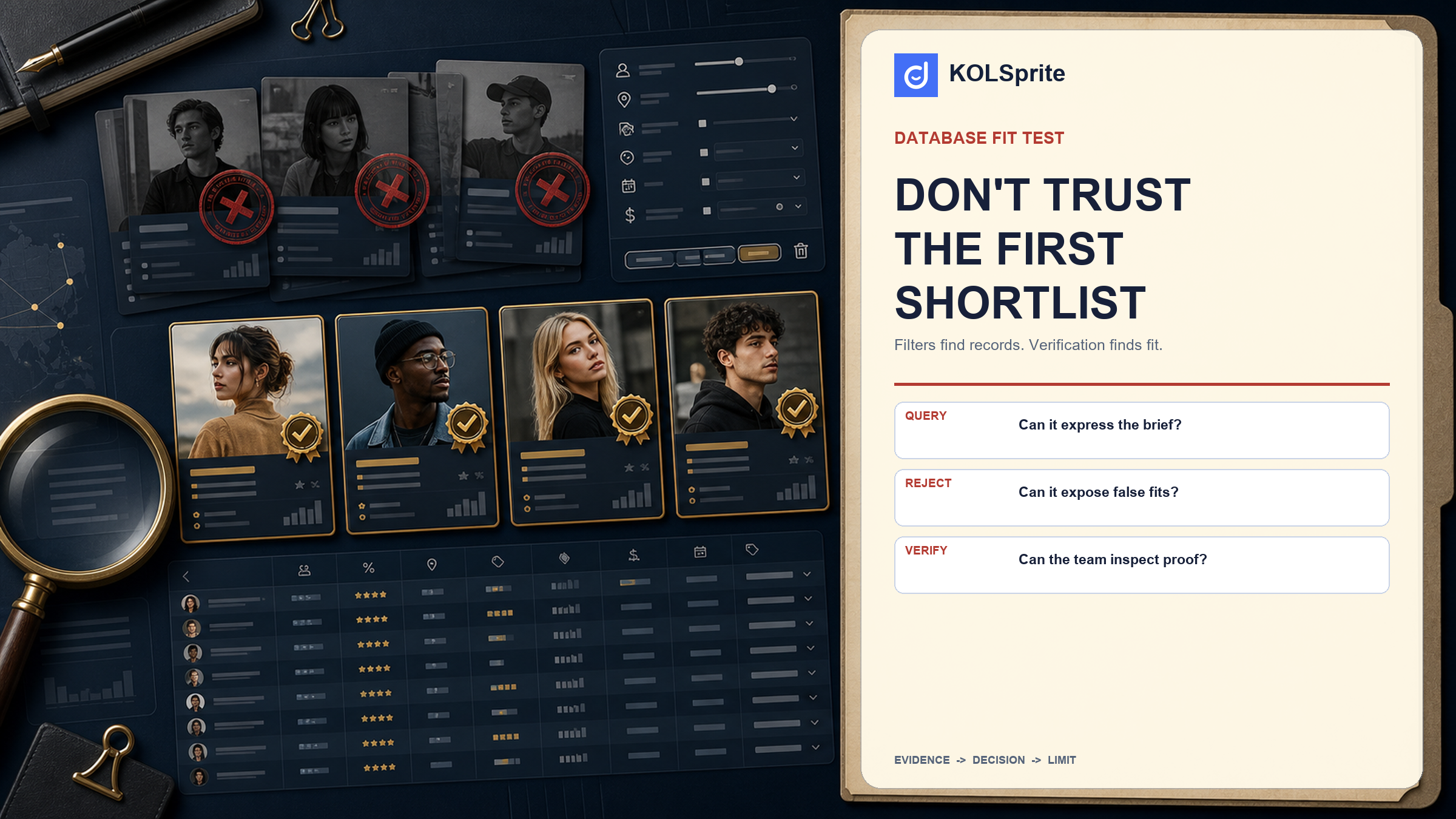
You buy creator tools or run brand deals for an agency. A huge database can look useful yet still waste your team's time. The real task is not finding names; it is finding creators who fit one precise brief before you buy, renew, or scale the tool. Test the TikTok influencer database with a real campaign job. Score the shortlist after you apply the filters. The result should be ten names ready for human verification. This guide gives you a five-part Fit Test, a score sheet, a 20-minute evaluation, rejection rules, and the complete handoff queue. Public data can speed discovery. It cannot confirm audience data, rates, replies, rights, availability, or sales.
Can this tool turn our product type, market, evidence need, and content limits into ten sound names that one teammate can verify today?
This question has an output you can see; it keeps a sales demo focused on the task. A tool may hold millions of records and still give you a broad or stale shortlist. A short shortlist can be worth more when you can see why each name is on it.
Write a one-line brief before the demo; here is one: "Identify U.S. creators who post about home organization, demonstrate products in use, fit a bounded paid test, and have recent content to review." Keep it narrow; a narrow brief makes bad matches easy to spot.
A practical TikTok influencer database should help reviewers apply the same checks; it should not turn public signals into a final deal shortlist.
Give each part a score from 0 to 4, apply its weight, and record the evidence behind every score above 2. The highest possible total is 100.
| Part | Weight | 0 points | 2 points | 4 points |
|---|---|---|---|---|
| Brief fit. | 20 | Cannot set market, type, or size | Primary filters work. Some review stays manual | The complete brief stays with the shortlist |
| Evidence view. | 25 | Names and totals only | Some public observations. The frame is thin | Recent posts sit by dated public observations |
| Bad-match control. | 20 | No specific way to reject | You can drop names, not save why | You can verify, reject, tag, and search again |
| Next-step file. | 20 | A flat shortlist | Basic observations and links | Evidence, risk, owner, and next check |
| Day-to-day trust. | 15 | Dates and gaps are hidden | Some scope is specific | Dates, units, gaps, and reach are specific |
Use score / 4 x weight for each part; scores of 3, 3, 3, 2, and 3 give a total of 70; this is not a market pass mark; it helps you test two tools with the same brief.
Register for KOLSprite and claim a three-day trial to run a bounded creator search, inspect public evidence, and build a verification queue.
Register and claim a three-day trial
An effective evaluation should make bad matches easy to see; on August 12, 2026, a bounded KOLSprite MCP search looked for home-organization creators; it gave five public results, including broad shop accounts and star-style accounts. This was a practical negative case. A word match did not prove category fit.
Do not call those creators poor fits; the snapshot did not test their recent content or name them. It only showed that a person had to review the shortlist. A consistent reject note might say, "Broad shop account; not enough recent home-organization content." Then tighten the search.
This was one public query on one date; it does not score the whole tool or all its records; it does not compare one vendor with another. It shows why your test needs a specific way to identify and log bad matches.
Bring your own brief; do not let the vendor pick an easy field.
| Time | Task | What to save |
|---|---|---|
| 0-3 min | Set the market, type, size, and evidence need | Which parts fit in the tool? |
| 3-7 min | Open the first ten names | How many show enough recent, relevant content? |
| 7-10 min | Reject specific bad matches | Can you save why and search again? |
| 10-14 min | Review posts and profile observations | Are dates and field names specific? |
| 14-17 min | Build the ten-name verification queue | Can you keep evidence, doubt, and next steps? |
| 17-20 min | Share the shortlist | Can another reviewer pick up the work? |
Stop the clock when the file is ready to use; do not stop when names first appear; log time spent in other tabs. Human verification is normal. Hidden clean-up time is a cost.
These are your evaluation rules, not market norms; adjust them for a rare role or a bounded market; record the change before the test.
This file is the primary output; it is not a shortlist of creators cleared for contact. Use one row per creator.
| Field | What to write | Why |
|---|---|---|
| Name and profile link | Current public name and direct URL | Stops mix-ups |
| Market clue | Visible reason the market may fit | Marks what still needs evidence |
| Type evidence | Two recent posts tied to the brief | Goes past a word match |
| Evidence style | Demo, lesson, match-up, or routine | Links the creator to the job |
| Public observations | Dated follower, view, or rate observations | Keeps the row easy to check |
| Fit doubt | One way the match may fail | Checks team bias |
| Must verify | Audience, rate, rights, timing, or conflict | Turns doubt into a task |
| Owner and state | Verify, hold, or reject | Keeps the shortlist fresh |
Use the same TikTok KOL analysis steps for each creator; the tool should produce a better verification queue; it should not claim that human review is no longer needed.
KOLSprite can help set the type and market; it can filter public profiles and show posts; you can reject loose matches and move the rest to a file; this is a consistent role for a research tool.
It cannot prove that a creator is available, wants the job, or will reply. It also cannot verify private audience data, rates, brand conflicts, rights, fraud, or sales. A public rate needs a consistent peer set, so use a defined TikTok rate peer group when that rate affects the decision.
Join the KOLSprite Discord community to compare filtering logic and shortlist verification with other creator teams.
 +
+
Join the KOLSprite Discord community
Use the score, the evaluation file, and the clean-up log; then pick one path.
Write the reason in plain observations; "It feels broad" is unsupported; "Seven of ten names passed the category check, and the file took 18 minutes" can be checked next year.
A renewal decision should include labor, not only the software fee. Include the minutes spent fixing filters, opening extra tabs, finding recent content, and rebuilding exports, then multiply that time by the number of searches your team runs each month. This calculation is a local cost record, not a promise of savings.
For a fair comparison, keep the brief, reviewer, time limit, and acceptance rules consistent across tools. Document any change before the evaluation begins. Otherwise, a more familiar interface may appear operationally superior simply because the reviewer already knows where its controls are, while a stronger database carries an avoidable learning penalty.
Also record which tasks improved. A faster first search has value, but it differs from a faster verification handoff. Keep those gains separate. At renewal, compare the same brief, scorecard, and repair log. A lower profile count can still be the better outcome when more names survive review and less manual work is required.
Brief: [Type, market, size, and evidence need.]Fit Test: [Score]/100 on [date].Evaluation: [Count] of ten names moved to the verification queue. [Count] passed.Clean-up: [Time and repeat tasks.]Gaps: [Dates, reach, evidence, file, or team use.]Decision: [Buy, test term, search only, or pass.]Next verification: [Date and another brief.]
Verify each name before you write. Review recent content, ask for audience data, rates, availability, rights, and brand conflicts, and save the answers that come from the creator or their agent. Do not present those answers as database observations.
Once a name passes, move it to a separate four-step TikTok outreach plan; keeping search, verification, and contact apart helps the team avoid a poor or false pitch.
A useful database result should survive a handoff. Give the exported file to a teammate who did not run the search, along with the original brief but no verbal explanation. Ask that reviewer to identify why each creator qualified, what evidence remains incomplete, and which verification task comes next. If the reviewer must reopen the platform simply to understand the shortlist, the export is an inventory of names rather than an operational decision file.
Record the handoff time and every clarification request. Those observations reveal whether the database preserves context, supports consistent qualification, and reduces avoidable reconstruction work. They also expose a common procurement mistake: evaluating search speed while ignoring the documentation required for compliance, outreach, and campaign ownership. Portability is not a decorative feature. It determines whether the research can move safely from discovery to verification without losing the assumptions and limitations behind each recommendation.
Repeat the handoff with a second campaign brief before renewal. A database may perform well for broad consumer categories yet require extensive manual interpretation for regulated products, regional niches, or specialized professional audiences. The second test shows whether the workflow is dependable across realistic assignments rather than optimized for one convenient demonstration.
The right tool does not remove judgment; it makes judgment quick, consistent, and easy to share. Buy that workflow gain. Treat the size of the shortlist as inventory, not proof of value.
Set your evaluation baseline with the TikTok KOL analysis guide, compare cohort logic in the TikTok engagement benchmark workflow, then hand verified names to the four-step creator outreach process. After publication, add persistent inbound links from the first two maintained pages.
Latest Articles
As an essential, data-driven toolkit for TikTok influencers and marketers, KOLSprite provides powerful features for effortless creator discovery, trending content identification, and actionable real-time insights.
It empowers users to make smarter decisions and significantly boosts their TikTok business.

 Refer & Earn