 +
+
You run a lean brand or manage creator samples on a tight budget. You need to know which creators deserve a sample. Follower count alone will not show who can explain the product or work well with your team. Treat TikTok micro influencers as a test cohort, not a cheap reach list. Allocate twelve seats across three lanes: product evidence, audience language, and operational fit. Verify each creator before contact, then run a 14-day learning cycle. The result is a balanced first cohort that can teach you how the product should be shown, discussed, and managed. This guide gives you the complete seat map, score sheet, red flags, handoff, and test plan. Public data cannot prove audience quality, rates, rights, replies, fraud, availability, or ROI.
Many teams use a band such as 10,000 to 100,000 followers; that can keep discovery and likely cost within bounds; it does not grade quality; it does not prove that a creator fits the product, earns trust, or will be easy to work with.
A 2025 report from Axios on brand and creator talks noted interest in smaller niche creators; brands sought a closer link with the right audience; that is a dated market sign, not a broad outcome benchmark. It supports a fit test. It does not prove that a smaller creator beats a large one.
Use the follower band to build a pool. Use specific product fit to award a seat.
On August 12, 2026, a KOLSprite MCP search identified five public U.S. skincare creators; the filter used about 10,000 to 100,000 followers and sorted by public interaction.
| Creator | Followers | Avg. views | Public rate | Products field |
|---|---|---|---|---|
| @gracenivyco | 83,888 | 35,388 | 3.10% | 75 |
| @sincerely.sarahhh | 86,517 | 93,812 | 1.08% | 1,465 |
| @sylviavanhoevenbeauty | 56,199 | 210,209 | 1.04% | 200 |
| @dakotasmart | 11,945 | 51,401 | 2.64% | 167 |
| @ababyandabulldog | 59,342 | 143,069 | 0.90% | 1,367 |
The three public measures do not rise in one order; the creator with the fewest followers did not have the fewest views or the lowest rate; the creator with the most views did not have the top rate. This is enough to reject follower count as the only rule.
It is not enough to rank these creators for a deal. This bounded query does not represent the market, and the product and sales-volume fields are public research fields rather than audited creator income. The search cannot prove topic fit, audience quality, fraud, rates, rights, replies, availability, or ROI. Review recent work and ask the creator before you make a deal decision.
An effective cohort has practical range; if all twelve seats reward the same strength, the test will teach you less.
These creators make product use easy to see; look for demos, comparisons, routines, close shots, setup, or specific doubt handling; judge how they demonstrate evidence. Do not assume that a past product is the same as yours.
These creators state a problem in language the customer may recognize; look for exact routines, pain points, questions, and tradeoffs; in this lane, a specific problem can matter more than a polished product shot.
These creators demonstrate public signs that a bounded test may be practical; look for recent posts, a format you can support, a specific contact path, and sound ad labels where they apply; these are clues. You still need to ask.
Register for KOLSprite and claim a three-day trial to compare public creator evidence before you send products or outreach.
Register and claim a three-day trial
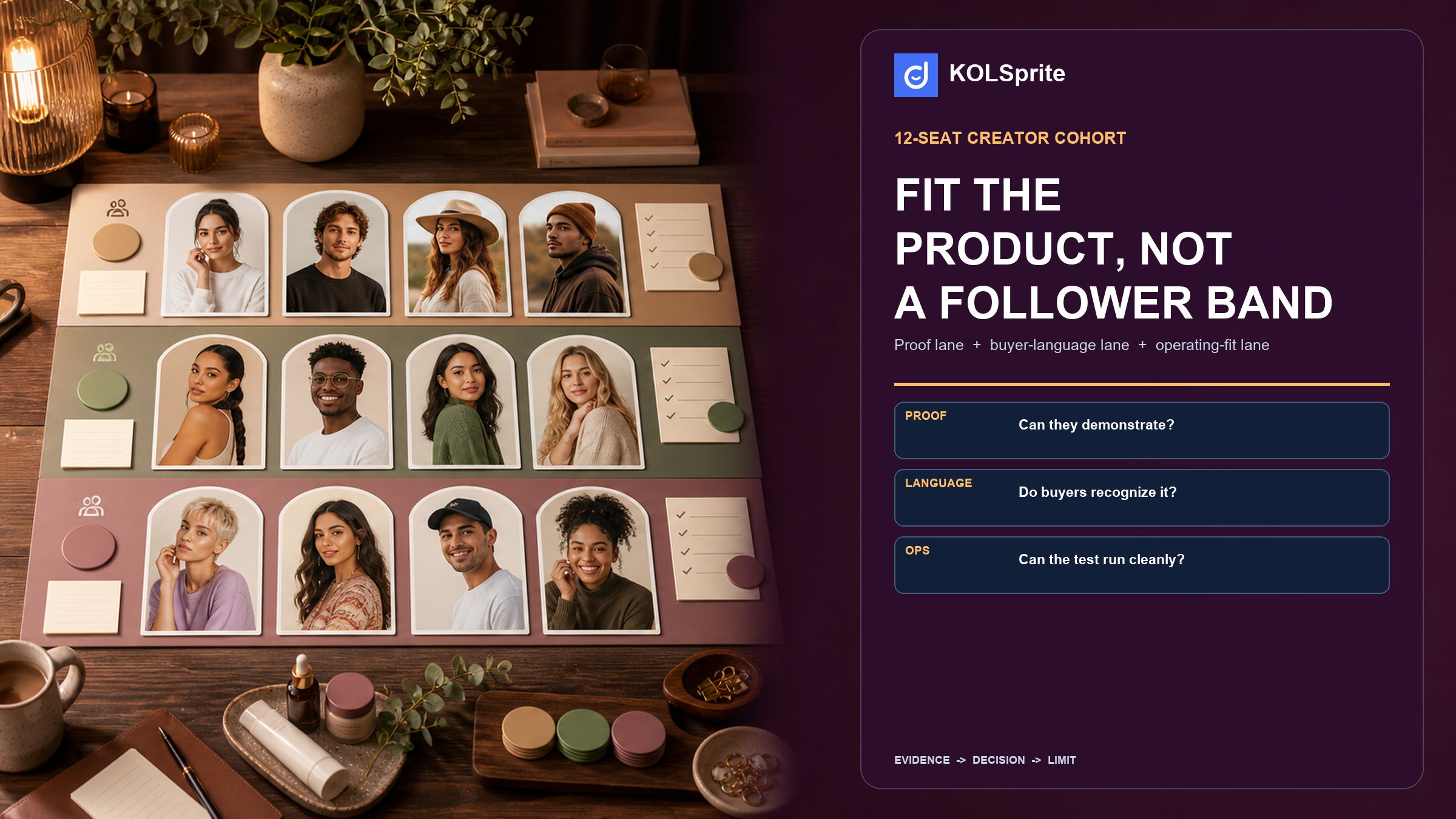
Give four seats to each primary lane. A creator may fit more than one lane, but you should still name one primary reason for the seat so the test remains easy to review.
| Seat | Primary lane | Evidence needed | Balance rule | State |
|---|---|---|---|---|
| 1 | Product evidence | Two recent demos | Talks to camera | Verify |
| 2 | Product evidence | Two recent demos | Hands or voice-over | Verify |
| 3 | Product evidence | A specific comparison or routine | Low end of size band | Verify |
| 4 | Product evidence | A doubt handled with safe claims | High end of size band | Verify |
| 5 | Customer language | A need stated more than once | New-user view | Verify |
| 6 | Customer language | Practical public questions | Skilled-user view | Verify |
| 7 | Customer language | A specific use case | Talks to camera | Verify |
| 8 | Customer language | A specific use case | Lesson or voice-over | Verify |
| 9 | Work fit | Recent posts and contact path | Simple shoot needs | Verify |
| 10 | Work fit | Specific ad labels and category care | More built-out shoot | Verify |
| 11 | Work fit | Steady, relevant content | Low end of size band | Verify |
| 12 | Work fit | Steady, relevant content | High end of size band | Verify |
The balance rules are examples; swap them for observations that matter to your product; you might use skin need, home setting, video style, or user skill. Do not infer private traits or audience observations from looks.
Score six parts from 0 to 2. A score of 0 means no public evidence, a score of 1 means mixed evidence, and a score of 2 means two recent public examples support the point.
| Part | Question |
|---|---|
| Topic fit | Does recent work address the same product or need? |
| Evidence skill | Can the creator make product use or change easy to see? |
| Word fit | Do they use exact and practical problem words? |
| Format fit | Can your brand support their normal style? |
| Claim care | Can the idea work without an unsupported claim? |
| Work clues | Do recency, contact, and ad labels support a review? |
Start verification with scores from 9 to 12; put scores from 6 to 8 on hold and name the missing observation; drop scores below 6. These are local operating rules. They do not predict results.
A red flag means reject or ask for evidence; it does not support a public claim about the creator.
For TikTok micro influencers, KOLSprite can help set the market, topic, and follower band; it can place public profiles and posts side by side; you can then assign creators to lanes and send a bounded list to human review.
Use the same TikTok KOL analysis steps for the deeper verification; KOLSprite helps gather and compare public evidence; it cannot prove private audience data, fraud, rates, availability, rights, replies, or ROI. Keep each unknown in the handoff.
Join the KOLSprite Discord community to discuss creator fit, sample allocation, and test design without sharing private campaign data.
 +
+
Join the KOLSprite Discord community
Each of the twelve seats needs a short card:
Then use a separate TikTok influencer outreach process; do not write as if the creator has said yes, likes the product, or fits the budget; the first note should invite a fit discussion and explain the bounded test.
The first cycle should teach the team; it is not a contest among twelve creators.
| Day | Action | Output |
|---|---|---|
| 1 | Set the seats, score rules, budget, samples, and claim limits. | Twelve checked names plus backups. |
| 2-3 | Send a specific and relevant note. | Sent, hold, or reject for each seat. |
| 4-6 | Log replies, rates, timing, conflicts, and rights needs. | Actual work observations replace assumptions. |
| 7 | Review the lane mix. Fill only failed seats. | A set test cohort. |
| 8-10 | Agree on product, scope, claims, review, ad labels, and rights. | A specific scope for each active creator. |
| 11-13 | Plan the sample send and answer questions. | Send log and issue list. |
| 14 | Review what the decision process taught. | A short memo and next test. |
Fourteen days may be too short for posted work or sales; that is fine; the first review asks whether the seat plan led to relevant talks and workable scopes. Later reviews can use approved first-party results.
Keep cohort balance separate from creator ranking. A high-scoring creator may still be redundant when another seat already covers the same evidence style, customer language, and production requirements. The final cohort should maximize useful variation within the approved risk and budget limits, because the purpose of the first cycle is comparative learning rather than a prediction of individual performance.
Track the share that passed the fit verification, reply state, known rates, scope fit, rights fit, claim issues, sample readiness, and lane mix. Show the base count for each rate. A reply rate from twelve notes is a local outcome; it is not a market norm.
If the source list itself needs a test, use a TikTok influencer database fit test before you build the cohort.
Preserve the original seat criteria when the cohort moves into outreach. If a creator is replaced, document the failed requirement and use the same qualification standard for the backup. This prevents selection drift, in which practical constraints gradually turn a balanced experiment into a convenient list of whoever replied first. The record also separates creator performance from process failure: an unsuitable brief, missing rights term, or delayed sample should not be interpreted as evidence that the creator category itself was ineffective.
Do not change the rules to make each pick look effective; save reject notes and failed assumptions. A cohort can still add value when some seats fail. The lesson should improve the next decision.
Micro is the size limit you select; fit is the reason a creator earns a seat; build for fit. Verify what public data cannot demonstrate. Let your own results replace assumptions over time.
Use the TikTok KOL analysis guide to define fit, test the search surface with the influencer database Fit Test, then send the final cohort through the four-step outreach workflow. After publication, add persistent inbound links from the first two maintained pages.
Latest Articles
As an essential, data-driven toolkit for TikTok influencers and marketers, KOLSprite provides powerful features for effortless creator discovery, trending content identification, and actionable real-time insights.
It empowers users to make smarter decisions and significantly boosts their TikTok business.
 Refer & Earn