 +
+
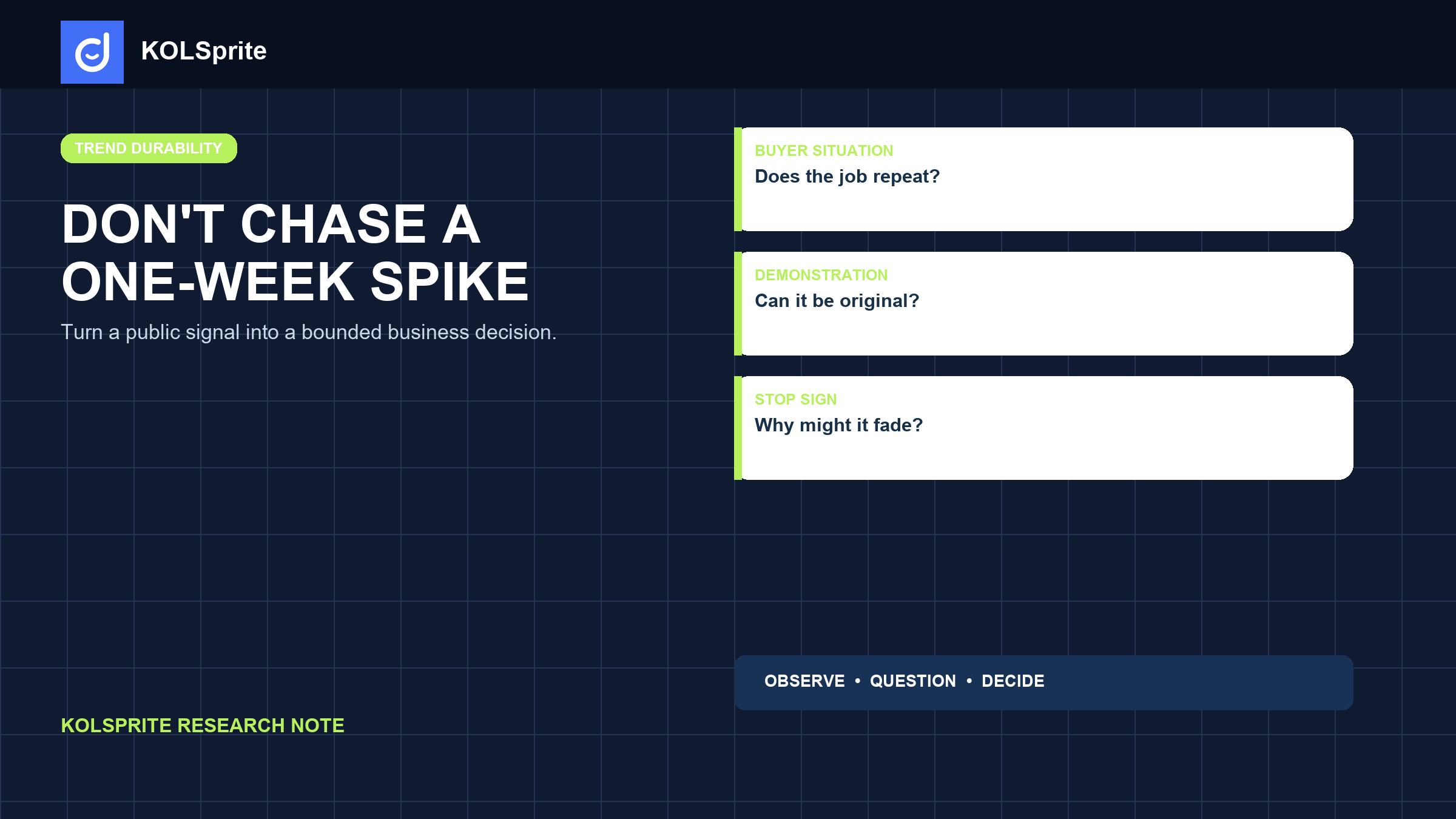
Learning how to find trending products on TikTok is easy if the goal is a feed full of fast-moving clips. It is harder if the goal is to choose a product test that still makes sense after the first burst of attention. Shopify founders do not need another list of viral items. They need a way to decide whether a visible spike has a repeatable buyer situation, a workable offer, and room for an original demonstration. This article uses a Trend Durability Test to make that call.
Ten-second answer: Find the signal, then look for the conditions that could outlast it: a recurring buyer situation, a clear demonstration, an offer that can be fulfilled, and a reason the trend might fade. Test the condition, not the spike.
A product can jump because a creator made a satisfying clip, because a seasonal moment arrived, or because a short-lived joke gave people a reason to share it. All three can create a strong graph. None tells a Shopify seller what should happen next.
When you find a trend, write down the smallest claim you can make without guessing. For example: this product is being shown in a compact-kitchen cleanup scene. That is more useful than writing that the product is a winner. It leaves room for research.
The durable part of a trend is often the situation, not the item. A product may appear in a morning routine, a small-space problem, a gift decision, or an annoying repair. Search beyond one viral post to see whether the same situation returns with different products and different people.
If the situation repeats, you have a potential research direction. If the only common thread is one creator's style, you may have a content reference rather than a product opportunity. That distinction saves teams from chasing the surface of a trend.
Register for KOLSprite and claim a three-day trial to review the public signal beside the offer facts a trend cannot answer.
Register and claim a three-day trial
A TikTok product trend is more useful when your team can explain the job without copying the original video. Could a different creator show the same use in a real setting? Could a buyer understand the benefit without the original joke, music, or visual trick? If not, the concept may be too fragile.
KOLSprite can help teams narrow public videos and review the captions, scripts, and comments around a product signal. Use that context to understand the structure of a buyer question, not to reproduce someone else's creative expression.
A trend can create a demand for information before it creates a demand for your offer. Check price, delivery, variants, listing language, and what the product can honestly claim. A product that needs a long explanation or has an unclear delivery condition may not be ready for a trend-led test.
This is a good moment to involve the person who owns the store. The researcher can say what was visible in public content. The store owner can say whether the product page and fulfillment can support the implied promise. The two facts should not be merged.
| Signal | Useful next question | Stop condition |
|---|---|---|
| Fast view growth | What problem makes viewers stay? | The clip works only as novelty |
| Repeated creator format | Can another creator show the job naturally? | The format relies on one personality |
| Many product mentions | Can the offer meet the implied expectation? | Availability or claim facts do not match |
Source scope: public trend, caption, and comment context supports a research hypothesis. Use TikTok Creative Center as one trend-discovery surface, then verify offer and operational facts separately.
Every trend note needs a disconfirming sign. It could be a highly seasonal setting, a narrow use case, comments that focus on a different product, or a video format that does not translate. Writing that sign down keeps a team from turning hope into a forecast.
A durable test is not pessimistic. It is specific. It tells the team what would make the opportunity stronger and what would make it weaker before money, inventory, or creator time is committed.
Watch when the buyer situation is plausible but the evidence is thin. Test when the situation, demonstration, and offer have a clear connection. Pass when attention is the only positive signal. These are not permanent labels; they are a way to give a trend an honest next action.
After the first pass, save the source and the decision. KOLSprite can keep supported public research context available for a later review, while the team owns the store facts and the commercial call. That makes a new test easier to explain when the trend changes next week.
Join the KOLSprite Discord to discuss trend notes, stop conditions, and the difference between attention and a usable product test.
 +
+
Join the KOLSprite Discord community
The useful output from how to find trending products on TikTok is not a longer watchlist. It is a question your team can answer: can our product solve this recurring job in a way our offer can support? That question can lead to a listing test, a supplier check, or a new creative brief.
If the answer remains vague, do not stretch the trend into a strategy. Let it remain an interesting signal. The best research often earns its value by making a fast-moving idea smaller and more testable.
A useful test has one question and one stop rule. For example, a team may ask whether a compact-storage use case makes sense for its own product page. It can make one short original video or one landing-page variant. The stop rule might be that the product cannot support the implied size, price, or delivery promise. This keeps the test focused on a buyer problem rather than on copying a rising format.
Choose a time window before you look for a result. A few days may be enough for a creative review. A longer window may be needed for a product-page question. The exact period depends on the channel and the volume of traffic. What matters is that the team names it first. Without a window, a trend can stay alive on a watchlist simply because nobody decided what would count as enough evidence.
When learning how to find trending products on TikTok, write down what would make the signal weaker. A sudden spike tied to one holiday, one sound, or one creator is not useless. It just needs a narrow claim. A repeatable scene across different accounts is stronger, but it still does not settle the offer. The test is there to compare the public pattern with the business conditions your team controls.
Keep one original creative boundary. Do not reuse a creator's script, a recognizable edit, or the exact visual joke that made a clip travel. Describe the buyer job in your own words, then show it with your own product facts. This is better for the audience and easier for a team to defend. It also tells you whether the underlying idea works without borrowed attention.
At the end of the review, record one sentence: what the trend changed in the team's understanding. It may have exposed a missing use case, a weak product photo, or an offer constraint. It may only have shown that the item belongs on a watchlist. Either outcome is useful. The purpose is not to prove that every trend deserves a launch. It is to make the next choice less guessy.
Share the note with the person who owns the product page before the team makes new creative. That person can spot facts the public signal cannot show: current stock, weak variants, a confusing return rule, or a product detail that the clip leaves out. The researcher can then revise the test or stop it. This handoff is a small thing, but it keeps a content discovery task from becoming a separate plan that the store cannot support. A good trend test makes the research and store teams ask the same question.
Keep the test budget modest at first. The first round is for learning, not for proving a big market story. A small test can reveal whether the buyer scene is clear and whether the offer makes sense. If it does not, stop early and preserve the reason. That record is useful when the same trend appears again in a different season or format.
Set a date for the next look. A trend note needs a review point, not an endless watch state. At that date, compare the original question with the new evidence and choose to test, wait, or close it. This keeps a quick signal tied to a deliberate business decision.
Continue the research: validate a trend before inventory · Amazon product validation on TikTok · make a creative choice from content evidence.
Latest Articles
As an essential, data-driven toolkit for TikTok influencers and marketers, KOLSprite provides powerful features for effortless creator discovery, trending content identification, and actionable real-time insights.
It empowers users to make smarter decisions and significantly boosts their TikTok business.

 Refer & Earn