 +
+
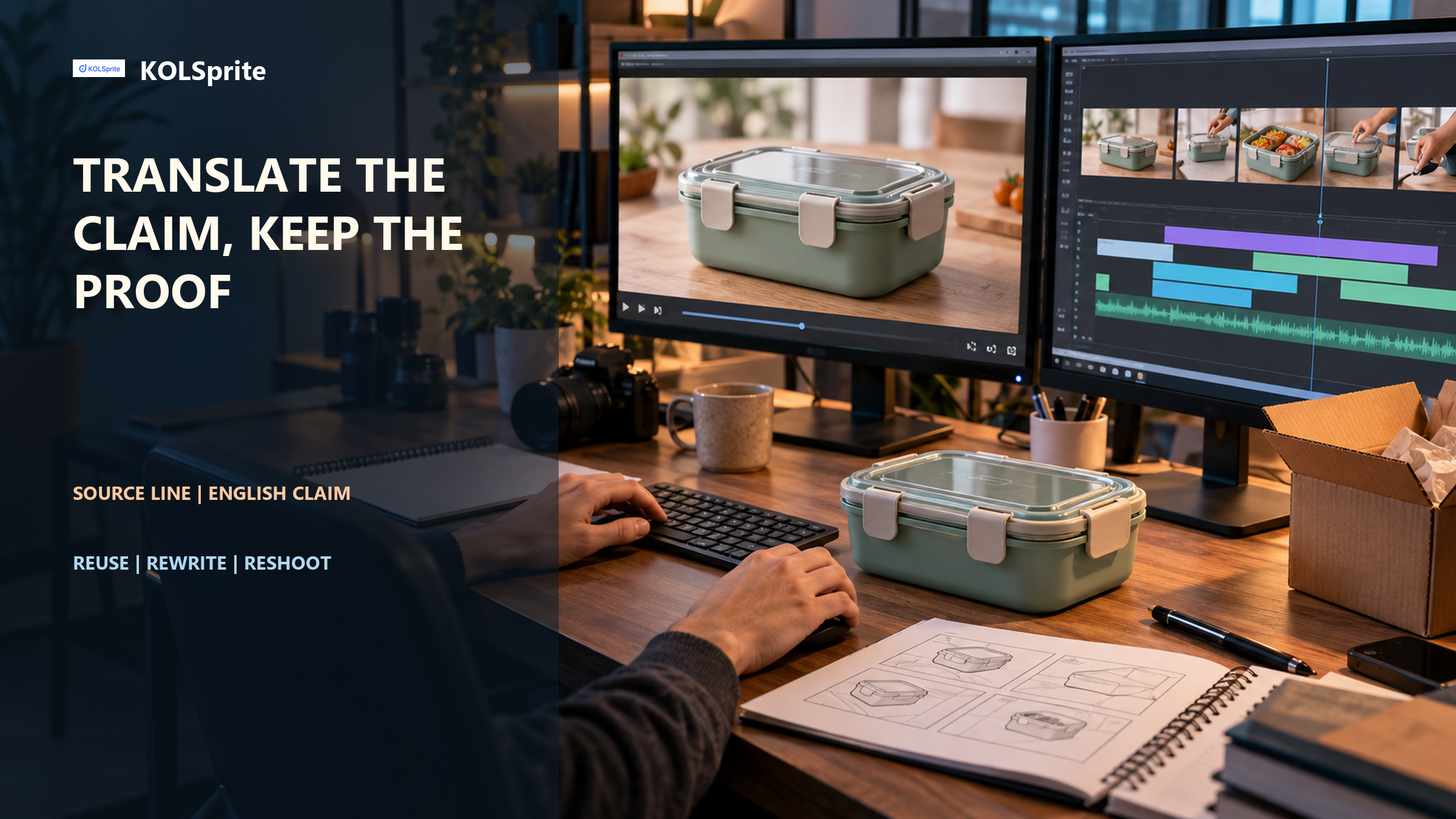
For a US launch, TikTok video localization should begin with the product claim and the footage that supports it, not a fluent English dub. Write down the source claim and name what the camera proves. Then decide line by line whether to reuse, rewrite, or reshoot. The claim-and-footage grid below helps an editor, translator, product owner, and reviewer reach the same decision before paying for finished audio.
For TikTok video localization, reuse a line when meaning and visible proof both survive the move to US English. Rewrite it when a literal translation overstates the claim. Reshoot when the camera never shows the needed proof. Translate the words only after you can name what the footage supports.
A natural dub can be accurate as language and still be wrong for the product claim. The source phrase may rely on a local idiom, a broad adjective, an implied comparison, or context outside the frame. US viewers may hear a stronger promise than the source team intended. The footage may also prove only a narrow use case while the English line sounds universal.
Run two reviews. The language review asks whether the English conveys the intended meaning in clear US usage. The claim review asks whether the brand can support that meaning and whether the video shows the promised fact. Neither review replaces the other. A translator should flag uncertainty; the product and compliance owners should approve the claim.
TikTok for Business described translation and dubbing in its Symphony creative suite on June 22, 2026. Those tools can help produce localized media. They do not certify the translation, the product statement, the rights, or the ad's suitability for a specific market. A person who knows the product still has to compare each line with the footage and the evidence behind the claim.
Write down the source line. Make a literal translation to spot issues, then state what viewers can see without sales language. Now choose what to do. The grid below uses a made-up video for a reusable travel bottle. It shows the review method. It does not describe a real campaign or product result, and it is not a legal opinion.
| Source intent | Literal English dub | What the footage shows | Decision | US adaptation |
|---|---|---|---|---|
| Compact for a short trip | Perfect for every trip | Three bottles placed in one small toiletry bag | Rewrite | Show the same set and say it fits this weekend packing setup. |
| Cap closes firmly in the demo | Never leaks | Creator closes and turns one filled bottle once | Rewrite | Describe the visible closure; do not make a universal leak claim. |
| Labels help tell products apart | You'll always know what is inside | Blank bottles with no readable labels | Reshoot | Add approved labels and show them clearly, or remove the line. |
| Twist the cap until seated | Twist the cap closed | Close view clearly shows the same action | Reuse | Use natural US wording that matches the visible step. Creation capability:TikTok Symphony describes translation and dubbing tools. That is a way to make a new asset, not a product-claim approval. Ad-language check:TikTok's ad-language guidance says ad text, spoken words, subtitles, and linked-page language must fit the targeted regions. This is a separate review from whether the product footage proves the claim. |
Source note: The linked pages document a creation tool and an ad-language check. The reuse, rewrite, or reshoot calls in the example are this article's editorial judgments.
The grid makes disagreement useful. A translator can say the literal dub is too absolute. A product owner can say what evidence exists. An editor can say whether the needed shot is present. A reviewer can choose the narrowest accurate wording or require a reshoot. The decision no longer depends on whether the English merely sounds good.
Use the KOLSprite Chrome extension to review supported public-video subtitles and script structure, then mark the lines your team must verify against the footage. Use desktop Chrome. On a phone, open this article on your computer to install the extension.
Install the KOLSprite extension
A reusable line has stable meaning, visible support, and no missing market context. Instructions are often candidates when the same product and action appear clearly. Even then, check units, labels, on-screen text, product version, and spoken timing. A correct line that points to an unreadable label is not ready.
Keep the source claim no broader than the source evidence. If the video shows one packing setup, say what fits in that setup. If it shows a closure action, describe the action. Avoid translating flexible praise into absolute English words such as always, never, perfect, guaranteed, or works for everyone unless the brand has a valid basis and the use is approved.
Reuse also requires rights. The brand must confirm it can adapt the video, voice, music, likeness, graphics, and other material for the planned US use. Public availability is not permission. The claim grid can flag rights as a separate review item, but it cannot create them.
Rewriting is the right action when the footage remains useful but the English promise has drifted. Begin with a plain description of the visible event. Then write a line that does not exceed it. “Perfect for every trip” becomes a statement about the shown weekend set. “Never leaks” becomes a description of how the cap closes in the demonstration, unless stronger substantiation and approval exist outside the video.
A rewrite can also make context clear. If a result depends on setup, time, or product amount, say so where viewers can hear or read it. Show the condition when it matters. Tiny on-screen text leaves a broad spoken promise in place.
Read the line against the shot, then read it without the shot. With the image, the claim should match what viewers can inspect. Without the image, it should not imply a larger promise through idiom or tone. This paired review is especially useful when several people approve separate parts of the asset.
First, make sure you understand the permitted video in its source language. Note how the script is built and what the subtitles say. Match each claim to the shot that supports it. Mark unclear words, missing audio, and culture-specific phrases for a skilled human reviewer. Do not pick the most sales-friendly English line when the source meaning is unclear.
Use a permitted source-language public product video on a supported TikTok surface as the KOLSprite input. Review its subtitles and script structure, then compare each line with the footage. The output is a source-script note with flagged claim lines. The brand decides whether to reuse, rewrite, or reshoot each one.
Keep each source line beside the action on screen. This helps an editor spot a promise the image does not support. Start with an accurate source-language video transcript. Then ask a qualified reviewer to settle any words that could change the claim. The machine-produced note is a starting point, not final copy.
KOLSprite helps the team read and review the source video. It cannot certify that the words are right, the product claims are sound, or the US ad meets the rules. It also cannot clear use rights or predict how the new video will perform. People still need to review the language, product facts, legal issues, platform rules, and rights for the final asset.
Discuss how to keep the product proof intact when a line needs rewriting.
 +
+
A reshoot makes sense when the old footage cannot prove the intended US claim. That does not mean the translation failed. In the bottle example, a line about telling the contents apart needs labels viewers can read or other clear visual proof. If the product version, pack, instructions, or demo has changed, new footage may cost less than trying to explain an old image.
Reshoot if a key step happens off camera or a cut hides the result. Do the same if the comparison is unfair or US viewers cannot read text needed to grasp the claim. A new shot may also be needed to make the disclosure clear. A fluent dub cannot fill a gap in the footage.
Give the reshoot a narrow shot list: starting state, required action, relevant condition, end state, and any label or disclosure that must be legible. Tie every shot to a line in the grid. This prevents the new production from becoming a general beauty pass that leaves the same proof gap in place.
TikTok's ad-language review checklist explains what the platform looks for. Check the rules for the ad placement and account you plan to use. A platform approval still leaves the brand responsible for its claims and legal review.
Read the audio, on-screen text, captions, product label, and landing page together. They all shape the claim a viewer hears. A careful voice-over can be undone by an absolute subtitle. The landing page can make an even broader promise. Keep the wording consistent from video to destination.
Cross-border meaning also appears in public questions and comments, but treat them as language clues rather than market-wide findings. The guide to checking how buyer meaning changes across languages can help frame that review. Keep the sample and uncertainty visible.
Use three final statuses. Approve means the English is natural, the meaning is faithful, the visible proof is sufficient, and required reviews are complete. Rewrite means the footage works but the line needs a narrower or clearer claim. Reshoot means the intended claim lacks usable visual support or necessary context.
Before export, run the process in the final subtitle quality check. Confirm timing, readability, line breaks, names, units, claims, and agreement with spoken audio. Watch once with sound, once without sound, and once while reading only the captions. Each pass catches a different mismatch.
A successful localization is not the version that sounds most fluent in isolation. It is the version in which the US viewer hears a clear claim, sees the evidence that supports it, and receives no stronger promise than the brand can stand behind. Build the grid first, and the reuse, rewrite, or reshoot decision becomes much easier to defend.
Latest Articles
As an essential, data-driven toolkit for TikTok influencers and marketers, KOLSprite provides powerful features for effortless creator discovery, trending content identification, and actionable real-time insights.
It empowers users to make smarter decisions and significantly boosts their TikTok business.
 Refer & Earn