 +
+
If your ecommerce team sells across languages, a fluent English translation is not enough. The useful question is whether the translated comment preserves the buyer's product reference, tone, uncertainty, and reason for asking. This guide shows content, localization, and product teams how to use TikTok comment translation without turning slang or ambiguous wording into a false insight. You will leave with a five-column evidence table, human-review triggers, and a comment-to-owner map for FAQs, creator briefs, product pages, and support.
Keep the original comment beside the translation. Add the exact source video and product. Label buyer intent separately from sentiment. Flag uncertain words instead of smoothing them away. Assign an owner only after the translation and context agree.
Translate the sentence, but preserve the doubt.
Translation asks what words and phrases mean in another language. Interpretation asks what the buyer wants, fears, compares, or plans to do. A translation can be accurate while the business interpretation is wrong.
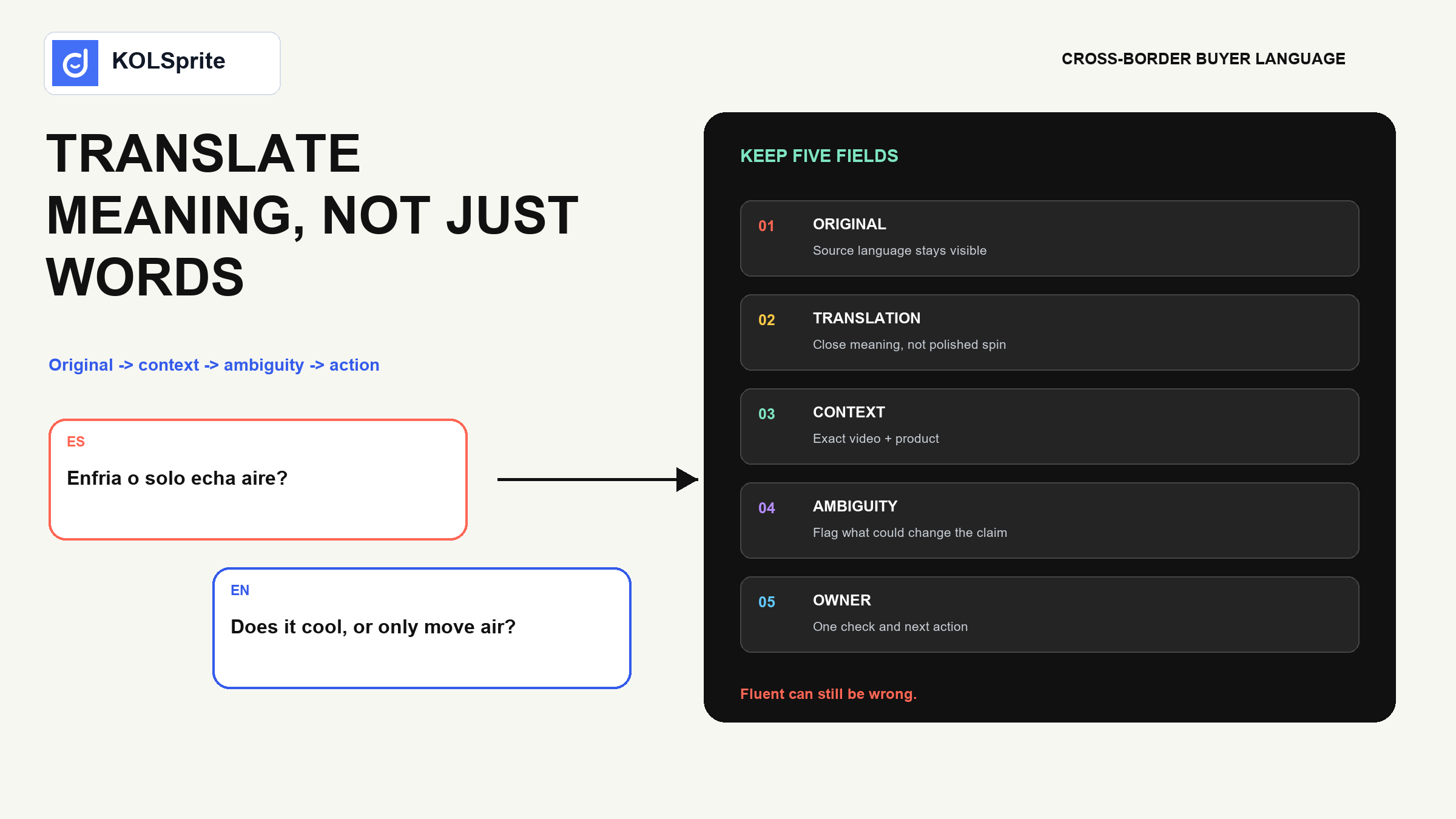
Consider a short Spanish comment that can be read as "Does it cool or only blow air?" The language job is straightforward. The product job is not. The commenter may be asking about a cooling plate, misting function, air temperature, or exaggerated creator wording. Without the source video and product, the team may turn the question into a feature claim the item does not support.
Sentiment does not solve this. A skeptical question may be high-value purchase intent. A positive expression may contain no useful product request. TikTok's official Comment Insights guidance separates question comments, sentiment, words, trends, and audience views. That separation is useful: buyer intent should not be collapsed into a positive-versus-negative label.
| Field | Why it stays | Example |
|---|---|---|
| Original text. | Lets a reviewer check slang, spelling, and product words. | Keep the exact comment and language code. |
| Literal or close translation. | Shows what the sentence says before business interpretation. | "Does it cool or only move air?". |
| Context. | Connects the line to the exact video, product, scene, and claim. | Creator touches a cooling plate while describing a fan. |
| Intent and confidence. | Separates the buyer job from translation certainty. | Feature clarification; medium confidence. |
| Owner and action. | Prevents an insight report with no decision. | Product owner verifies feature; content owner revises caption. |
Do not publish personal profile details in the operating sheet unless the workflow genuinely needs them and your policy allows it. Most content decisions need the wording, source, date, product, and intent. They do not need a public dossier on the commenter.
We used KOLSprite Video Search for the Spanish phrase "ventilador portatil" in the US market. The retained records included wearable waist fans and handheld fans, with captions about hot workdays, multiple speeds, LED lights, portability, and charging. One 43-second video from ValentinoFinds described a waist fan with ten speeds and a light; the linked PADOX product record listed a $15.99 price and 23,028 units in its latest 30-day field. The selected video record showed 4.1 million visible plays and 159 comments.
We then used the KOLSprite caption-extraction path on that exact video. Some segments were clear enough to retain: the speaker described ten speeds, an internal light, USB charging, and usefulness on hot days. Other segments were visibly garbled. A few words did not form reliable Spanish sentences, likely because automatic transcription struggled with fast speech, background audio, or pronunciation.
This is the same risk a team faces with comments. A system may produce a fluent-looking output even when the source is misspelled, abbreviated, sarcastic, code-switched, or tied to something happening on screen. The correct action is not to discard every machine result. It is to mark the uncertain part and route only the decision-critical line for review.
Research note. KOLSprite US video search for "ventilador portatil" and caption extraction for video ID 7643198497365167373, accessed August 3, 2026. Eight video records were reviewed and one transcript was inspected. The transcript contained both usable and garbled segments. No public comment text was returned through the MCP, so the table below uses clearly labeled hypothetical comments to demonstrate the review method rather than inventing audience findings.
| Original comment | Working translation | Ambiguity flag | Likely intent | Owner and next action |
|---|---|---|---|---|
| Hypothetical: "Enfría o solo echa aire?". | "Does it cool, or does it only blow air?". | "Cool" may refer to a plate, mist, or colder air. | Feature clarification. | Product owner verifies mechanism; content owner names it plainly. |
| Hypothetical: "Cuánto dura en el 10?". | "How long does it last on level 10?". | "10" must match the video's speed setting. | Battery-life objection. | Testing owner records run time under stated conditions. |
| Hypothetical: "Sirve para trabajar afuera?". | "Is it useful for working outside?". | Weather, heat, dust, and job conditions are unknown. | Use-case fit. | Support and content add limits; do not promise workplace safety. |
| Hypothetical: "Se siente pesado en el cinturón?". | "Does it feel heavy on a belt?". | Comfort depends on weight, clothing, and duration. | Wearability concern. | Product page adds weight and a realistic wearing demo. |
The table is useful because it does not jump from a translated sentence to a marketing claim. Each line exposes the missing fact. If that fact affects safety, compatibility, money, or a core promise, a fluent translation is only the start.
Do not ask a bilingual reviewer to check every "Where can I buy this?" comment. Save review time for ambiguity that can change a decision. Escalate when:
For low-risk wording, machine translation plus a confidence flag may be enough. For a decision-critical theme, ask a fluent reviewer to check the original line and source video, not only the English output.
KOLSprite's value here is not a detached translation box. While the team browses TikTok, the product, video, caption, creator, and comment analysis remain part of the same research route. Save the exact source before summarizing. Use AI analysis to cluster repeated questions, but open representative comments in context before turning the cluster into an action.
For a cross-border workflow, create four lanes: feature questions, use-case questions, objections, and requests. Add a fifth "unclear" lane instead of forcing each line into a confident category. Translate the representative lines, not only the cluster name. A cluster called "battery" can hide duration questions, charging-port questions, replacement questions, and complaints about a failed unit.
Use a comment-to-owner map:
| Buyer signal | Primary owner | Useful output | Evidence needed before publishing |
|---|---|---|---|
| Feature clarification. | Product and content. | Labeled demonstration or FAQ. | Specification or direct test. |
| Compatibility. | Product and support. | Fit table or supported-use note. | Model, size, or condition check. |
| Repeated objection. | Product marketing. | Original creator proof brief. | Representative source comments and claim boundary. |
| Quality complaint. | Support and operations. | Issue investigation. | Order or defect evidence; public comment alone is insufficient. |
| New use request. | Product. | Research backlog item. | Feasibility and safety review. |
The customer-feedback-to-Shopify workflow is a useful downstream path when a verified theme deserves a page test. The competitor-mention classification guide helps when translated comments name another brand. For the creative layer, use the proof-test framework to turn the buyer question into original evidence instead of copied language.
Repeat this process across another relevant category before turning one language pattern into a broad rule. A Spanish-speaking construction audience and a bilingual beauty audience may use the same word differently. Category transfer is a test, not an assumption.
Take the sample line, "How long does it last on level 10?" First, check the clip. Does the fan have ten set steps, or does the speaker use ten to mean full power? Check the item page next. Does it list run time by speed? If not, the team does not yet have an answer.
Now set the work path. The language lead keeps the source line. The product lead tests the fan on the named level. The test log notes the charge, room heat, start time, and end time. The content lead waits. When the test is done, the team can write a short reply and a clear page note.
This path may seem slow for one line. It is fast when the same question shows up many times. One good test can help the reply team, the page, the next creator brief, and the support desk. One bad guess can spread to all four.
Use a low-risk line in a lighter way. "Where is the link?" needs no lab test. Keep the source, translate it, and send the user to the right place. "Will this work in a hot shop for ten hours?" needs care. The line may touch run time, heat, work rules, and safe use. Send it to a person who can check the facts.
Slang needs the same care. A phrase such as "no manches" can show shock, doubt, or a light joke. It should not become a product fact. An emoji can change tone, but it cannot prove intent by itself. A brand word may name a rival, a style, or the whole type of item. Keep the word until the team knows which use fits.
The best sheet is not the one with the smoothest English. It is the one a new team member can trace. They can open the source. They can see what was clear. They can see what was in doubt. They can see who checked the fact. They can see what changed as a result.
Use this rule for each market. Keep local speech local. Do not force one US English phrase onto all buyers. The final page can still use plain English, but the insight log should hold the words that led to it.
Good TikTok comment translation makes buyer language usable without pretending ambiguity disappeared. Preserve the original text, exact source, product context, confidence, and owner. Use KOLSprite to keep the evidence close while you browse, and use human review where one uncertain phrase could change a claim or product decision.
Review multilingual video and comment context while keeping every insight tied to its source. Create a KOLSprite account to claim a three-day trial membership.
Register for a three-day KOLSprite trial
Share an anonymized original line, source context, and ambiguity flag. A fluent speaker may catch a buyer meaning the summary missed.
 +
+
Review the translation map on Discord
Latest Articles

As an essential, data-driven toolkit for TikTok influencers and marketers, KOLSprite provides powerful features for effortless creator discovery, trending content identification, and actionable real-time insights.
It empowers users to make smarter decisions and significantly boosts their TikTok business.

 Refer & Earn