 +
+
If you manage a Shopify product page, TikTok comments can reveal the questions your listing fails to answer. They can also mislead you. Jokes, tags, repeated praise, and unsupported claims are easy to mistake for buyer insight. This guide shows how to run customer feedback analysis with a decision-first process. You will choose the right videos, use KOLSprite AI Comment Analysis to group themes, verify important comments, and turn only supported findings into product-page tests.
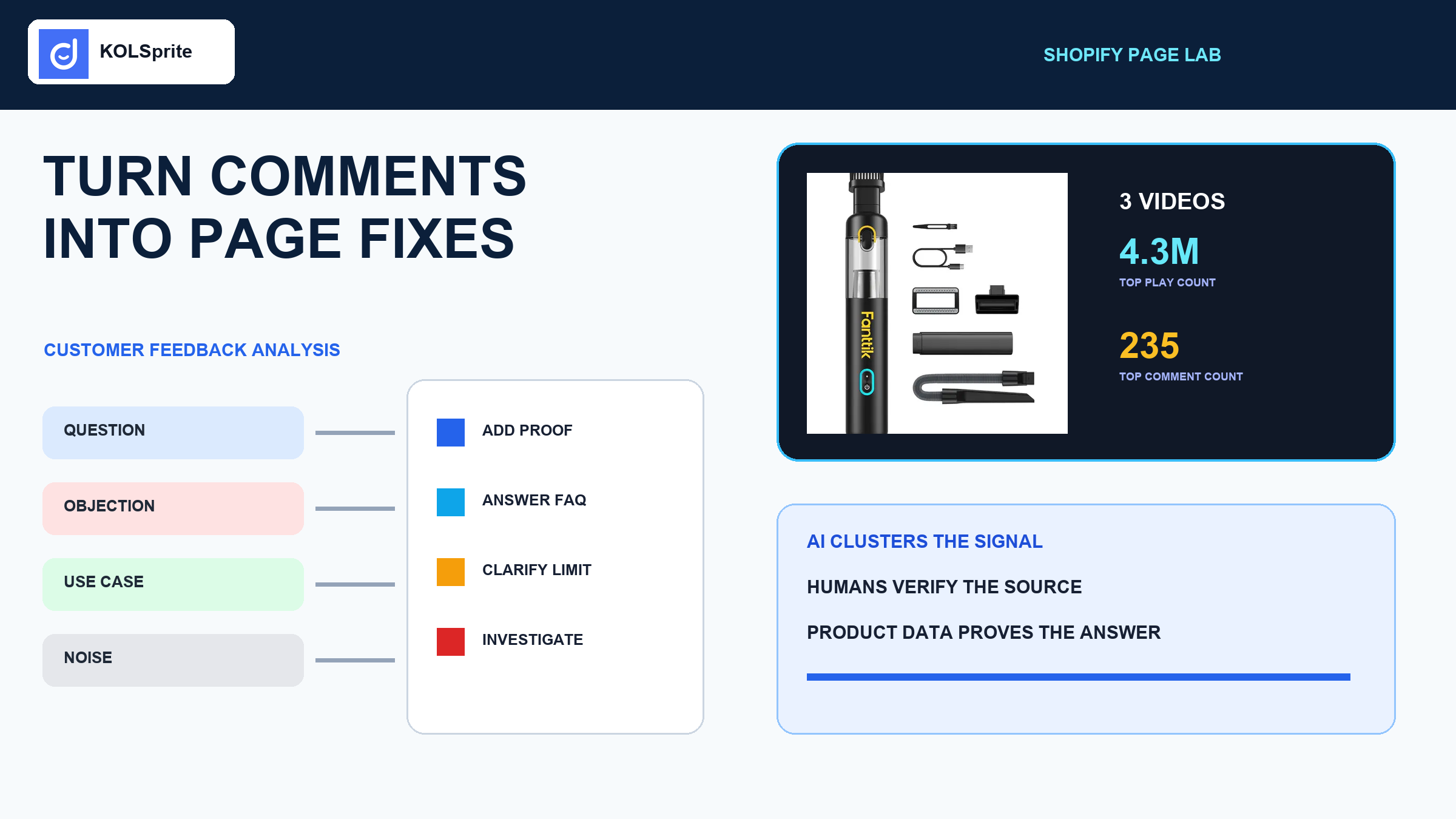
Do not paste an AI summary into a product page. Convert each repeated theme into one of four actions: add proof, answer a question, clarify a limit, or investigate the product. Keep the original comments available for review. Publish a claim only when the product and business evidence support it.
Comments tell you what people wonder. They do not prove the answer.
A broad request such as "analyze our comments" creates a broad report. Start with the page decision. For a portable car vacuum, the question might be: which buyer doubts should the product page answer before asking for the order? That sentence guides the video sample, theme labels, and final page changes.
Shopify's product-page guidance says useful pages should make product details, images, price, variants, reviews, trust signals, and the call to action easy to understand. It also recommends using customer feedback to improve the page. TikTok can add earlier language from people who are watching a demonstration, including questions they may ask before buying or before leaving a formal review.
The page still needs one primary measure. If you add a compatibility section, measure product-page conversion and support questions. If you add a comparison chart, watch conversion, return reasons, and whether shoppers choose the correct variant. A page edit without a decision and measure becomes decoration.
A keyword search for "mini vacuum" did not return only vacuums. It also returned insulated tumblers and an air pump used for vacuum bags. We kept exact car-vacuum videos and removed products that only shared a word. This cleanup matters because the wrong source creates the wrong feedback themes.
Three retained US car-vacuum videos had different contexts. A 53-second video from itutn_vacuum had 4.3 million plays, 60 comments, and 2,094 recorded 30-day product units for a $29.99 item. A 38-second video from molly_poppinss had 2.5 million plays, 235 comments, a 1.5% interaction field, and 1,261 recorded 30-day units for a $12.99 item. Another product record for a Fanttik car vacuum was priced at $39.99 and showed 10,053 units in its 30-day field, 12,472 reviews, 4,786 linked creators, and 11,833 linked videos. The team can preserve those exact sources in KOLSprite video search before it opens the comment review.
The numbers help scope the research. They do not tell us what the comments say. The higher-comment video is a reasonable place to begin a theme review, while the large product record can provide broader content context. The team should not merge comments across prices or products without keeping the source attached.
Research note. KOLSprite US product and commerce-video records, accessed July 30, 2026. Exact car-vacuum rows were retained; tumblers and an air pump were excluded from the vacuum decision set. Comment counts are visible record fields. No comment theme in this article is presented as observed unless it is verified in the original source.
Open a retained TikTok video in the browsing context and expand its comments. Use KOLSprite AI Comment Analysis for the first pass. Ask it to separate buyer questions, use cases, objections, comparisons, praise, complaints, jokes, tags, and unclear items. The goal is a navigable map, not a final conclusion.
In the second pass, open the original comments behind every theme that could change a product claim, FAQ, image, or support policy. Check whether several distinct people raised it. Remove duplicates, copied phrases, off-topic replies, and comments that discuss another product. Preserve uncertainty when the language is vague.
The feature is most valuable because it reduces the time needed to find repeated ideas inside a busy comment section. Human review remains necessary. A summary may combine different meanings or make a small cluster sound larger than it is. KOLSprite helps the team locate and organize the evidence; the product team decides what the evidence can support.
| Theme label | Example question to look for | Possible page action | Evidence needed before publishing |
|---|---|---|---|
| Compatibility | Will it work in tight gaps or on fabric? | Add supported surfaces and attachment images | Manual, product test, and support history |
| Power | Can it lift sand, crumbs, or pet hair? | Show a controlled debris test | Repeatable normal-use test |
| Battery | How long does it run and charge? | Add a clear specification block | Verified product specification |
| Cleanup | How do I empty or wash it? | Add a four-step care panel | Manual and actual maintenance test |
| Noise | Is it loud inside a car? | Add an honest use note or video | Measured or controlled demonstration |
| Value | Why not use a full-size vacuum? | Explain the quick-clean job, not a universal replacement | Clear positioning and price context |
| Risk | Does it overheat, clog, or lose suction? | Investigate before changing the page | Quality, returns, support, and supplier records |
The examples above are a coding plan, not reported findings from the retained videos. That distinction should remain in the internal research file. When real themes are collected, replace the examples with the exact verified language and source links.
If verified comments repeatedly ask where the vacuum works, add a small matrix for seats, floor mats, cup holders, vents, trunks, and unsupported materials. Use "supported," "use with care," and "not recommended" rather than vague check marks. Link each claim to the manual or an internal product test.
Measure whether variant questions and preventable returns decline. A higher conversion rate is useful, but a lower return rate may be the more important outcome.
If people ask how the bin and filter are handled, add four images showing removal, emptying, approved cleaning, and reassembly. Do not hide the unpleasant step. Clear maintenance can build trust and reduce misuse.
Measure support contacts about cleaning, product-page engagement with the section, and return reasons. A maintenance section can lower impulse conversion while improving buyer fit. That may still be a win.
If viewers compare the mini vacuum with a full-size model, position the product around the job it can do well: fast cleanup between deeper sessions. Avoid claiming it replaces every household vacuum. Show a controlled amount of ordinary debris and the time required.
Measure qualified conversion, product questions, and comments about the intended use. The page should help the wrong buyer leave before ordering.
| Field | What to record | Why it matters |
|---|---|---|
| Source | Video ID, creator ID, product ID, market, and access date | Prevents comments from losing context |
| Theme | Short neutral label and verified examples | Keeps the summary traceable |
| Confidence | Repeated, emerging, isolated, or unclear | Stops one comment from becoming a page claim |
| Business check | Manual, quality test, returns, support, or supplier evidence | Separates questions from answers |
| Page action | Proof, FAQ, limit, investigation, or no change | Turns research into work |
| Result | Test date, primary metric, guardrail, and decision | Feeds learning into the next analysis |
This ledger creates the closed loop that comment tools often miss. Research becomes a page test. The test creates conversion, return, and support evidence. That evidence changes the next comment review.
High-frequency buyer questions belong near the decision they affect. Size and compatibility belong near variant selection. Shipping and returns belong near the offer. Care instructions can sit below the main proof, with a short link higher on the page. A serious safety or compliance limit should not be buried in an FAQ.
Use the exact buyer language when it is clear and appropriate, but edit for accuracy. A comment such as "Will this get dog hair out of the seat gap?" can become a heading: "Cleaning pet hair from seat gaps." The answer must come from product evidence, not from the commenter's hope.
Shopify recommends clear details, reviews, strong images, mobile usability, and one primary measure per test. Review the page on a phone. A large comparison table that looks good on desktop may be unreadable when the buyer is standing beside a car.
The workflow begins where the signal appears. KOLSprite lets a researcher inspect TikTok videos and creator context while browsing. Product and video research help clean the source set. AI Comment Analysis groups a large discussion into reviewable themes. The team can then save the useful findings beside the product decision.
This contribution is natural because the task crosses content, product, and buyer language. KOLSprite does not know your Shopify conversion rate, return reasons, product manual, or supplier quality record. Those systems finish the answer.
Use the TikTok comments for Amazon and Shopify research guide as the upstream method. Use Shopify's product-page optimization guidance for the downstream page test. The KOLSprite AI Comment Analysis guide explains the feature and its review limits in more detail.
Spend ten minutes choosing the page decision and clean videos. Spend ten minutes generating and reading the AI theme map. Spend ten minutes verifying the most important source comments. Spend ten minutes checking product and business evidence. Spend five minutes assigning one page test, owner, measure, and review date.
When no theme survives verification, publish nothing. "No page change" is a valid research result. It protects the product page from noise and keeps the team focused on stronger evidence.
The old page says, "Strong suction for every mess." That line sounds bold, but it leaves the buyer with more doubt. What mess? Which part of the car? How long can the unit run? How is the filter cleaned?
The new page starts with a smaller claim. "Made for quick car cleanups between deep cleans." A short clip shows crumbs on a seat and dust near a cup holder. The next block lists the tools in the box. A small chart shows which parts are used on seats, mats, gaps, and vents.
The page then shows how to empty the bin. The filter step is easy to see. A note tells the buyer what not to wash. The run-time field comes from the approved product spec. The brand does not guess it from a comment.
The call to action stays close to the offer. The care block sits below it. On a phone, the table becomes a short list. Each line has one job. The page is not longer just to look busy. It is clearer where the buyer needs help.
The team runs the new page for a set time. It tracks sales, returns, and support notes. If sales rise but returns also rise, the page may still attract the wrong buyer. If sales hold and care questions fall, the new block has done useful work.
This is how feedback becomes value. The comment points to a gap. The product record checks the answer. The page makes the answer clear. The store result tells the team whether to keep it.
TikTok comments can expose questions, language, use cases, and objections. They are not a representative survey of all customers. Visible commenters may differ from buyers. Comment volume can be shaped by reach, controversy, humor, or creator behavior. AI clustering can miss context.
Strong customer feedback analysis makes these limits clear. It uses comments to find decisions worth checking, then uses product, Shopify, support, and return data to decide what is true.
Keep the final note simple. Write what people asked, what the team checked, what the page changed, and what happened next. A short clear record is more useful than a long theme report that no one can act on.
Begin with a verified supported-use and care section, not a broad "powerful suction" claim. Use KOLSprite AI Comment Analysis to locate repeated compatibility and cleanup questions, reopen the original comments, and confirm every answer with the product manual and a normal-use test. Measure conversion together with returns and support. The goal is a clearer buyer decision, not more copy.
Create a KOLSprite account and claim a three-day trial membership. Use the trial to put this workflow into practice before your next product, content, or creator decision.
Register for a three-day KOLSprite trial
Share the theme label, evidence boundary, and page test without posting private customer data. The strongest feedback will improve the decision, not inflate the claim.
 +
+
Discuss the feedback-to-page workflow on Discord
Latest Articles

As an essential, data-driven toolkit for TikTok influencers and marketers, KOLSprite provides powerful features for effortless creator discovery, trending content identification, and actionable real-time insights.
It empowers users to make smarter decisions and significantly boosts their TikTok business.

 Refer & Earn