 +
+
If your team asks how to sell beauty products on TikTok Shop, start with the lip color you will ship. Put that SKU, its proof, the listing, and the creator's script side by side. Check the category and every product claim before you list it. Then film a demo that answers a buyer's question. A good application shot cannot prove an untested wear claim.
This order gives a US beauty team a useful payoff. You can approve what the camera can honestly show, assign an owner to every claim that needs proof, and hold only the lines that outrun the evidence. A creator can show application; the brand still has to prove what the formula does.
A lip-stain clip can look finished before the product is ready to sell. The shade appears on screen. The creator likes the color. The edit may even imply a full day of wear. But the team still has three questions. Is this product in the right Shop category? Does the listing match what the buyer will get? Can the brand support the claims in the video?
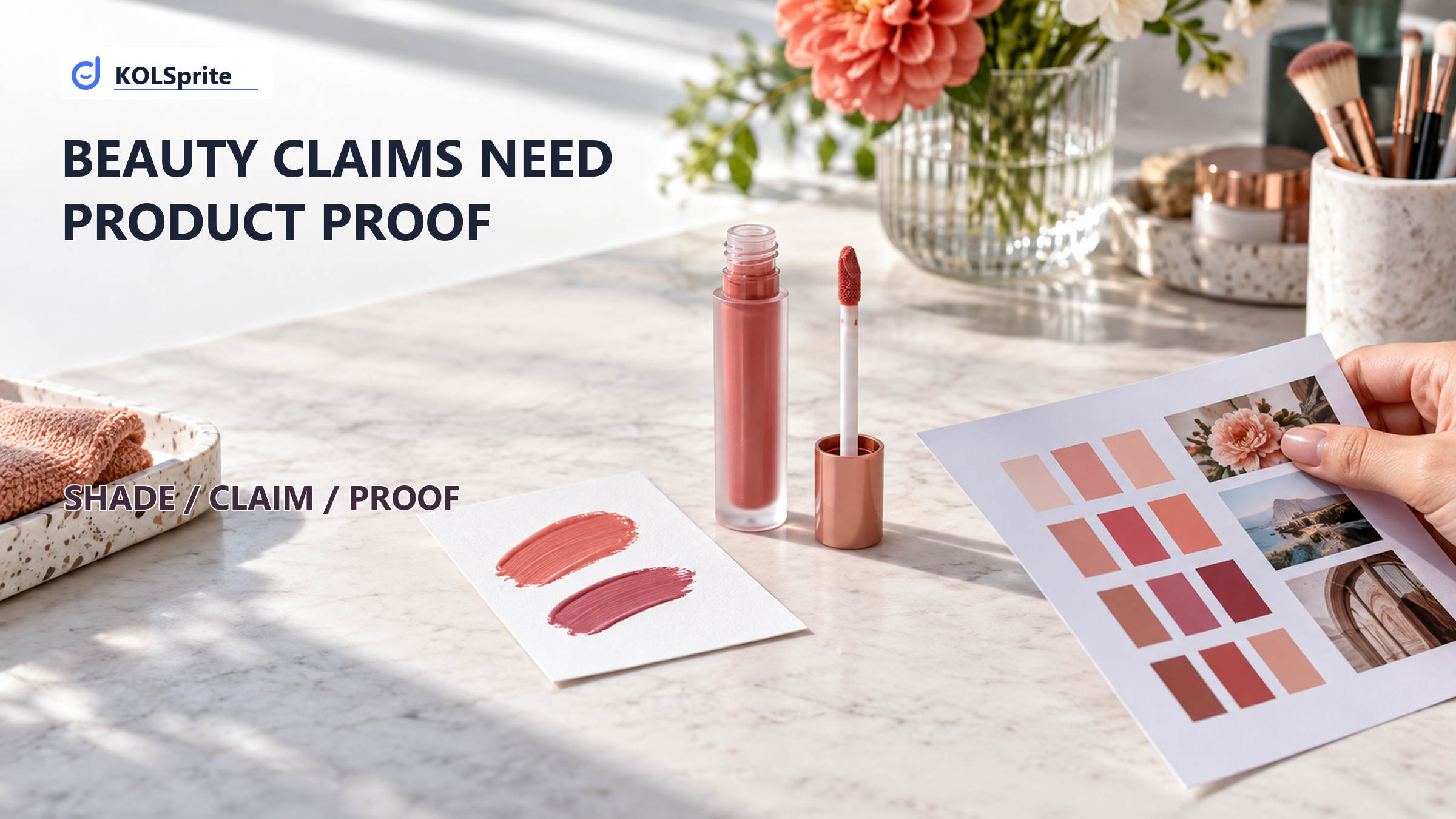
Bring the work back to one physical unit. Record the product name and shade exactly as sold. Place the package and supporting material beside the proposed Shop title, description, images, and creator talking points. The goal is not to make every line cautious. It is to make each line belong to the product. Guidance on choosing the accurate Shop category can help frame the classification question, but the team still has to review the actual lip stain it plans to list.
That review should separate three kinds of information. First are owned facts, such as the shade name, amount, finish language, and package details the seller controls. Second are demonstrations, such as showing the applicator, a single coat, or the visible color under stated lighting. Third are performance claims, such as long wear or resistance to greasy food. The first two may be straightforward to document. The third needs evidence that a creator's impression alone cannot supply.
Use a decision sheet rather than a loose collection of comments. Each proposed statement should have an evidence status and an owner. That prevents a listing writer from assuming the creator tested the formula and prevents the creator manager from assuming the package supports a dramatic line.
| Review row | What to place on the sheet | Launch decision |
|---|---|---|
| SKU evidence | The exact item, shade, package, and seller-held support | Name an owner and confirm before listing |
| Listing statement | Category, title, images, and product facts a buyer will see | Keep only language that matches the shipped item |
| Creator demo | Application, visible shade, lighting, coat count, and what happens on camera | Approve a bounded, reproducible demonstration |
| Unresolved claim | Wear, transfer, food resistance, or other performance language without adequate support | Test and review it, or remove it |
Source note: KOLSprite public US searches, accessed September 29, 2026. Three observed video descriptions used different claim angles: greasy-food wear, long-wear language, and dark-shade emphasis. Two of the linked products are lip-liner markers, not the seller's lip stain. This small public sample is useful for comparing words, not for treating those words as test findings.
The sheet turns disagreement into a decision. If the package and owned materials support the shade name but not a wear duration, the shade row can move while the wear row remains open. If the camera accurately shows a dark shade on one person, that is an observed demonstration, not proof that every buyer will see the same color under every light. Keeping rows separate makes it possible to launch honest creative without letting one unresolved promise contaminate the whole page.
Open a relevant TikTok example with KOLSprite for Chrome, then record the claim your own product can actually support. Use desktop Chrome. On a phone, open this article on your computer to install the extension.
Public videos can show which buyer questions creators are trying to answer. In the bounded KOLSprite case, the differences in visible shade and wear language suggest three useful prompts for the brand: What does the color look like during application? What exactly was done before a food-resistance statement was made? What does “long wear” mean for this formula, under what conditions, and with what support?
Those prompts are more valuable than copying a popular phrase. A public caption may help you notice that buyers care about deep shades or eating while wearing color. It cannot verify that your formula behaves the same way. For a broader method, review how to learn from public beauty videos without copying claims. The operating rule is to borrow the question, not the answer.
Turn public claims into questions before they enter the brief. If a video says the stain survives greasy food, ask what happened after eating and under what conditions. If it says the color lasts all day, ask what duration the brand can support. If it calls a shade perfect, ask whether the creator can show that named shade in clear light. These questions keep research useful. They also put proof back in the brand's hands.
The first test can be simple. Name the shade and show the labeled product. Then show the applicator, one stated number of coats, and the color in steady light. If the next scene uses different light or a later time, say so. Viewers should know what happened between cuts.
Shade accuracy deserves special care because screens, lighting, skin tone, and editing affect appearance. The video can truthfully show how the shade appears in that setup. It should not suggest that the color will look identical for every viewer. Product images have a related job: showing the actual product and shade gives the buyer a stable reference while the video demonstrates application.
If the brand wants a wear demonstration, define it before filming. State the starting condition, elapsed time, activity, and the exact observation that will be shown. Do not let a quick cut stand in for an undocumented test. A seller-owned review still has to decide whether the evidence is suitable for the claim. The FTC's advertising guidance for small businesses is a relevant source for thinking about claim support; TikTok Shop's locked beauty category guidance and product listing guidance should be reviewed for the seller's current listing decision.
Bring the buyer question, not a private formula or customer record.
 +
+
A good edit keeps the buyer's question but narrows the claim. Instead of “This stain will survive anything,” show the shade after one coat in the light used for filming. If the brand has run and reviewed a wear test, the script can describe that test and its result. Without that proof, the creator should not imply a broader result.
Do the same with personal experience. A creator may describe what they actually did and what they visibly observed, but the brand should not turn one person's experience into a universal formula promise. Keep subjective reactions clearly subjective. Keep measurable product statements tied to seller-held support. Keep safety or skin-related implications out unless they have appropriate evidence and review.
This editing discipline also improves creative quality. Specific actions are easier to film than vague superlatives. “Show the applicator and one coat of shade X” gives the creator a shot. “Prove it is the best stain” gives the creator pressure to overstate. A bounded brief produces footage the team can evaluate rather than enthusiasm it cannot substantiate.
Search public US lip-stain products and videos in KOLSprite. Set aside unrelated items. For each relevant clip, note the shade, what the creator shows, and any wear claim. Put those notes next to the launch sheet. They show which buyer questions the team should address and which phrases need proof before they enter a creator brief.
The next action is not to declare a winning claim. It is to take each observed phrase back to the actual SKU. Confirm whether the proposed listing states it, whether seller-held material supports it, and whether the planned footage can show it. Assign a person to resolve each open row. Product research and video research help organize the review; the brand's evidence determines what it may say.
KOLSprite does not approve a beauty category, test wear or skin safety, verify a creator's experience, or show market-wide demand. The public case is a narrow reference set, not a substitute for product testing, policy review, legal review, or seller documentation. That boundary is important because a polished public caption can look more authoritative than it is.
That is the practical answer to how to sell beauty products on TikTok Shop. Public videos raise buyer questions. The seller proves its product facts. The creator shows only what the approved brief can support.
At release review, ask four direct questions. Is this exact SKU eligible for the chosen category based on the seller's current check? Does the listing match the shade, package, and product that will ship? Does the creator video show what the script says it shows? Does every performance claim have an identified owner and adequate support? A “no” does not always stop the entire launch, but it must stop the affected statement.
Use three statuses: release, revise, and hold. Release facts and demonstrations that are accurate and supported. Revise lines that can become truthful through specificity, such as naming the shade or removing a universal conclusion. Hold claims that require evidence the team does not have. Record the reason so the same language does not return in the next edit.
The finished deliverable is a filled lip-stain launch decision sheet, not a folder of attractive references. It names the claim owner, evidence status, creator shot, and unresolved work for every important promise. That gives the launch team a clean sequence: qualify the product, align the listing, approve the bounded demonstration, and release only the words the specific lip stain can carry.
Latest Articles

As an essential, data-driven toolkit for TikTok influencers and marketers, KOLSprite provides powerful features for effortless creator discovery, trending content identification, and actionable real-time insights.
It empowers users to make smarter decisions and significantly boosts their TikTok business.

 Refer & Earn