 +
+
For a Shopify merchant with a shedding brush, a pet-grooming opportunity in Seller Center can look like a match. Should you attach your brush to it? Only if the exact suggestion and your owned SKU truly match. Check its category, reference image, and product criteria against your brush. Reject a wipes or vacuum-groomer match despite a shared keyword. You will leave with a short suggestion-to-SKU note and a decision you can defend before listing.
TikTok Shop Product Opportunities is a discovery lead, not a finding that your specific item will sell or pass review. Keep a suggestion only when the owned SKU meets the platform's stated matching criteria and the listing can show the same product honestly.
On a busy catalog day, an opportunity badge can feel like a ready-made decision. The platform has noticed a term, your store carries something in the broad category, and the next button is close. That sequence is useful for discovery. It is not a shortcut through product identity. The first object in this audit is not the opportunity tile. It is the exact brush sitting in your stock room or supplier file.
TikTok's Product Opportunities guide, dated August 25, 2026, describes several kinds of leads, including high-potential products, trending keywords, and low-competition categories. Those are not the same promise. A keyword may help a relevant listing get found. A specific product opportunity can carry a product-matching test. The guide tells sellers to review matching criteria and says a submitted product must match the category and show the same product in its images. It also says to review pre-filled listing information for accuracy before submitting.
Start the note by copying the suggestion exactly as it appears in your account. Do not summarize it as "pet grooming" if the details say "pet grooming vacuum kit." Record the opportunity type too. A broad search term may be relevant to a brush, while a product reference image of a vacuum tool is not. If the suggestion is for a specific item, a category label alone does not make your SKU identical. That distinction is the whole audit.
The platform may make adding an item quick, but speed of entry is not proof of fit. A merchant who clicks through with a wrong-format product can end up with a misleading listing and a failed match. The cleaner decision is sometimes a fast no.
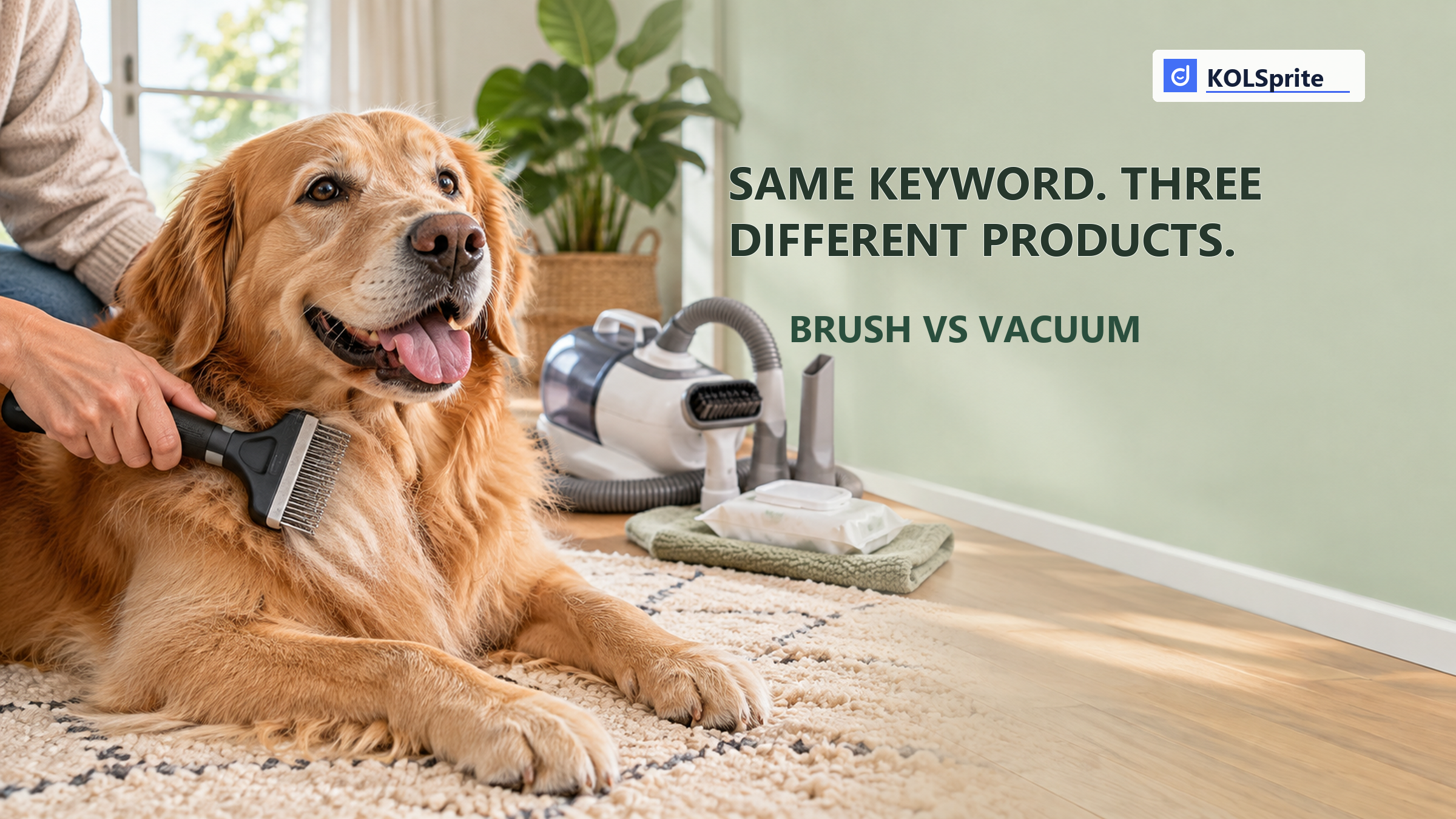
A bounded KOLSprite US search for pet grooming on September 30, 2026, surfaced a shedding brush, grooming wipes, and a pet vacuum groomer, as well as unrelated human grooming items. These are not interchangeable products. Wipes clean a surface; a shedding brush removes loose fur by hand; a vacuum groomer adds a powered collection function. A pet owner may use more than one, but that does not make their specifications or promises equivalent.
Observed format contrast: one broad pet-grooming search included grooming wipes, a pet vacuum groomer, and a shedding brush. These are public product-search examples, not products shown to be recommended in the merchant's private Seller Center.
Source: KOLSprite US product-search observation, September 30, 2026. TikTok's official opportunity guide supplies the matching rule; the public search illustrates why a broad term needs product-level review.
Suppose your own item is the brush. A public brush listing may help you see how a similar tool is described. The wipes result should leave your direct-comparison set. It has a different format and buyer action. The vacuum groomer should leave too unless your item has that powered function and the other relevant specs. A keyword hit is not a permission slip to borrow its product type, images, or claims.
That first pass is deliberately unsentimental. It is easy to imagine a story in which all three items solve "pet grooming." It is harder, and more useful, to ask what the buyer holds, how the tool works, and what must be in the box for the listing to be true. The brush cannot become a vacuum by selecting a category tag. It should not be submitted as one just because the opportunity looks attractive.
Install the KOLSprite extension to inspect public pet-grooming listings. Separate a brush from wipes or a vacuum kit before matching a Seller Center suggestion to your own SKU. Use desktop Chrome. On a phone, open this article on your computer to install the extension.
Write the brush's brand, model, head style, dimensions, material, included parts, and any relevant size or pet-type limits from your own product file. Then look at its real product images. Do they show the item you will ship, with the same accessories and variation? If the catalog data is incomplete, stop here. The opportunity page cannot repair an uncertain SKU. The listing should begin with an accurate product, not with a trend term.
Next, read the suggestion's criteria. Is this a trending keyword, where the question is whether the phrase truthfully applies to your brush? Or is it a high-potential product with a reference item that must match in category and images? TikTok's separate Spotlight product guide is stricter about identical products, including category, brand, specifications, and appearance. Do not assume a generic grooming brush qualifies for a named Spotlight item. The seller should follow the criteria on the actual opportunity shown to its account.
Now write the buyer action in one sentence. "The buyer uses this manual brush to remove loose fur from a pet's coat" is a different action from wiping paws or collecting fur with a vacuum. This is not a slogan. It is a check against the common habit of forcing distinct products into a broad trend. If the action does not match the reference item, the suggestion has already failed the practical test, even before a formal review.
Look at the content question last. What can your own brush show in a short, fair demonstration? Perhaps a hand using the brush on an appropriate coat, with the amount of loose fur visible at the end. But the scene must be tested with your item and a suitable pet; do not borrow a public clip as proof. If your team cannot show the promised use without tricks or an unsupported result, that is another reason to hold the listing. A platform lead does not change the truth of the item.
The finished suggestion-to-SKU note has four parts. First, quote the exact Seller Center term and its opportunity type. Second, identify the owned brush and its key specifications. Third, record the relevant public comparison: manual shedding brush retained; wipes and vacuum tool rejected as wrong formats. Fourth, state the decision and why. This is a short audit trail, not a product research report.
Here is a defensible reject case: "Do not submit our manual shedding brush against a pet vacuum groomer reference. The tools share a grooming keyword but differ in power source, function, included parts, and buyer use. Review a manual-brush opportunity instead." That sentence protects the catalog from a false match. It also gives the team a useful next search. The decision is not "no pet grooming products." It is "not this suggestion for this SKU."
A conditional keep case is just as clear: "The suggestion is a grooming keyword, not an exact product reference; our brush performs the named task and our images and title describe that task accurately. Review the term in the live criteria before submission." Notice what this does not say. It does not promise approval, reach, or sales. It says the item may be relevant enough to review in Seller Center.
If the record is a Spotlight product, use the stricter identical-product test from TikTok's guide. A similar silhouette or buyer purpose is not identical brand, specs, and appearance. A merchant should be comfortable writing "reject" even when the platform markets a growth path. That is the difference between treating opportunity discovery as a lead and treating it as a command.
Join the KOLSprite Discord to discuss the question behind your next test.
 +
+
Join the KOLSprite Discord community
Use KOLSprite product search with the generic pet-grooming term to see public offers, then remove irrelevant human grooming items and separate wipes, vacuum tools, and brushes. Keep only brush records that share the buyer task with your owned brush. This gives the catalog reviewer a cleaned category comparison and questions for a truthful listing. It does not read the private suggestion screen.
KOLSprite cannot inspect your private Seller Center recommendation, certify a Spotlight match, or forecast success for your SKU. It also cannot verify your stock, product specs, or right to use a claim. The public records answer a narrow question: which kinds of items can sit under a broad search term. The platform's actual matching criteria and your own product facts decide the submission.
This division of work makes the research more useful. Public search helps the reviewer see where a keyword is loose. Seller Center tells the seller what it is being invited to match. The merchant's own file tells the team what it can sell. Confusion starts when one source is asked to do another source's job. A search result is not a review result, and a suggested phrase is not a substitute for a product specification.
It is tempting to call every rejected result "noise" and move on. Keep one wrong-format example in the note instead. The wipes and vacuum tool explain why your brush needs a narrower comparison. That small contrast can prevent a future teammate from making the same broad-keyword leap when a new opportunity appears. It is a concrete reason, not a generic caution about data quality.
If the exact suggestion and your brush do match, carry the decision into the listing. TikTok's opportunity guide says pre-filled information should still be reviewed for accuracy. The product title, images, category, and variations must describe the brush you will ship. A term that helps people find it is useful only if it also fits the item. If the term points buyers to a vacuum kit, it is doing the wrong work for a manual brush.
The next check is simple: would a buyer recognize the delivered item from the listing and the demonstration? If not, revise or reject the match. TikTok's Product Listing Policy requires clear, truthful product information and warns against irrelevant or misleading attributes. For a specific follow-through, make the chosen SKU and its variants match the actual offer before submitting.
When the suggestion fails, that is not lost time. It is a timely inventory decision. The brush may still deserve its own listing or another discovery path. You can reject weak product ideas before inventory and use a separate read of product signals and demand if the question turns to market strength. Neither exercise should erase the exact-match test in front of you.
A shared keyword is not a shared product. The best use of TikTok Shop Product Opportunities is to keep the suggestion that fits the item you own. Reject the one that asks your brush to act like wipes or a vacuum. The audit ends with a smaller set of honest options and a listing the customer can trust.
Latest Articles

As an essential, data-driven toolkit for TikTok influencers and marketers, KOLSprite provides powerful features for effortless creator discovery, trending content identification, and actionable real-time insights.
It empowers users to make smarter decisions and significantly boosts their TikTok business.

 Refer & Earn