 +
+
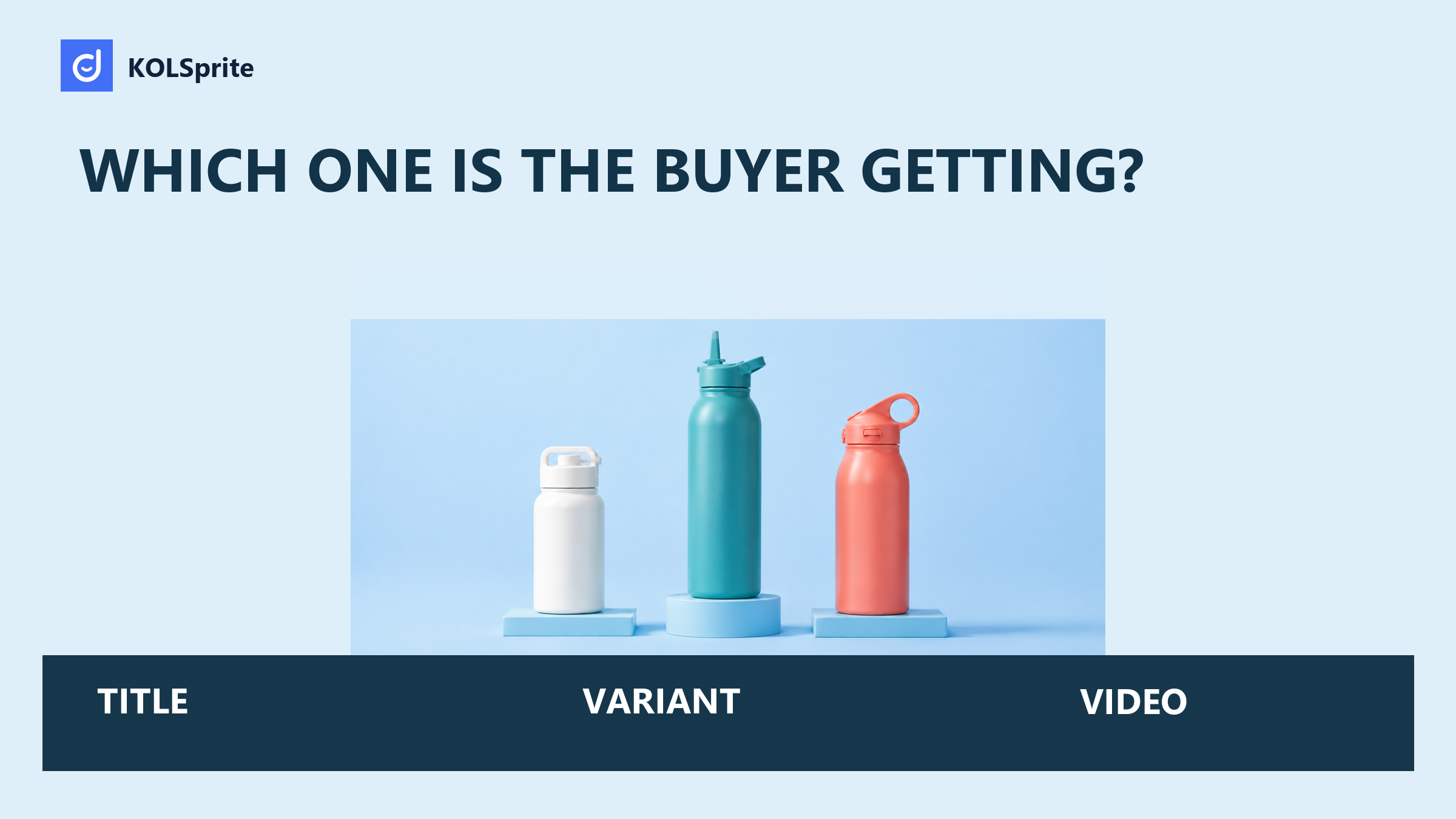
For catalog managers, a finished variant label makes the buyer choice concrete: "Blue travel bottle, one bottle, straw cap included." Beside it, the selected image shows that blue bottle and its straw cap. A shopper can now choose without translating a warehouse code or guessing whether the accessory costs extra. That small agreement between label and image is the standard to carry through the listing and creator video.
Before increasing traffic, decide what needs repair: the title, the variant mapping, or the product claim. The goal is simple. The buyer should know which exact product will arrive after they make a selection.
This example is hypothetical. A brand sells a travel-bottle family with three choices: 12-ounce blue bottle, 20-ounce blue bottle, and 20-ounce blue bottle with a straw cap. The video shows a straw cap and calls the item “the blue travel bottle.” The product page title says “Blue Bottle,” and the selector has “Blue Small,” “Blue Large,” and “Blue Plus.”
The issue is not that the page has three options. The issue is that the video’s useful feature, the straw cap, is not tied to the option that includes it. A buyer can choose Blue Large, see a blue bottle, and reasonably assume the cap shown is included. The title and selector do not help them separate the standard cap from the straw-cap bundle.
The correction is specific. Rename the third option “20-ounce Blue Bottle with Straw Cap.” Make its image show that exact cap. Adjust the video text to say “shown: 20-ounce bottle with straw cap.” Keep the other options clear about what they include. The brand does not need a new story. It needs each version to tell the same one.
Catalog teams often work field by field. A title is written in one place. Images come from another team. A creator clip is approved later. The buyer sees them as one story. They use the title, selected option, image, and visible video claim to decide whether the item fits their need.
Start the review with a selected SKU, not a product family. Ask: what is this exact item called; what color, size, or bundle does the buyer receive; what does it include; and what claim does the video make about it? Put the answers in one plain line. If the line cannot be written without adding a caveat, the offer is not ready for more traffic.
This approach does not demand that every page repeat every detail. It asks the page to avoid contradiction. A short title can still be clear. A video can still be playful. The selected option must remain understandable at the moment the buyer chooses it.
| Documentary observation | Question for the catalog owner |
|---|---|
| The listing policy requires accurate brand information. | Does the buyer see the correct brand rather than an internal shortcut? |
| The listing guide distinguishes basic details from sales information. | Do the selected option and the general description refer to the same sold item? |
| Product imagery must represent what is sold. | Does the picture match the contents of this particular variant? |
Source: TikTok Shop US Product Listing Policy and Product Listing guidance. Scope: listing fields and accurate product representation. Market: US. Access date: 2026-09-03. Sample: two official seller documents. Cleaning: documentary review; no live listing review or approval data. Limit: a coherent description does not guarantee approval or sales. Product Listing overview and Product Listing Policy.
Those rules provide a floor, not a traffic plan. A listing can meet a basic requirement and still leave a buyer unsure which variant a video shows. Conversely, a very clear creator explanation cannot correct a selected SKU that names the wrong capacity. Treat accuracy and purchase clarity as related but separate tests.
Try KOLSprite's web research for three days and review public scripts and questions beside your own catalog sheet. MCP access is separate from the web trial.
Register and claim a three-day trial
Use a short claim-to-SKU sheet. In the first column, write the selected variant. In the second, copy the title a buyer sees. In the third, name what the main image shows. In the fourth, write the product claim from the video. The fifth column holds the mismatch, if any. This does more than a general note that “the listing needs work.”
Do not begin by changing copy. A title problem may be a mapping problem. A mapping problem may be an image-assignment problem. A video problem may be a claim that applies to only one option. The sheet lets the catalog owner fix the right object once instead of making several partial edits.
Use the merchant’s own SKU sheet as the source of truth. A public video is evidence of what the buyer may hear, not evidence that an item is in stock or that a selected option is correct. This keeps the review useful without making the video team responsible for private catalog records.
| Illustrative variant | Mismatch | Corrected wording |
|---|---|---|
| 12-ounce Blue Bottle | Video may imply a straw cap. | “12-ounce Blue Bottle, standard cap.” |
| 20-ounce Blue Bottle | “Blue Large” hides the size. | “20-ounce Blue Bottle, standard cap.” |
| 20-ounce Blue Bottle with Straw Cap | “Blue Plus” does not name the included part. | “20-ounce Blue Bottle with Straw Cap.” |
Apply this check to the exact SKU a buyer can select. State the mismatch in buyer language. Then write the smallest corrected phrase that tells the buyer what changes. Confirm the phrase against the merchant-owned SKU record before publishing. The point is not to make every option long. It is to make the difference visible where the decision happens.
Titles answer, “What is this?” Variant names answer, “Which version am I choosing?” Images answer, “What will I receive?” The video answers, “Why might I want it?” A product description can answer deeper questions. When a field tries to do another field’s job, the page gets noisy. When no field answers a basic question, the buyer starts guessing.
That framework is useful during review. If a buyer cannot tell which cap comes with the item, do not first add a broad benefit paragraph. Repair the option name and supporting image. If a video says “fits every bag,” test whether that is a supportable claim for the shown variant. Claims should remain close to the item they describe.
KOLSprite can support a review of a public linked video, its script, and visible buyer questions against a merchant’s own SKU sheet. It can produce a claim-to-SKU mismatch note for the catalog owner. It is not a listing editor, inventory sync, or private SKU verification service.
In the bottle example, the KOLSprite note should name the visible cap and the claim made about it. The merchant then checks the selected SKU. That handoff separates what the public video shows from what the catalog actually promises to send.
Bring one public-facing wording problem to Discord. The aim is a clearer choice, not a longer product title.
 +
+
Join the KOLSprite Discord community
More traffic is not a cure for a confused offer. It can produce more questions, more abandoned selection, and more service work. First repair the part that makes the buyer select the wrong thing. Then check the product tag, creator script, and destination again as one path.
For the research side of that path, use TikTok Shop product research. For the language around the offer, see Shopify product positioning on TikTok. A clear listing is not a promise of demand. It is the baseline that lets demand lead to the right selected item.
A catalog lead, a creative lead, and a support lead notice different forms of confusion. Run the selected-SKU check before a major creator push or paid traffic increase. The catalog lead verifies the item. The creative lead checks the visible promise. The support lead names the question that would create the most avoidable contact.
Keep the record short and dated. When the next video is planned, the team can reuse the exact product wording instead of starting from memory. A TikTok caption extractor can help preserve the public language that needs review. The final decision remains with the people who own the listing.
Use a separate image check for every selected option. Open the option a buyer would select and look only at the image set. Can you identify the color, size, and included part without reading the video? If two options use the same picture but have different contents, add the image work to the repair list. A photo that is attractive but shared across unlike variants creates a silent mismatch.
Then run a video check. Pause on the frame where the creator shows the product. Write the exact option that frame represents. Compare it with the linked item and spoken words. The script does not need to list all options. It does need to avoid presenting one option as though it were the whole family. A simple “shown with straw cap” can prevent a false assumption.
Give the repair one final owner. A content owner can suggest clearer words, but the catalog owner confirms the selected SKU. A designer can replace an image, but the item record decides what that image must show. This keeps the approval path fast. It also makes it possible to explain a correction later without relying on a loose group memory.
After the repair, test one real buyer path without internal knowledge. Select an option, look at the image, read the title, and then play the linked video. Note the first point of doubt. If there is none, the offer is ready for the next traffic decision. If there is one, fix it while the scope is still small.
With the blue bottle and included straw cap established, the shopper may still prefer another color or decide the bottle is too small. Clear selection leaves those choices intact. Its job is to remove uncertainty about the order's contents. A buyer who understands the offer and declines it has reached a different decision from one who leaves because the selected image contradicts the label.
Latest Articles

As an essential, data-driven toolkit for TikTok influencers and marketers, KOLSprite provides powerful features for effortless creator discovery, trending content identification, and actionable real-time insights.
It empowers users to make smarter decisions and significantly boosts their TikTok business.

 Refer & Earn