 +
+
This guide is for brand and growth teams that have a product with several possible selling points but no clear first message. Shopify product positioning on TikTok should help you choose one buyer problem that a creator can show and your product page can finish explaining. The posture-corrector case below produces a completed three-angle brief, then selects the safest angle for the first creative test.
Before you watch more videos, choose one moment in the buyer's day. A feature lives on a spec sheet. A position lives in someone's day. A desk worker adjusting the product between calls is more useful than another broad claim about better posture. KOLSprite helps the team compare how creators frame that moment; Shopify then has to support the same promise with accurate product details, sizing, delivery information, and proof.
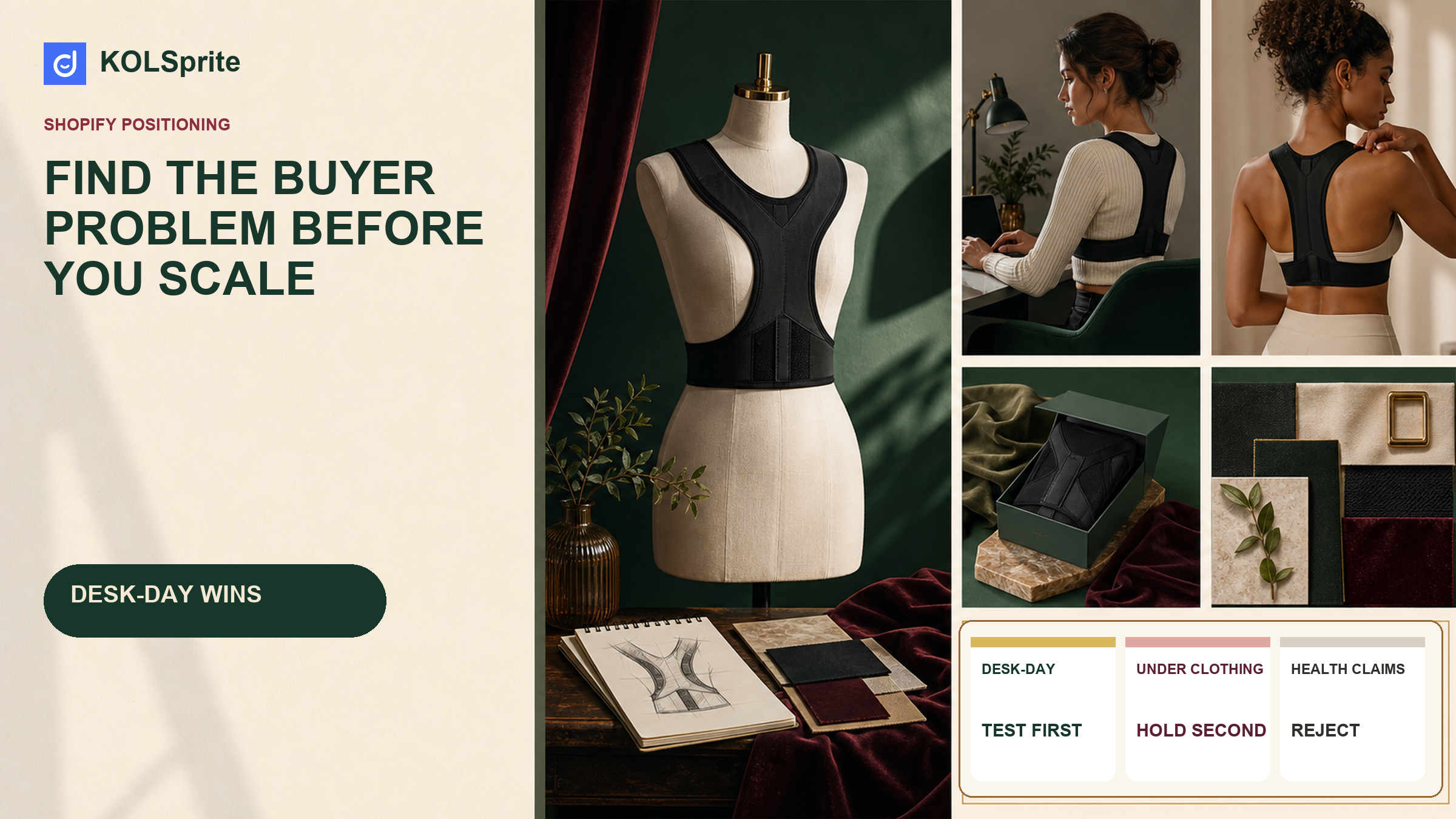
A posture corrector can be sold as a health outcome, a confidence product, a comfort aid, or a simple reminder during a long desk day. Only one of those angles is both easy to show and relatively easy for a Shopify page to support without overpromising: the desk-day reminder.
That conclusion came from comparing what creators could visibly demonstrate in KOLSprite video search. Clothing fit, strap adjustment, setup, and daily routine appeared on camera. Long-term pain relief and body change did not. The first test should therefore sell a believable moment, not a medical-sounding result.
A posture corrector may have straps, soft material, and several size settings. These are features. They do not tell a creator why a buyer would use the item today.
The position starts with a real moment. The buyer may want a reminder during a long desk day, a product that sits neatly under work clothes, or an easy step in a daily routine. Any idea that depends on an unproven health promise or body change does not belong in the test.
The best message is not always the most clever line. It is the message where four parts agree: the buyer's problem, what the creator can show, the product facts, and the next step on the store page.
| Part | Simple question | What to do |
|---|---|---|
| Buyer problem | What is happening in the buyer's day? | Choose one clear use moment. |
| Visible demo | What can the creator show on camera? | Remove promises that cannot be seen or checked. |
| Product facts | Does the item support the message? | Keep size, materials, use steps, and limits accurate. |
| Store page | Does the page answer the same problem? | Match the headline, images, FAQ, and offer. |
A KOLSprite US video search for "posture corrector" found several creator formats. One selected video had 4.7 million plays and 35,800 likes. Another had 1.1 million plays and a higher recorded interaction rate. The contrast changed the useful question. The team did not need to crown the biggest video; it needed to find the proof that another creator and the Shopify page could repeat.
These numbers help the team choose videos to study. They do not prove a health result, sales rate, or message that every buyer will like. The useful lesson is simpler: creators can explain the category through clothing, setup, and daily routine.
The brief should ask creators to show how the item is adjusted and used, including an honest limit when needed. Treatment, pain relief, or body-change promises require the right proof and approval and are outside this first test.
Research snapshot. KOLSprite video search; US market; accessed July 22, 2026; five posture-corrector records reviewed for format and relevance. The examples are content observations only. No health, medical, sales, or representative-market conclusion was inferred.
Give each message one row. Name the buyer, the use moment, the demo, the likely concern, and the page detail that backs the claim. This turns brand language into a test the team can run. If no one can say what the creator will show in the first five seconds, the idea is still a feature list.
Keep the first test small. Hold the price, product facts, page, and offer steady. Change only the message and the proof. Then check whether viewers ask about the promise and whether the page gives the same answer. A losing angle can still show the team what to fix.
A useful position fits into a sentence a shopper can repeat: "For [buyer] in [situation], this product helps with [simple task] by [fact the creator can show]."
A positioning angle for a posture corrector could focus on an adjustable reminder during a long desk session. The creator can show how the item fits, how it feels during a normal task, and when they would remove it. The store page can answer size, material, care, and comfort questions.
Avoid words such as "perfect," "corrective," and "guaranteed." Clear product facts are easier to trust and easier for a creator to say in a natural way.
Shopify's official product-positioning guide gives a broader template for choosing one clear reason that a shopper should care. It provides a useful check on the store message after the TikTok test.
TikTok video search keeps examples organized by buyer problem. A hook is worth saving only after the creator, product, and full video have been checked for the same pattern: buyer situation, product demo, concern, proof, and final reason to act.
Write down why you kept each example. Then use KOLSprite creator and content research to find formats that fit the message. Carry the same plain language into the product page, FAQ, and email. The TikTok UGC strategy guide for ecommerce brands shows how to turn that message into a useful content plan.
The video and store page should answer the same buyer problem. They do not need to use the exact same words. But the headline, first image, FAQ, email, and support answers should support the promise made in the video. If they tell different stories, the video may get attention while the store creates doubt.
Give one person final say on the message. That owner approves the demo, the banned claims, and the facts that must stay fixed. This keeps a creator from making a promise the page or support team cannot explain.
A first test is meant to guide the next test, not deliver a final answer about the whole market. Its result should be read against the question written before filming. For a desk-day message, the relevant issue is whether viewers understood that use case.
Views are only one part of that answer. Watch time, useful comments, product-page visits, add-to-cart actions, support questions, and trackable sales show more of the path when those signals are available. One number may look strong while the full path shows a problem.
For example, a video may get many views but send few people to the store. The hook may be fun while the product value stays unclear. Another video may get fewer views but bring clear size questions and stronger store visits. The second result may give the team a clearer message to build on.
Change one main part in the next round. You may keep the buyer problem and improve the demo. You may keep the demo and use simpler words. You may also fix the product page if the video creates interest but the page does not answer the same question.
The losing result belongs in the record too: what the team tested, what buyers seemed to understand, where they became confused, and what changed next. This stops the same weak message from returning three months later.
A stop rule should exist before the second test. A message stops when it needs a claim the product cannot prove, when creators cannot say it naturally, or when the store cannot support it. That boundary saves time and keeps the brand promise honest.
The KOLSprite extension update log confirms that AI Comment Analysis is available in the extension. It becomes useful when buyer questions can guide the next message test, provided the important original comments are checked before the store page changes.
| Angle | What the creator can show | What Shopify must prove | First-test call |
|---|---|---|---|
| Desk-day reminder | Adjustment, clothing fit, sitting at a desk, and when the product comes off | Size, material, care, comfort expectations, and an honest use statement | Test first |
| Confidence under clothing | Visibility under two outfits and movement during a normal day | Accurate dimensions, fabric details, and a clear return policy | Hold as a second angle |
| Corrects pain or posture | No reliable short video can prove a lasting health result | Evidence and approvals beyond normal product copy | Reject for this campaign |
The first angle is the one the creator can show, the product page can support, and the support team can explain without adding a warning. That makes the desk-day reminder the best opening test. It is smaller than a health promise, but it is clearer, safer, and easier to judge.
Show how the product acts as a simple reminder during a long desk day; do not promise lasting posture correction or pain relief. This sentence gives the creator room to work while keeping the page, support answers, and claim boundary aligned. It also keeps Shopify product positioning on TikTok tied to a promise the whole buying path can support.
Weak version: "Fix your posture and feel better all day."
Test version: "A simple, adjustable reminder for long desk days, with a fit you can check before you buy."
Creator brief: Open at the desk, show how the straps adjust, wear it during one normal task, and name one honest comfort limit. The video should send viewers to a page that shows the same fit details and answers size questions without changing the promise.
What KOLSprite contributes: the video search narrows the category to creator examples that actually demonstrate clothing, setup, and routine. After the post runs, AI Comment Analysis is useful only if it answers a new question: did viewers understand the desk-day use case, or are they still asking for proof the page should provide?
The method transfers when a product has several believable uses but the store needs one first message. A skin-care tool might be framed around a morning routine, travel, or easier cleanup. A drawer organizer might focus on finding items faster, making a small space work, or keeping a shared room tidy. An apparel accessory might lead with fit, styling range, or a specific occasion.
Keep the structure and change the proof. Each angle still needs a buyer, a moment, something a creator can show, an objection, and a matching Shopify page element. The winning angle is not the one with the grandest promise. It is the one the team can explain clearly, support honestly, and learn from in a small test.
After the first round, review which question appears in comments, search terms, support messages, and on-page behavior. Keep the original angle if people understand it and the page answers the next question. Revise it when viewers repeat the same confusion. Drop it when the proof required is unavailable or the message attracts the wrong buyer.
Create a KOLSprite account and claim a three-day trial membership. Use the trial to research products, inspect linked videos, and check the evidence before you act.
Register for a three-day KOLSprite trial
Share the three positioning angles in the KOLSprite Discord community and ask other operators which promise the creator and product page can both support.
 +
+
Get feedback on a Shopify positioning brief
The desk-day reminder deserves the first test because it is the promise both the creator and the Shopify page can keep. Pair it with one clear adjustment demo while holding product facts and the offer stable. The second brief changes only after comments, page behavior, and support questions show where the message broke.
Latest Articles
As an essential, data-driven toolkit for TikTok influencers and marketers, KOLSprite provides powerful features for effortless creator discovery, trending content identification, and actionable real-time insights.
It empowers users to make smarter decisions and significantly boosts their TikTok business.

 Refer & Earn