 +
+
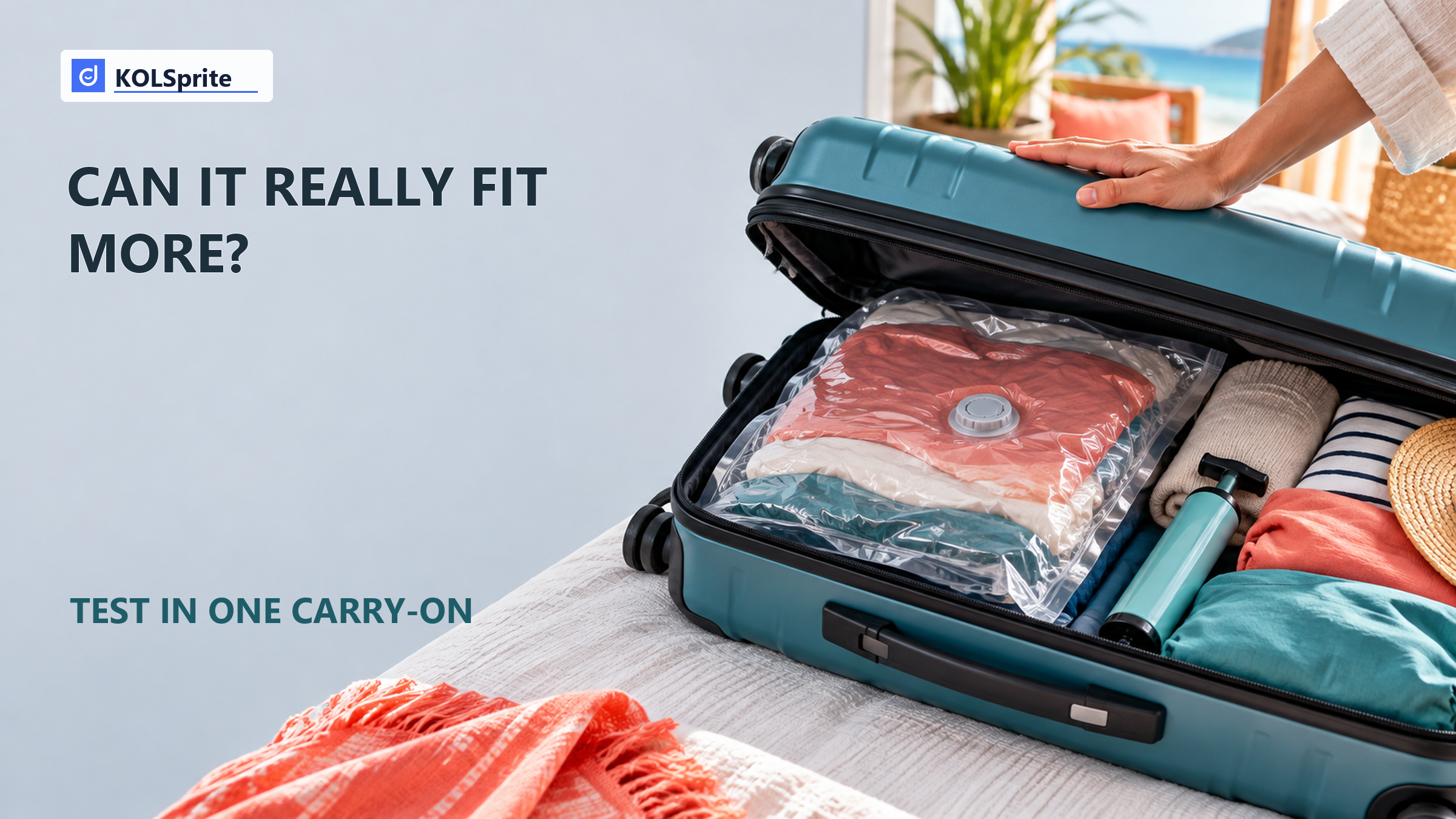
Before a US travel-accessory team repeats a carry-on promise from five product-linked video titles, it needs a test of its own bag. Can its creator say the same thing? Not yet. The titles reveal a buyer question, not a measured space saving. The direct answer is to run one side-by-side packing test with your own bag, pump, clothing set, and suitcase. Film the whole setup, record what changes, and write a claim limited to that result. The payoff is a demo brief a creator can actually use without borrowing another seller's promise.
A search for "vacuum packing bags TikTok" can point you toward a common question: will this help me pack my carry-on? Five public titles cannot prove the answer for your product. Your own repeatable test can show what happened under named conditions.
The starting item was a VACBIRD X8 travel vacuum-bag product found in a bounded KOLSprite US product search on September 30, 2026. A follow-up search by that exact product ID, 1731574752405852625, returned five linked video records. Their visible titles returned to a few ideas: packing more into a carry-on or personal item, using a rechargeable pump, and reusing the bags. That pattern is useful. It suggests the shopper is not asking for a technical description of a seal. The shopper wants to know whether a small travel bag will hold the clothes for a trip.
| Visible title theme across the five links | Buyer question it raises | What remains unproven |
|---|---|---|
| Carry-on or personal-item packing | Can the same clothing set fit in a smaller bag? | Any measured space saving for this or another bag |
| Rechargeable pump | Can the buyer use the system away from home? | Pump runtime, ease of use, or what your unit includes |
| Reuse | Will the bag serve more than one trip? | Seal life, durability, or performance after repeat cycles These are coded themes from five product-linked titles, not quotations of each title or descriptions of watched scenes. |
Source: bounded KOLSprite US product and linked-video observation, September 30, 2026. TikTok's Product Listing Policy requires truthful, supported product claims; the observed titles do not supply that support for another bag.
A title may promise, hint, or tease. It can be written before a scene is filmed and can be more forceful than the scene itself. Here, the titles were visible, but the packet does not establish what any video showed on screen. It would be careless to write that five creators demonstrated compression or that their bags saved a set share of space. The honest finding is narrower and more useful: five linked titles kept circling the same packing question.
"Pack more" sounds like a single outcome until you try to measure it. More than what? The same suitcase without compression? A different suitcase with different dimensions? A packing cube? A bag filled with bulky sweaters instead of thin shirts? The answer can change with each choice. It may also depend on the pump that comes with the product, how fully the bag is loaded, and whether the buyer has to open it again before boarding.
Even a clear reduction in the volume of one filled vacuum bag does not automatically mean a traveler may bring more on a flight. An airline can limit bag size and weight, and a compressed bundle can still be heavy. A personal item must fit the carrier's rule for that trip. Treat "fits under the seat" and "airline approved" as separate claims that require their own support. The public titles do not settle either one.
The same care applies to reuse. A title that mentions reuse does not tell you how many cycles a seal can survive. If your team wants to make a durability claim, that is another test, not a line to borrow from a competitor's hook. A first packing demo can show a bag being opened and used again during the shoot. It cannot honestly stand in for months of travel. Keep the first claim close to the first test.
This is why matching products by the buyer's job helps more than matching them by a broad category. A pump-driven vacuum bag and a roll-up compression sack may both serve packing, but they ask the traveler to do different things. A useful comparison names the exact task and the equipment needed to do it.
Install the KOLSprite extension, find the exact vacuum-bag product, and inspect the linked public videos for claim angles. Test any promising claim on your own product before using it. Use desktop Chrome. On a phone, open this article on your computer to install the extension.
Here is the owned demo brief. Product: the exact vacuum bag and pump your team will ship. Suitcase: one named carry-on with its internal dimensions recorded. Clothing set: a fixed list, such as two sweaters, three shirts, one pair of jeans, and two small items, photographed before packing. Baseline: place that same clothing set in the suitcase without the vacuum bag and show the remaining usable space. Test: pack it into your bag, close it according to your instructions, run the included pump, and place it in the same suitcase. Measure: record the packed bag's height at the same points before and after, plus whether the suitcase closes without force. Result: leave the outcome blank until your team performs and records the test. Creator instruction: show the baseline and test in one clear sequence, and state only what this setup showed.
The proposed clothing list is a test design, not an observed VACBIRD result. Your team can change it before filming, but it must keep the set fixed once the comparison starts. Do not remove a sweater between takes or shift to a larger suitcase. If the bag needs a pump, show the pump and name whether it is included with the product. If your unit's instructions set a limit on how full the bag may be, follow that limit. The viewer should not have to guess what changed.
Pick a result that a viewer can understand. A ruler beside the packed bundle may show a height change. A top-down view can show how the suitcase closes with the same clothes. Both are better than a broad percentage pulled from another listing. If the difference is small, report a small difference. If the suitcase still will not close, that result may still teach you which clothing mix is a poor fit for the product. An owned test is valuable because it can make you narrow or drop a claim before the claim reaches a buyer.
Make room in the brief for a caveat in plain speech. "This was our bag, this clothing set, and this carry-on" is not a weak ending. It tells viewers what they saw. It also gives the creator a natural way to avoid implying that every traveler will get the same result. The test is a demonstration, not a guarantee that every airline or suitcase will accept the packed bag.
Before the shoot, decide whether the claim is about the bag itself or about the whole packing outcome. "This filled bag became shorter after pumping" needs a visible before-and-after measure on that filled bag. "The same clothes fit in this carry-on" needs a baseline with those clothes, the same case, and the case closing after compression. The second claim is stronger because it answers the travel question. It also needs a more careful test.
Write down where the camera goes. Show the empty suitcase and the fixed clothing set in one view. Show the bag being loaded and sealed. Keep the pump and the bag in frame while air is removed, then show the packed result beside the baseline. If you need an edit for time, make the sequence clear and retain the uncut source footage for internal review. The goal is not to make a scientific lab film. It is to keep the demonstration from asking the viewer to trust a jump cut.
A single successful run supports a narrow statement about that run. For a broad marketing claim, repeat the test with more than one clothing mix and bag, and ask the product and legal owners what level of support they require. Do not average incompatible setups into one cheerful number. If one setup works well and another does not, that contrast can help the team describe who the bag suits. It may also reveal a product issue worth fixing before a creator makes the claim public.
TikTok's US listing policy warns against false or unproven claims about function. That is relevant even when a sentence looks like an ordinary travel tip. A claim may be made by an image as well as a caption. A case that appears to close only because the camera hides a bulging side is not a faithful demonstration. Name the setup, show the result, and let the footage do the modest work it can do.
Join the KOLSprite Discord to discuss the question behind your next test.
 +
+
Join the KOLSprite Discord community
The search phrase "vacuum packing bags TikTok" gives a team a buyer question to test; it does not supply the answer.
The bounded KOLSprite workflow starts with the VACBIRD X8 product found in a US product search, then uses its exact product ID to find linked video titles. Read the visible title language for repeated buyer questions, such as carry-on capacity, the pump, and reuse. Turn those questions into a list for your own product team. The output is title-language evidence and a proposed owned test, not a set of transferable performance claims.
KOLSprite's public title and metric fields cannot prove a compression percentage, airline compliance, durability, private conversion, or the performance of your bag. They do not show what happened in the videos when those scenes have not been watched. Keep the five-title observation on one side of the brief and your test footage, measurements, and approved claim on the other.
This boundary makes the public material more useful, not less. If five titles mention a carry-on, the team has a reason to choose a carry-on for its first test. If titles mention a rechargeable pump, the team has a reason to show how its own pump works. If titles mention reuse, the team can decide whether it needs a separate cycle test before speaking about durability. Each theme becomes a question the product must answer. None becomes a result by repetition alone.
The same idea applies to physical tradeoffs beyond space. A bag and pump add weight and take up room of their own. A packed bundle may be harder to open at the airport. Your team may decide those costs are small for its intended traveler, but it should see them during the test. The guide to physical product tradeoffs is a useful companion when the pitch depends on saving space while the product itself has size and weight.
After filming, fill the result line in the demo brief with what the team actually observed. Record the filled bag's measured dimensions before and after pumping, whether the same clothing set fit in the case, and any trouble sealing or using the pump. Then choose one of three calls. If the result is clear and repeatable, write a narrow claim that names the setup. If the result varies, frame the video as a demonstration of how the bag works, not a promise of extra packing space. If it fails, drop the pack-more claim.
A creator can still make a good travel video without a sweeping promise. The hook can be the problem: "Can I fit this weekend's clothes in one carry-on?" The middle can show the test with your own product. The ending can show the honest outcome. That gives the creator a story and gives the buyer evidence. It is stronger than asking a creator to repeat a line from a title whose scene the team has not even reviewed.
Turn the final, owned result into a creator brief built around proof. Include the exact product, suitcase, clothing set, pump, approved wording, and any limit the viewer needs to hear. Keep a copy of the source footage and the product team's signoff with the brief. The creator may bring a fresh voice and travel setting, but the claim should stay tied to the test.
The five titles did their job when they revealed a question worth testing. They did not answer it. When someone searches for "vacuum packing bags TikTok," they may see a bold promise. Your team can offer something better: a visible comparison with your own bag, measured under conditions you can name. A public title can point to a question; only your own test can answer it.
Latest Articles

As an essential, data-driven toolkit for TikTok influencers and marketers, KOLSprite provides powerful features for effortless creator discovery, trending content identification, and actionable real-time insights.
It empowers users to make smarter decisions and significantly boosts their TikTok business.
 Refer & Earn