 +
+
A keyword result page can make product research look objective. There are prices, sales fields, and video counts, all ready to sort. But the page may quietly mix products that solve different problems. Comparing their headline numbers first is a fast way to build a misleading conclusion.
For a TikTok Shop product comparison, write the buyer job first and reject records that cannot perform it. Only then compare the retained offers’ public fields and choose a conditional content proof test.
The question was narrow: which public TikTok Shop records belong in a shipping-label-printer content test? The buyer job was “print a shipping label at a small seller’s packing station.” That job is narrower than the keyword shipping label printer. A keyword retrieves language. A buyer job decides whether a record belongs.
Seller Center documentation separates product, creator, content, and performance views and encourages product-specific action. TikTok Shop’s seller guidance explains available decision surfaces; product validation and sales forecasts remain outside its scope. The comparison below is therefore a cleaned, public snapshot, not a market census.
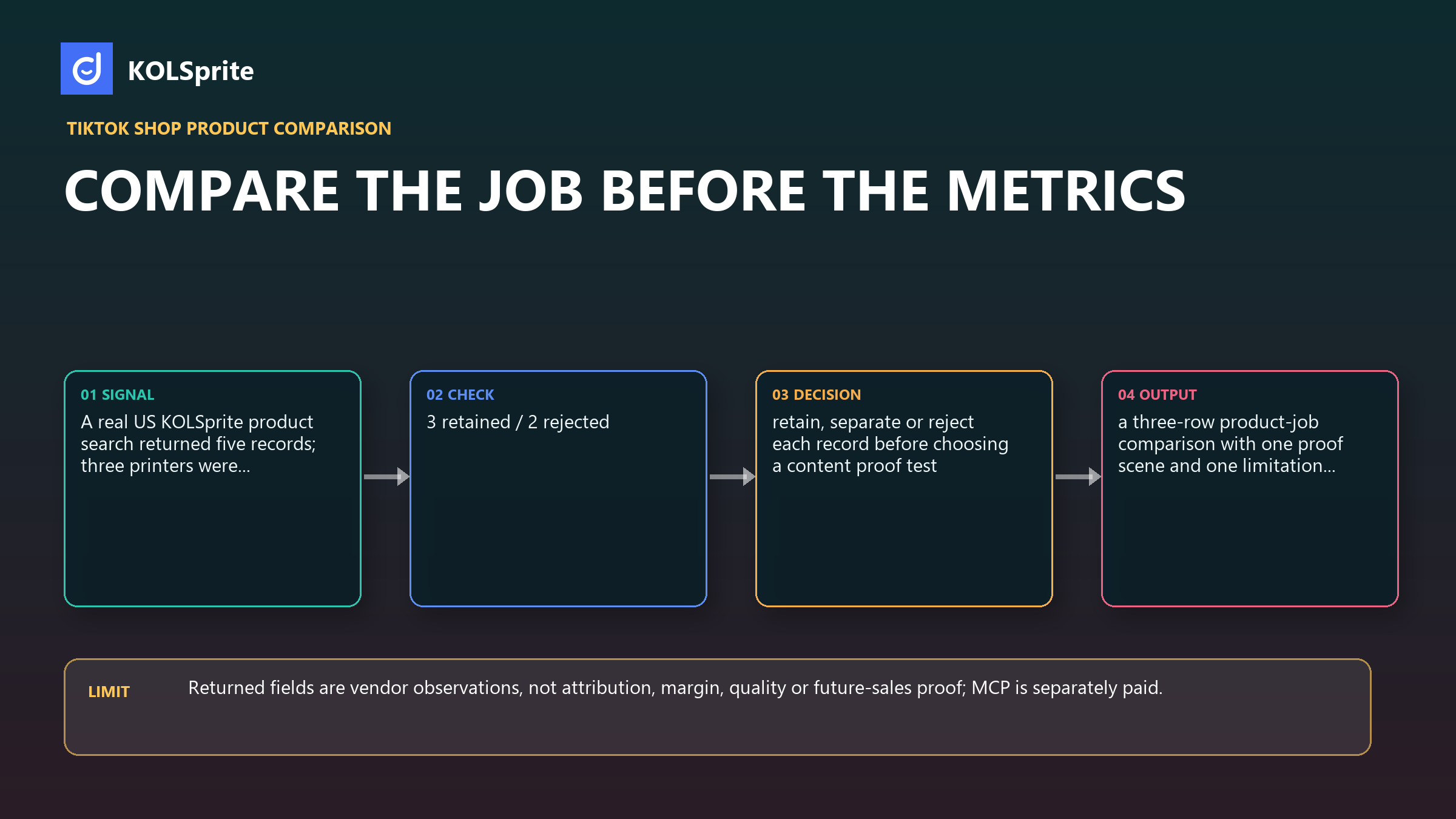
A single US product_search call for “shipping label printer” returned five records. Three printer products were retained. Two prepaid-label bags were rejected because a bag cannot perform the defined printing job. The page size was five, so the result is deliberately bounded.
Scope: one KOLSprite product_search page. Market: US. Access date: September 4, 2026. Sample: five records. Cleaning: three printers retained and two prepaid-label bags rejected. Limit: not a category census or outcome proof.
This cleaning step is the central research decision. Leaving the bags in because they share “label” language would let irrelevant records affect the range of prices, units, and linked videos. The rejection is about comparison fit, not offer quality. It says they answer a different buyer need and require a separate comparison.
The two rejected bags still teach a useful search lesson. Their language may match a seller who wants prepaid postage or a ready-to-use label pack. That is not the job in this notebook. The record should show “rejected for this comparison,” not “bad product.” This wording keeps cleaning separate from product judgment.
Save the rejection reason beside each removed row. A future researcher can then see whether the record was a duplicate, a different product type, or an adjacent job. Without that note, the cleaned table looks arbitrary. With it, another person can repeat the buyer-job test without repeating the whole search.
| Retained product job | Listed price | Returned 30-day units | Linked videos | Proof scene to test | Limitation |
|---|---|---|---|---|---|
| Pocket sticker printing | USD 30.35 | 1,916 | 198 | Show a compact organization task, not parcel fulfillment. | It is not comparable to letter-size shipping output. |
| Letter-size mobile printing | USD 46.45 | 1,119 | 422 | Show a phone-to-page workflow for a mobile seller. | Setup ease remains unverified. |
| Desktop shipping labels | USD 51.40 | 5,632 | 2,867 | Show a packing-station label from order to package. | Fields do not prove margin or product quality. |
Scope: retained comparable records. Market: US. Access date: September 4, 2026. Sample: three printers. Cleaning: non-printer results removed before comparison. Limit: observations do not prove realized price, margin, quality, attribution, or future demand.
The figures tempt a quick ranking. The desktop shipping-label record has the highest returned unit field and the most linked videos in this narrow set. The figure only shows its position in this narrow set. It does make it a different product job from the pocket sticker printer. The table should cause a seller to separate the testing question before deciding which number matters.
Read the first row as an organization offer. Its compact format may fit labels for jars, drawers, or small stock. A parcel-fulfillment scene would make it look weak for a job it was not built to do. The right test would show the small space and the small label task.
Read the second row as a mobile printing offer. The public listing language points to letter-size output and phone use. A fair proof scene would begin on a phone and end with a full page. Setup smoothness remains an open question in this snapshot.
Read the third row as a packing-station offer. The observed fields are larger in this three-record set, but the scene still comes from the job. Show the label moving from order to package. Do not turn the higher public numbers into a quality claim.
Register for KOLSprite and claim a three-day trial of the web product. MCP access is sold separately.
Register and claim a three-day trial
Public metrics are descriptive fields, not a verdict. A listed price is not realized price. A returned 30-day unit field is not a profit statement. A linked-video count does not say whether those videos are persuasive, original, compliant, or accessible to a new seller. The three records came from one page, at one time, in one market. They are evidence with a boundary.
That boundary improves the work. Instead of asking, “Which product wins?” ask, “Which product job deserves a distinct proof scene?” The desktop model suggests a fulfillment scene. The pocket model suggests organization. The mobile letter-size model suggests a phone-connected setup. Combining them into one generic printer video would blur the reason each offer might matter.
A TikTok Shop product comparison begins with that separation. It is a record-retention decision before it is a metric-ranking exercise.
Use each number only for the question it can help frame. Price can shape an offer review, but it does not reveal the final amount paid. The unit field can describe the returned window, but it does not reveal profit. The video field can show how much linked content the vendor returned, but it does not rate that content. This keeps the notebook factual and useful.
Choose one retained job, then write a hypothesis that the evidence can actually support. For the desktop shipping-label model: “If small sellers see the order-to-label-to-package sequence, the product’s packing-station role may be easier to understand than in a feature list.” The claim is conditional. It does not predict units, conversion, or profit.
Now choose the proof scene. Show an order, the label output, the package, and the finished packing surface. Avoid presenting the scene as proof that every seller needs the product. Its role is to make the buyer job visible. For a systematic way to reject poor comparison inputs before a test, see TikTok Shop product research.
The workflow is bounded. Use KOLSprite to search TikTok Shop products. Remove non-comparable records, then compare current public fields after defining the buyer job. The output is a clean comparison with retained IDs and a rejected-record count.
Returned fields are vendor observations, not attribution, margin, quality, or future-sales proof. KOLSprite cannot establish those facts, and MCP access is separately paid.
A second content test could focus on the mobile printer. The question would be whether a phone-to-page scene makes the mobile job clear. A third could focus on the pocket printer and a compact labeling task. These tests should not run under one generic “printer” brief. Their proof moments differ because their buyer jobs differ.
Write one expected observation under each test. For the desktop model, the seller may watch for questions about label size or setup. For the mobile model, the key question may be device connection. For the pocket model, it may be whether viewers understand the intended label use. These are prompts for a content review, not predicted results.
Join the KOLSprite Discord to discuss the question behind your next test.
 +
+
Join the KOLSprite Discord community
Place a limit memo under every public comparison. One keyword page is not the full category. Listed price is not realized price. Sales and video fields are vendor estimates with bounded windows. The sample does not prove margin, attribution, product quality, or future demand. This is not boilerplate. It tells the next reader where the comparison should stop.
The memo also prevents a product team from turning research into a false requirement. No seller needs to reproduce the observed linked-video count. No creator needs to make the exact videos associated with a record. The usable output is a testable product-job hypothesis, not a borrowed growth claim.
Add the access date and market to the memo. Public fields can change, and a US result page does not speak for another market. A dated note makes later comparison possible. It also stops an old snapshot from being presented as a current fact after the research window has passed.
A retained record is eligible for comparison. It is not approved for inventory, ad spend, or an affiliate campaign. Those choices need costs, shipping terms, return risk, rights, quality checks, and the seller’s own financial model. This distinction makes the notebook practical instead of timid.
The clean handoff is a question, not a recommendation to buy stock. Ask the operations owner for landed cost, return risk, and inventory terms. Ask the content owner whether the proof scene can be made with a real sample. Ask the decision owner what result would justify the next test. The public table cannot answer those questions, but it can make them product-specific.
After the product job is clear, connect it to the rest of the operating system. The TikTok Shop analytics tool discussion can help frame a stock decision with appropriate internal evidence. The public table should remain a starting point, not a substitute for that evidence.
Before closing the notebook, save three lists: retained, separated, and rejected. Give every record a short reason. Keep the access date, US market, buyer job, and page scope beside those lists. This creates an audit trail for the next search.
The completed three-row table now has a precise role. It supports a content conversation about three offers and three proof scenes. It also states what the snapshot cannot prove. The next creative step belongs in a TikTok video ideas matrix that preserves those differences.
Compare the buyer job before you compare the numbers. Then archive the rejected records instead of hiding them. The final product of this notebook is a traceable research decision. Another seller or editor can reopen it, understand the cleaning rule, and know exactly where fresh evidence is still needed.
Latest Articles

As an essential, data-driven toolkit for TikTok influencers and marketers, KOLSprite provides powerful features for effortless creator discovery, trending content identification, and actionable real-time insights.
It empowers users to make smarter decisions and significantly boosts their TikTok business.

 Refer & Earn