 +
+
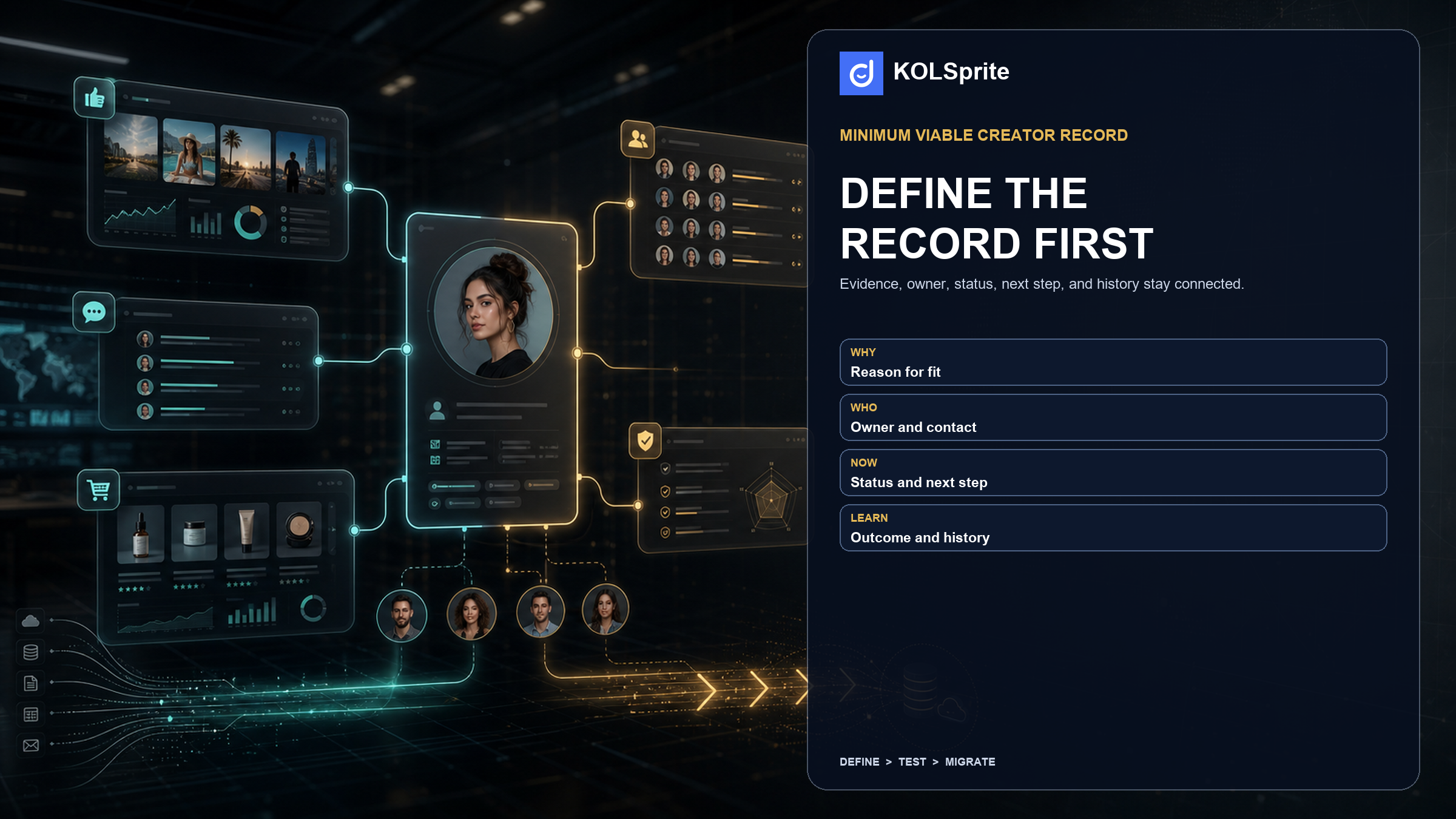
Creator teams can find plenty of people. Yet they often cannot tell who made contact, why a creator was chosen, or why someone was declined. An influencer CRM should solve that record problem before it becomes a software purchase. First, define the twelve fields, owners, and next actions your team needs. Then decide whether to buy, build, or keep a system. You will have a basic creator record that makes a move or renewal easier to test.
Ask, "What choice must this record support after the researcher moves on?" If the answer is only "store creators," the team is not ready to buy a platform. A useful record lets the next person contact, pause, approve, pass on, or learn without rebuilding the full history from old messages.
The supplied 2026 U.S. keyword snapshot showed monthly volume of 110, CPC of $45.46, and difficulty of 0 for this category. Those figures show search interest. They do not prove a vendor's quality or define what your team needs.
Teams often call all creator data a CRM, but four separate records are at work. Mixing them without clear owners creates repeat fields and lost history.
| Record | Purpose | Core owner | Example decision |
|---|---|---|---|
| Discovery note | Capture public reasons to investigate. | Researcher | Does this candidate deserve review? |
| Relationship record | Preserve contact and decision history. | Partnership lead | Who follows up, and why? |
| Agreement file | Store private terms and approvals. | Legal or operations | Can work begin under approved terms? |
| Performance record | Keep first-party campaign results. | Marketing or analytics | What should be repeated or changed? |
Limitation: You can connect these records without keeping them in one product. Private talks, contracts, payment details, and first-party results belong in the systems your company already approves.
This split makes buying easier. Vendors often promote contact history, outreach status, filters, and campaign results. Use those items to shape your questions. Do not assume that any one product holds every field you need.
Build this schema in a sheet or current system before you move any data. You do not need a full creator biography. You need enough facts for the next person to make the next choice.
| # | Field | Why it exists |
|---|---|---|
| 1 | Creator name and public profile link | Identifies the candidate. |
| 2 | Research source and date | Makes the evidence traceable. |
| 3 | Fit reason | States the relevant product, audience, or creative connection. |
| 4 | Evidence note | Records a specific public video or profile observation. |
| 5 | Decision status | New, review, contact, pause, declined, or handoff. |
| 6 | Decision owner | Names who acts next. |
| 7 | Last contact date | Prevents duplicate outreach. |
| 8 | Next action and date | Turns history into a queue. |
| 9 | Contact channel | Shows where the team can continue the thread. |
| 10 | Offer state | Draft, sent, discussed, accepted, declined, or not applicable. |
| 11 | Internal notes | Holds approved working context, not vague impressions. |
| 12 | External-system link | Connects to contract, payment, or reporting record where appropriate. |
Do not add a field just because it appears in a sales demo. Add it when it helps with a common choice or prevents a known mistake. Follower count alone is usually weak. A dated and clear fit reason tells a teammate why the creator made the short list.
Register for KOLSprite and claim a three-day trial to see how creator research, saved resources, and supported collaboration workflows fit your operating record.
Register and claim a three-day trial
A field without an owner will soon be blank. Name who adds research, who clears a creator for outreach, who updates the next action, and who moves private work to the right system. This owner map matters more than a polished dashboard.
For example, a researcher saves a public note and sets the status to "review." A partnership lead accepts or declines the creator and owns the next action. When talks become private, an operations owner links to the approved agreement file. Marketing can later add a link to the campaign review. One list does not need to replace every other system.
KOLSprite can support the early steps. Teams can find and assess creators, save research notes and creator resources, and use supported outreach, promotion, and collaboration tools. It is not a universal influencer CRM and should not be presented as one. Keep private records in their approved systems.
When a creator moves from research to outreach, carry the dated KOLSprite fit note and source link into the approved relationship record. That small handoff lets the next owner see why the creator entered the pipeline without copying private contract, payment, or contact data back into a browsing tool.
Use this scorecard to make the buy, build, or keep choice.
| Question | Buy | Build or configure | Keep current |
|---|---|---|---|
| Does the team repeatedly lose relationship history? | Yes, across people and campaigns. | Only in one team workflow. | No, history is accessible. |
| Are fields and owners already agreed? | Yes, ready to migrate. | Partly; test the schema first. | No, define them first. |
| Is a private-system handoff required? | Confirm integration or export process. | Link the existing systems. | Document the handoff. |
| Can three records pass the migration test? | Proceed to a limited trial. | Refine the template. | Fix data discipline. |
Limitation: A short vendor trial cannot prove long-term use. Test real records, access rules, and transfers with your team before you commit to a move.
Run a small test before you import a large list. Choose three records: one person never contacted, one active talk, and one closed project. Move the twelve fields. Then ask both the old owner and a new teammate to find the fit reason, last action, next action, and private record link. If either person must search elsewhere for basic facts, the record or transfer is incomplete.
This is also the right time to compare a working outreach process with your record design. The TikTok creator outreach SOP can help define the sequence that a relationship record should preserve. For sample logistics, connect the next action to a creator seeding tracking workflow rather than burying shipment status in free-form notes.
Join the KOLSprite Discord community to discuss practical creator records, workflow ownership, and tool handoffs.
 +
+
Join the KOLSprite Discord community
At renewal, do not ask whether everyone likes the platform. Ask whether it fixes a known work problem. Check a small sample. Did the team avoid repeat contact? Could a new owner understand the fit reason? Was the next action clear? Did private work reach the right system without putting sensitive details in the wrong place?
If not, the team may need clearer fields, fewer fields, or better owners. A new platform cannot fix a record that no one updates. If the answer is yes, name the exact work that improved and keep the scope narrow. An influencer CRM earns its place by helping with a real choice, not by holding the most creator data.
Before a creator moves to "contact," the record should give a short reason for fit and the next request. That note can feed a four-step influencer outreach process. It should never excuse generic mass messages. A good record makes a personal next step easier. It does not replace judgment.
For TikTok collaborations, record whether the creator has received the current disclosure instructions. TikTok requires creators promoting a brand, product, or service to use its content disclosure setting. Your legal owner should still decide the wording and review process for each market.
The schema works only when each entry means the same thing to every owner. Add a short field guide. Define a fit reason, the point when a status changes, and what belongs in notes. This does not make every judgment the same. It keeps "interested," "contacted," and "follow up later" from becoming three names for one unclear state.
Reserve "contact" for a message sent through an approved channel. Use "review" when research is done but no choice has been made. Use "pause" when a creator may fit later but has no action date. Use "declined" with a short factual reason, such as "current content does not show the needed use case." Avoid vague labels about quality or audience.
| Field | Good entry | Weak entry |
|---|---|---|
| Fit reason | “Shows compact apartment cooking in recent public posts.” | “Good creator.” |
| Evidence note | “Linked 8/12 video shows one-pan preparation sequence.” | “Strong content.” |
| Next action | “Partnership lead to approve paid outline by Thursday.” | “Follow up.” |
| Decline reason | “No current content tied to the campaign use case.” | “Not a fit.” |
Limitation: Shared terms improve teamwork. They do not turn a human creator review into an objective score. Leave room for the owner to explain the facts.
Choose five records each month and review them with someone who did not create them. Can that person find the source, fit reason, last action, and next owner? Does the record link out to private work? If not, fix the field or process before adding another tool.
Watch for two warning signs. First, every exception becomes a new column, so the record takes too long to update. Second, the team replaces clear notes with a score and can no longer explain it. A short record with sound next actions is worth more than a large database no one uses.
End each audit with one small change. You might require a next-action date, clarify decline reasons, or add an agreement link. Record the change and check it in the next sample. That cycle improves the system whether you later buy, build, or keep it.
Define the operating stages with the TikTok creator outreach SOP, test sample handoffs with the creator seeding workflow, and compare execution steps in the four-step outreach process. After publication, add maintained inbound links from the first two pages.
Latest Articles
As an essential, data-driven toolkit for TikTok influencers and marketers, KOLSprite provides powerful features for effortless creator discovery, trending content identification, and actionable real-time insights.
It empowers users to make smarter decisions and significantly boosts their TikTok business.

 Refer & Earn