 +
+
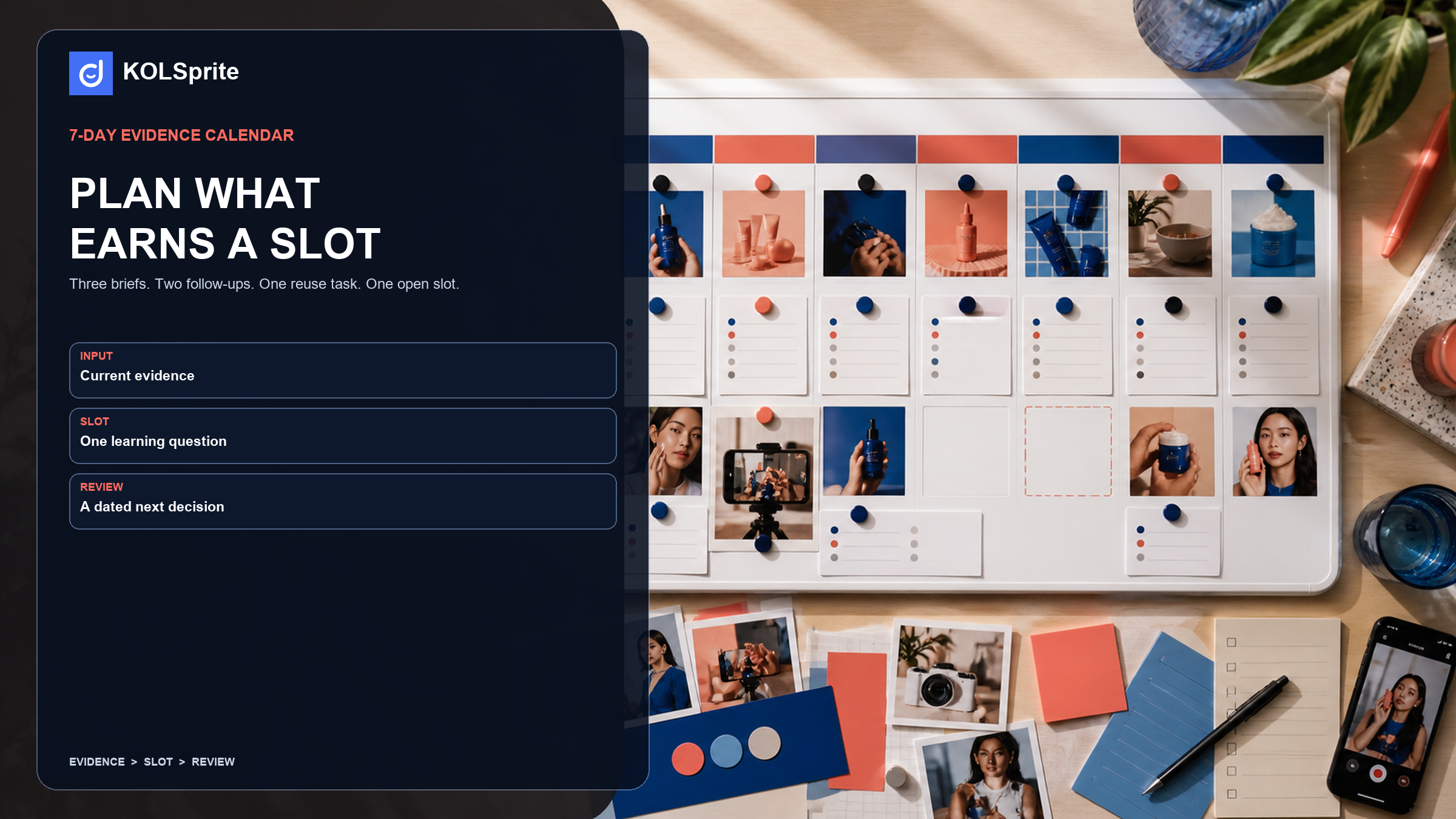
Lean Shopify, Amazon, and TikTok Shop teams rarely lack ideas. The harder task is choosing which idea deserves a slot this week. A TikTok content calendar helps when each slot names a buyer question, the public evidence behind it, and what the team hopes to learn. Plan seven days around three production briefs, two follow-ups, one reuse task, and one planned empty slot. You will leave with a weekly queue your editor can use before the production meeting. A trend or view count can guide a test, but it cannot prove demand.
For every proposed post, finish this sentence: "We are testing this proof angle for this buyer question because we saw this pattern." If the team cannot finish it, leave the slot open. A full calendar is not the goal. A useful next test is.
A current TikTok Shop University planning resource recommends weekly and monthly planning. That is useful operating guidance. It does not decide the individual post for your product, which is why the evidence column matters.
A calendar becomes busywork when its slots say only "trend," "product demo," or "creator clip." Those labels name formats, not decisions. A producer still needs to know which customer doubt matters, what must stay fixed, and what to review after the post runs.
Three habits cause most of the trouble. Teams copy the video with the largest public view count, though timing and an existing audience can shape that number. They use a trend because an empty box feels risky. They also change the hook, offer, creator, length, and edit at once. The result teaches them little. A useful TikTok content calendar makes these choices clear before filming starts.
Start with one product and one buyer question. For a portable walking pad, ask, "Will this fit my workday and small apartment?" Review a small set of relevant public videos. Note only what you can see: the opening, the proof, the setting, a question in the comments, and the requested action. Save the source URL and date with each note.
| Look for | Write down | Do not conclude |
|---|---|---|
| Opening | “Desk-to-walk transition appears before narration.” | “This hook will drive sales.” |
| Product proof | “Creator shows storage under a desk.” | “All buyers have this constraint.” |
| Buyer question | “Comment asks about noise during calls.” | “Comments represent the full market.” |
| Creator choice | “Uses a small-home work scene.” | “This creator is right for a deal.” |
Limitation: Public content gives you research leads. It does not prove demand, margin, usage rights, or future reach. Use it to form a test, then apply your own product, stock, and legal checks.
KOLSprite keeps this review close to the TikTok page. You can inspect relevant videos or creator profiles while browsing, save useful notes, and compare proof angles with buyer questions. A human owner must still decide what is safe and practical to make.
Register for KOLSprite and claim a three-day trial to collect the creator and video evidence behind your next seven-day plan.
Register and claim a three-day trial
Use the calendar below as your working sheet. It plans fewer posts than days on purpose. The empty slot gives the team room to act on a sound new observation. It also keeps a weak idea from entering production just to fill a box.
| Day | Buyer question | Evidence note | Brief | One variable | Owner | Review cue |
|---|---|---|---|---|---|---|
| Mon | Will it fit under a desk? | Small-space setup is visible in several relevant examples. | Show storage, then a short walk. | First shot: stored vs. in use. | Editor | Watch-through to setup |
| Tue | Is it disruptive on calls? | Noise is a recurring public question. | Show a work-call scene with truthful product audio. | Caption question. | Producer | Useful questions |
| Wed | Can I start quickly? | Setup is a visible proof angle. | One-take start-to-walk demo. | No variable; baseline. | Editor | Completion and saves |
| Thu | Same as Monday | Reuse Monday footage if the shot is clear. | Cut a second opening from approved footage. | Opening only. | Editor | Compare with Monday |
| Fri | What does it replace? | Product framing needs a direct answer. | Creator-style workday routine. | Scene choice. | Creator lead | Questions about fit |
| Sat | Follow up on a real question | Use a logged question, not a guessed trend. | Reply or clarification video. | Question selected. | Community owner | Clarity of reply |
| Sun | None | No evidence queued. | Intentional empty slot. | None. | Content lead | Refresh evidence |
The calendar has three core briefs: small-space setup, call-time noise, and a quick start. It also has two follow-ups, one reuse task, and one protected empty slot. A small team can see the full workload at a glance.
Use the same path for trend inputs. A query may be worth exploring, but it is not automatically a posting instruction. For a separate method of checking search language before it enters the queue, see this guide to TikTok search trend validation.
Begin with last week's plan, not its loudest result. Mark each post as complete, incomplete, or not comparable. A post is not comparable when several key parts changed at once or the source note is missing.
Keep shop facts separate from public content signals. TikTok Shop University's seller learning materials explain how to schedule shoppable videos. Check the options in your own account before you promise a publish time.
Join the KOLSprite Discord community to discuss practical content calendars, research habits, and weekly test queues.
 +
+
Join the KOLSprite Discord community
Every calendar needs a stop rule. Stop an idea when it needs a claim you cannot support, relies on footage you cannot use, or changes too many things to teach the team anything. Refresh it when a new buyer question, clearer product proof, or relevant observation changes the brief.
Low public interaction is not a verdict on the product. It is a reason to check the context. Perhaps the proof came too late, the question was unclear, or the examples were not alike. The next step may be a new cut, a new scene, or no post. That restraint belongs in a sound TikTok content calendar.
Before the meeting ends, each filled row needs a source note, claim check, owner, footage status, and review cue. If a video needs a closer visual review, use a TikTok content analysis workflow. The calendar should hold the decision, not every part of the analysis.
Next Monday, place the evidence record beside the results. The goal is not certainty. It is a more deliberate week: a clear reason to post, a clear reason to stop, and one useful question left open.
At the handoff, keep the chosen source links and short evidence notes with the saved KOLSprite research. The producer can then reopen the same public examples instead of trying to reconstruct why a slot was approved. The calendar still owns the publishing decision; KOLSprite preserves the research context behind it.
Open the next planning meeting with a one-page review sheet. This keeps one large number from taking over the story. For each completed brief, list the buyer question, source note, fixed parts, changed part, published post, and observed response. Keep the record short. It should preserve the reason for the test, not create more reporting work.
| Review field | Question to answer | Example response |
|---|---|---|
| Original question | What uncertainty did this post address? | Can a buyer picture storing it under a desk? |
| Test design | What remained constant and what changed? | Same footage and offer; stored opening changed to walking opening. |
| Observed response | What public or first-party signal appeared? | More questions asked about storage than noise. |
| Decision | What happens next week? | Repeat storage proof; make a clearer noise answer. |
Limitation: The sheet helps your team compare its own work. Public metrics do not prove what caused a result. Content signals also do not prove sales, margin, or product demand.
Keep an incomplete test in the record instead of quietly removing it. If a creator could not film, the offer changed, or the product was unavailable, that operating fact explains why the result cannot be compared. It may also reveal a planning issue worth fixing. A calendar is a production tool, so its review should include practical constraints as well as content observations.
When the team disagrees, name the point of dispute. One person may question the sources. Another may accept them but reject the reading. A third may agree with both but find the test too costly. These are different issues. Write down the open question and assign the next evidence step.
Leave room for new information. A late product shipment, changed offer, or valid customer question may justify replacing a row. Record what changed, why, and whether the original question will return next week. This keeps a reasonable adjustment from breaking the team's learning record.
Also separate a reusable asset from a reusable idea. A clean product demo may support a second cut. A claim, creator phrase, or third-party clip may need new approval or rights. Treat reuse as an editing choice until the right owner confirms the rest. Research material is not automatic permission for commercial use.
Use the TikTok AI content strategy guide for choices that sit above this weekly queue. Bring only the useful question and source note back to the calendar. A strategy guide cannot replace a dated choice about what to make.
Use the TikTok AI content strategy guide to set the broader direction, validate the language with the TikTok search trends workflow, and inspect candidate examples with the TikTok content analysis guide. After publication, add maintained inbound links from the first two pages.
Latest Articles
As an essential, data-driven toolkit for TikTok influencers and marketers, KOLSprite provides powerful features for effortless creator discovery, trending content identification, and actionable real-time insights.
It empowers users to make smarter decisions and significantly boosts their TikTok business.

 Refer & Earn