 +
+
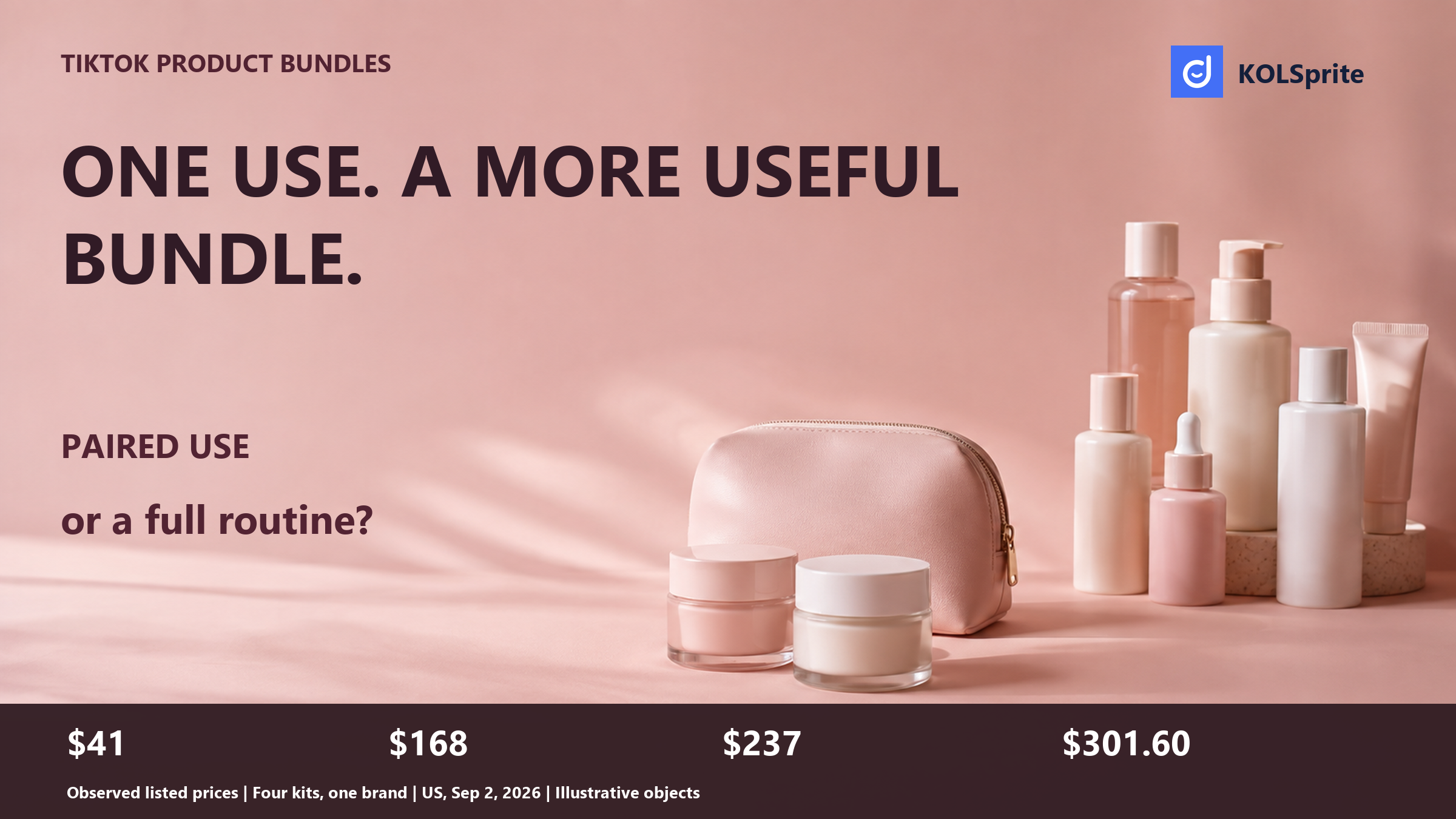
On September 2, 2026, KOLSprite MCP observations covered four retained listings from one brand. Those listings offer a way to compare sets, not proof that more items make a better bundle. A useful set helps a buyer finish one job and removes a decision. Extra stock can instead make a clear product confusing, leaving the buyer to sort through parts and wonder why they belong together.
Before you group products, name the use occasion in one sentence. “Get ready for a trip with carry-on skin care” is a use. “Move more units” is not. Then test whether every component helps the buyer complete that use and whether the combined order can still carry a viable margin.
Merchandising teams often begin with the inventory list. That is understandable. They know which SKU is popular and which one is slow. But an offer built from stock pressure tends to feel like stock pressure to a buyer. The popular item has a clear purpose. The added items need an explanation that the team cannot honestly give.
Begin from the other side. Ask what a buyer is trying to do in one sitting. A travel kit might help a person pack for a weekend. A starter set might help a person begin a routine with fewer choices. A repair kit might help a person fix one common problem. Each component should either enable the job, reduce friction, or replace a choice the buyer would otherwise need to make.
The test is simple. Remove one item from the proposed set. Does the buyer lose the ability to complete the stated job? If not, it may be a cross-sell rather than a bundle component. That does not make it a bad product. It means it needs its own offer logic.
A narrow September 2, 2026 US search retained four skincare kits from the same brand. They are not a market census. They do show how different listed sets can be, even when a single brand owns the catalog.
| Neutral kit label | Listed price | Reported 30-day units | What the listing signals |
|---|---|---|---|
| Five-step routine set | $168.00 | 21,336 | A broad routine format |
| Eight-product glow set | $237.00 | 11,863 | A larger multi-item set |
| Eight-product weekly set | $301.60 | 6,178 | A premium-priced routine set |
| Cream pair set | $41.00 | 6,166 | A smaller paired offer |
Source: KOLSprite MCP. Scope: skincare sets. Market: US. Access date: September 2, 2026. Sample: four listings from one brand. Cleaning: removed one single-product result and neutralized claim-heavy names. Limit: listed prices and estimated 30-day units only; costs, discounts, sales lift, feature access, and skin-care claims remain unverified.
The price range alone is useful. A $41 pair and a $301.60 set make different asks of a buyer. Unit counts describe the observed listings, while discount levels, profit, creator mix, and reasons for purchase remain unknown. That is why the table uses neutral kit names and compares offer shapes instead of ranking winners.
Read the table as an offer gallery. It suggests questions: does the buyer need a small paired use, a guided routine, or a larger collection? Your answer should come from your own buyer task and economics, not from copying a listed price.
Register for KOLSprite and claim a three-day web trial to explore public product offers. Keep your own buyer task and unit costs beside the comparison. The separate MCP service is not included in web membership.
Register and claim a three-day trial
Three offer forms are easy to blur together. A prepacked set is one physical package. A SKU multipack is a defined quantity of the same SKU. A virtual bundle combines existing products without physical prepacking. They can look similar on a product page, but they create different warehouse and setup work.
TikTok Shop's Virtual Bundles feature is allowlisted. If a seller does not have access, the seller should check with an Account Manager. The feature combines existing products without physical prepacking. That rule does not mean that every listing called a set uses Virtual Bundles. It also does not establish that a beauty category is eligible. TikTok Shop's Virtual Bundles guidance is the source for the feature limits.
This distinction matters because a merchandising idea can be sound while the implementation route is wrong. A team may want a pick-and-pack set because the items need one branded insert. Another may want a virtual combination to test demand without rebuilding stock. Do not choose the offer structure until you know what the buyer needs and what the account can use.
A bundle needs a fast answer to “Why these together?” In short product content, show the finished use before listing components. A person who sees a weekend travel kit packed into one pouch can grasp the job. A person who sees eight bottles in a row may only see work.
That does not mean every bundle must be small. It means the sequence needs a logic a buyer can repeat. Show the starting problem. Show the items in the order of use. Show the result that the set helps the buyer reach. Keep claims within what you can support. The content should explain the use, not promise an outcome the listing cannot prove.
For a hypothetical desk-setup bundle, the job could be “make a shared desk ready for a video call.” A cable clip, small light, and phone stand might earn a place because each helps that task. Adding a branded water bottle may raise item count but does not help the call. It belongs in a separate recommendation, if anywhere.
A complete use still needs a viable order. Build a simple bundle brief with the listed price, product cost of each component, pick cost, packaging cost, shipping weight, discount funding, and any creator payment. Compare it with the parts sold separately. The goal is not to force a discount. The goal is to see whether the buyer convenience and the seller economics can both hold.
Consider a hypothetical three-item travel set. Each item has a $7 product cost, and the order needs $3 in special packaging plus $6 in fulfillment. The direct cost before promotion is $30. If the set sells for $45 and a creator earns $4, the team has $11 before platform fees and overhead. That may be workable or too thin depending on the category and current terms. The arithmetic is not a published result. It is a reason to calculate before a campaign makes the bundle feel fixed.
Watch for a false value signal: a larger discount that erases the reason to buy the full set. If the buyer can get the key item alone and the extras add little use, the bundle discount may only subsidize unwanted inventory. A smaller, clearer set can often be easier to explain and easier to fulfill.
Use this short brief to turn an idea into a decision:
Keep the brief honest. If account access to a feature is unknown, write “unknown.” If components are not yet priced, write “not calculated.” Confirm that the warehouse can pick the set without a manual workaround. This is not weak planning. It prevents a vivid creative concept from being mistaken for a finished offer.
Describe the intended use in the KOLSprite Discord and discuss what each component adds. Treat any feedback as a research prompt, not a guarantee that the offer will sell.
 +
+
Join the KOLSprite Discord community
Public offer research is best used as a filter. It can show that a category contains small paired offers and larger routine sets. It can help a team notice the words and product construction that sellers present. It cannot certify a winning price or tell you that a buyer will value your version.
Take a proposed bundle through three rejection questions. First, can the team name one buyer use without mentioning inventory? Second, can it explain every component in that use? Third, can the set meet its price and margin guardrails without a discount that removes the reason to sell it? A no answer on any one question is a useful stop signal.
For example, a team may propose a popular cleanser plus two slow creams. The observed listings do not prove the proposal is bad. But if the team cannot say when all three are used together, it should stop. It can test a simpler pair, a routine guide, or a single product with a clear follow-up offer. Rejection saves more time than a broad launch that teaches nothing.
A good bundle makes a buyer's next step simpler. It is not a clearance plan wearing a new label. The four observed same-brand kits show that public listings can take many shapes and price points. They do not choose your set for you. Your buyer task, component logic, and margin do that work.
Use a product rejection test to stop weak ideas early. Add context by checking product momentum against demand, then compare the final buyer job with TikTok signals for an Amazon product before moving stock.
Item count does not settle the bundle question. Each piece must help one buyer finish one use, and the order must leave enough room to run. Keep a small set small when it tells that story better. The comparison supports a use-based choice, not the claim that a bigger pile necessarily gives the buyer more value.
Newer Article
<<TikTok Shop Conversion Rate: Check the Denominator
Latest Articles

As an essential, data-driven toolkit for TikTok influencers and marketers, KOLSprite provides powerful features for effortless creator discovery, trending content identification, and actionable real-time insights.
It empowers users to make smarter decisions and significantly boosts their TikTok business.

 Refer & Earn