 +
+
“You have been brushing your pet wrong.” It is a loud opening, but it makes a promise the video may not be able to honor. If the next shot only shows a hand pulling fur from a brush, the viewer has not learned what was wrong, who the claim fits, or why this tool is different. The better opening is often less theatrical: “If fur collects in the brush before it reaches the bin, watch this cleanout.” That line gives the demo a job it can complete.
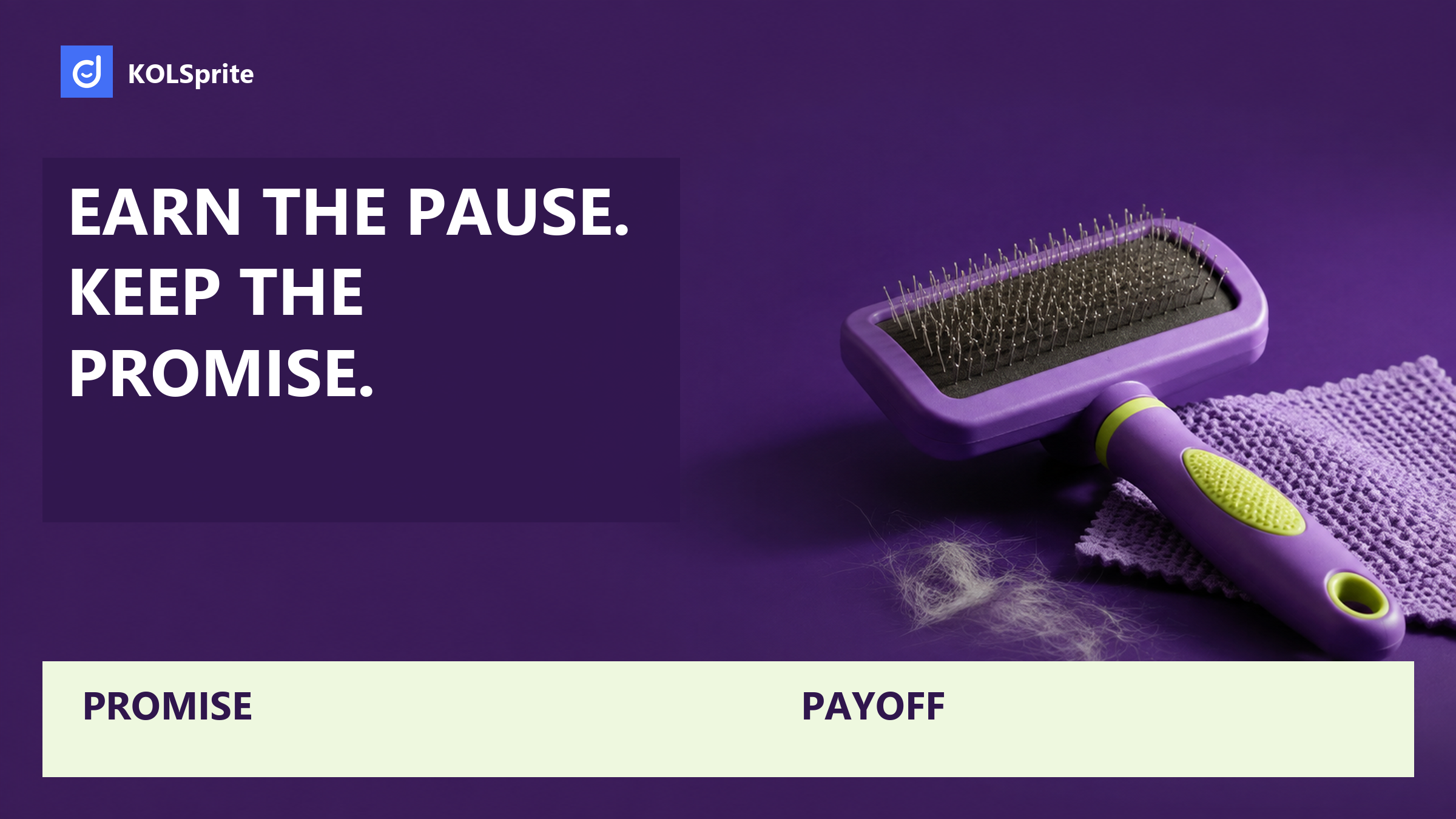
For a brand writer, a hook is not a small headline pasted onto a video. It is an agreement about the next few seconds. The right choice depends on whether the viewer needs a surprising idea, a reason to self-select, or visible proof. This article uses an explicitly invented pet-hair brush demo to make that choice concrete. It does not claim that any line won a test or that a brush produces a customer result.
Take the bad line seriously before replacing it. “You have been brushing your pet wrong” creates a broad accusation. It asks the video to diagnose the viewer’s routine, establish authority, and prove a better method. A short product demo rarely has room for all three. The opening also attracts people who want a debate about pet care, not people deciding whether a brush is annoying to clean.
Its honest replacement is narrower: “This is for the brush that holds fur after the grooming is over.” Now the viewer can reject or accept the premise quickly. The rest of the video can show the trapped fur, the release action, and the empty brush. Narrowness is not a concession. It directs attention toward a problem the visual can actually resolve.
Before writing, name the evidence the opening commits you to show. A curiosity line needs an answer. A qualification line needs a recognizable situation. A proof line needs a visible action that supports the claim. When the contract is unclear, the body becomes a parade of unrelated closeups because no one knows what must be paid off.
Use this quick editorial test: remove the sound and watch the first claim against the next two shots. Can a viewer see the answer, situation, or action? If not, alter the opening or collect a better demonstration. Do not use a later voiceover to rescue a promise the footage does not carry.
Here are three original lines under edit. “The part nobody wants to do” opens a small gap that the cleanup shot must close. “For the brush that is awful to clean” names a problem, though it needs a clear image to explain what “awful” means. “Watch the fur leave” asks for no setup at all. Its plainness is a strength if the action is clear. None deserves the label “best” on the page alone. Each line asks the camera to do a different job, and the wrong footage would let all three down.
| Question | Official guidance in scope | Editorial application in this article |
|---|---|---|
| How is a video structured? | TikTok Creative Codes separates hook, body, and close, and advises communicating value early. | Each invented opening is paired with a specific first visual and an ending that completes its own promise. |
| What counts as a good hook? | The guidance supports an early value proposition; it does not publish a universal winning line. | Curiosity, qualification, and proof are treated as different contracts, not as performance claims. |
| What result should a writer expect? | No result threshold is used here. | The examples are teaching drafts only. A team still needs to inspect the actual footage and its own outcomes. |
Scope: one official Creative Codes guidance article about hook, body, and close. Market: US-oriented TikTok creative guidance. Access date: 2026-09-03. Sample: one documentary source, not a campaign dataset. Cleaning: no performance percentages or source examples were reused. Limit: this guidance does not prove retention, sales, or a winning hook for a particular brush.
Try KOLSprite web research for three days to study a permitted reference script before writing your own opening. Check the video yourself; MCP access is separate.
Register and claim a three-day trial
Curiosity is useful when the reveal is visual and prompt. It is weak when it makes the product seem mysterious for no reason. For the fictional brush, the useful mystery is not “wait until you see this.” It is the small mechanical question the viewer can answer by watching: where did the trapped fur go?
Write the reveal before the first line. If the reveal needs a long explanation, the opening is probably trying to carry too much. A curiosity hook can earn attention, but it owes the viewer a clear turn. It should not turn a routine product use into a fake secret.
Qualification is the clearest choice when a product solves one irritating version of a common task. It lets the wrong viewer leave without wasting the rest of the story. A person with a brush that cleans easily does not need the fictional demo. A person who dreads picking fur from bristles may recognize the issue before the product name appears.
That precision improves the body. Instead of asserting that everyone needs a new brush, show the before state that defines the audience. The limitation matters: a writer should not imply that a grooming tool works for every coat, pet, or care need unless the available proof supports that claim. The point is a cleanout action, not veterinary advice.
Opening: “The part of brushing nobody wants to do is still inside this brush.”
First visual: A close shot shows loose fur packed between the fictional brush’s bristles. A hand presses the release control, then lifts the fur away in one visible piece.
Body: Show one ordinary pass over a pet-safe practice surface or a clearly staged fur sample, then return to the bristles. Keep the action legible. Do not imply a medical benefit, reduced shedding, or a universal grooming result.
Payoff: “The useful part is not more fur in the brush. It is being able to remove what you can see.” The ending answers the opening’s question and leaves the claim at the level the demonstration can support.
Why this pair fits: The viewer is invited by an unresolved but ordinary annoyance. It works only if the release action is plainly filmed early. If the brush does not have a visible cleanout, use a different hook.
Opening: “For the brush that is easy to use but awful to clean.”
First visual: Split the frame between a brush doing its normal job and the same brush after use, with fur caught where fingers would have to pull it free.
Body: Let the narrator identify the exact friction: cleanup happens after the useful part is already done. Then show the fictional brush’s removal step. The sequence should make no comparison to every other brush and should avoid calling the item “best.”
Payoff: “Keep the brushing step. Change the cleanup step.” The line gives a qualified viewer a reason to consider the object without pretending the product remakes pet care.
Why this pair fits: It filters for a known annoyance. Use it when the product’s strongest proof is convenience after use, not a surprising feature or a broad transformation.
Opening: “Watch the fur leave the brush before the next pass.”
First visual: Start on the release action, not on a package or a pet portrait. The frame should make it obvious which material is leaving and where it goes.
Body: After the release, show the brush ready for another pass. A short caption can identify the action, but the shot should still make sense without it. The product’s visible mechanism is carrying the message.
Payoff: “A brush is easier to pick up again when cleanup is not a separate chore.” This is an interpretation of the shown action, not a promise about time saved or hair reduction.
Why this pair fits: Use proof when the product has one legible action that can stand on screen. It is the most honest option when curiosity would only delay a clear demonstration.
Bring one original hook and the scene that answers it to Discord. Discuss the match, rather than sharing someone else's script to copy.
 +
+
Join the KOLSprite Discord community
The choice between those pairs is a choice about the viewer's next question. With curiosity, it is “What is going to happen?” With qualification, it is “Is that my problem?” With proof, it is “Did I just see that work?” A script that asks all three at once makes the body carry three debts. For a short cleanout demo, one clear question is enough.
There is also a practical production check. A hook may sound excellent in a document and still fail because the needed first image is hard to capture. The fictional release action needs a tight, steady shot with enough contrast to show the fur. The qualification version needs a believable before state. When a team cannot obtain the needed image, the opening needs to change. A stronger voiceover cannot make a hidden action visible.
A permitted reference video can help a writer notice structure without copying its language. With KOLSprite, use supported subtitle and script analysis to identify where a reference makes its opening claim, when it shows the product action, and what its close asks the viewer to remember. Then manually watch the footage again. The useful output is a private promise-to-payoff note: claim, needed visual, and unresolved risk.
The TikTok video analyzer guide connects a breakdown to a creative brief. For this task, the note might say, “The reference reveals the action before naming the feature.” That describes a structure, not a line to borrow. The TikTok caption extractor guide is a useful next step when the spoken promise needs close review. A transcript alone cannot show a hidden cut or confirm what the hand did.
That note should not become a bank of borrowed hooks. It is a check against empty imitation. KOLSprite does not guarantee retention, verify every visual claim for you, or grant reuse rights. Confirm the source is permitted, use an original line, and make the chosen promise fit your own demonstration.
Suppose the actual shoot reveals that some fur stays on the bristles. This is a hypothetical editing problem, not a product finding. The proof hook can still show a removal action, but its ending must not suggest a fully clean brush. The curiosity version needs to reveal the remainder too. The qualification version may be the best fit if the honest message is a simpler step, not a perfect result. Small visual details can change which sentence is fair.
A broader TikTok content strategy can give these choices different roles. A proof-led clip may answer a product question. A qualified opening may address an old complaint. A curiosity-led clip may introduce an unfamiliar action. These are editorial roles, not forecasts of reach. There is no need to force one kind of opening onto every brief just because a line sounded lively in a review meeting.
A good hook does not need to summon the largest possible crowd. It needs to start with the viewer whose next question your video can answer. For the fictional brush, that might be a person frustrated by cleanup, not every pet owner and not everyone browsing grooming content.
The cleanout line leaves out a person whose brush already empties easily. That is a useful limit, not a flaw to hide with broader copy. The opening can serve the frustrated viewer without claiming everyone needs the tool. For this demo, which viewer should hear the first line and know the brush is not for them?
Newer Article
<<TikTok Carousel: Give Each Swipe a Reason to Exist
Older Article
TikTok Shop Conversion Rate: Check the Denominator>>
Latest Articles

As an essential, data-driven toolkit for TikTok influencers and marketers, KOLSprite provides powerful features for effortless creator discovery, trending content identification, and actionable real-time insights.
It empowers users to make smarter decisions and significantly boosts their TikTok business.

 Refer & Earn